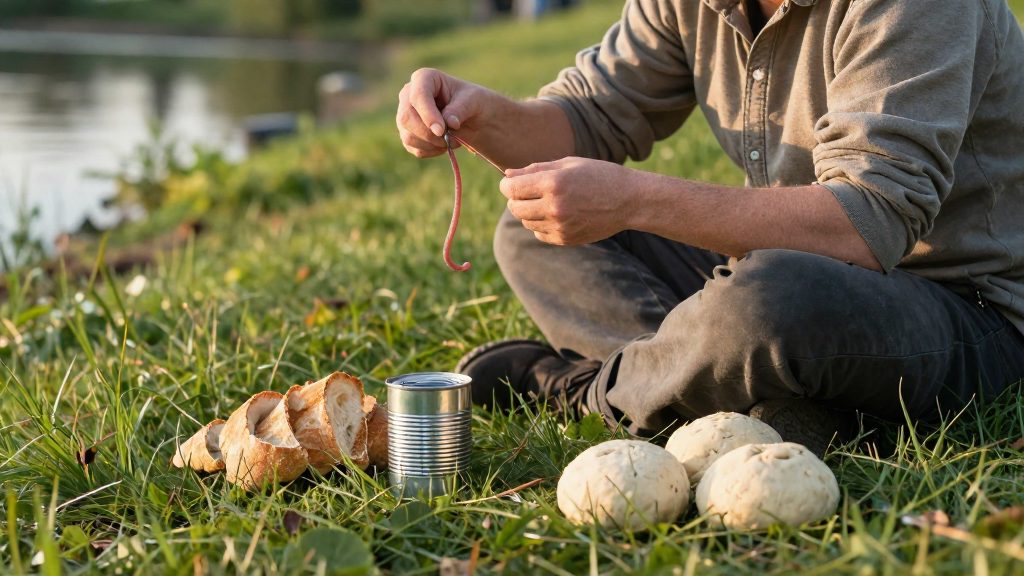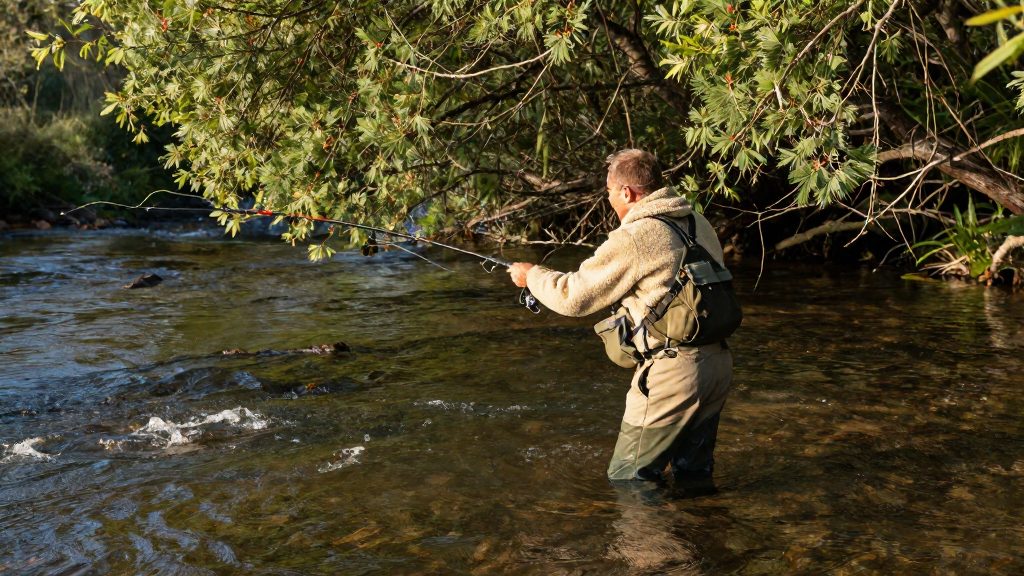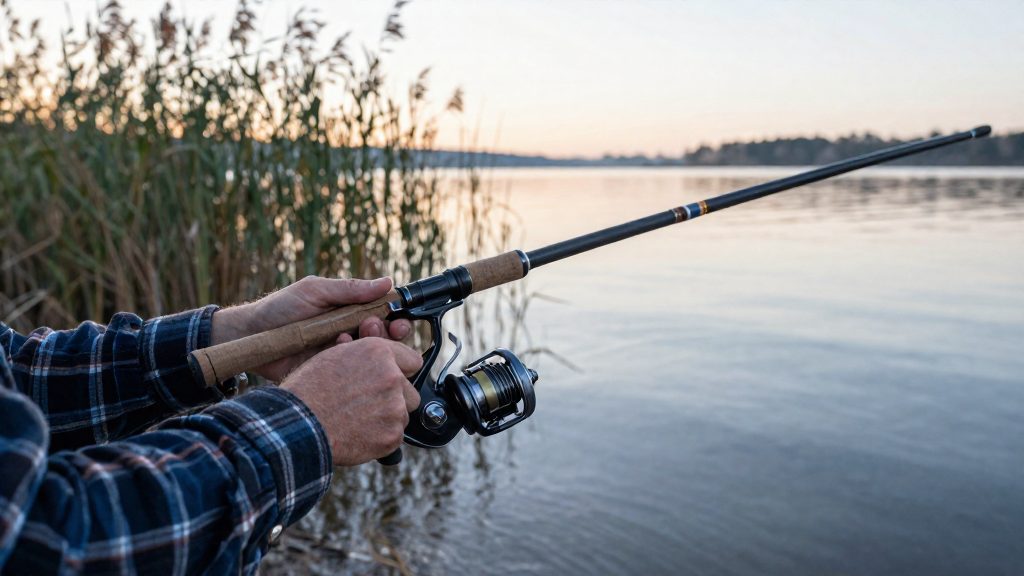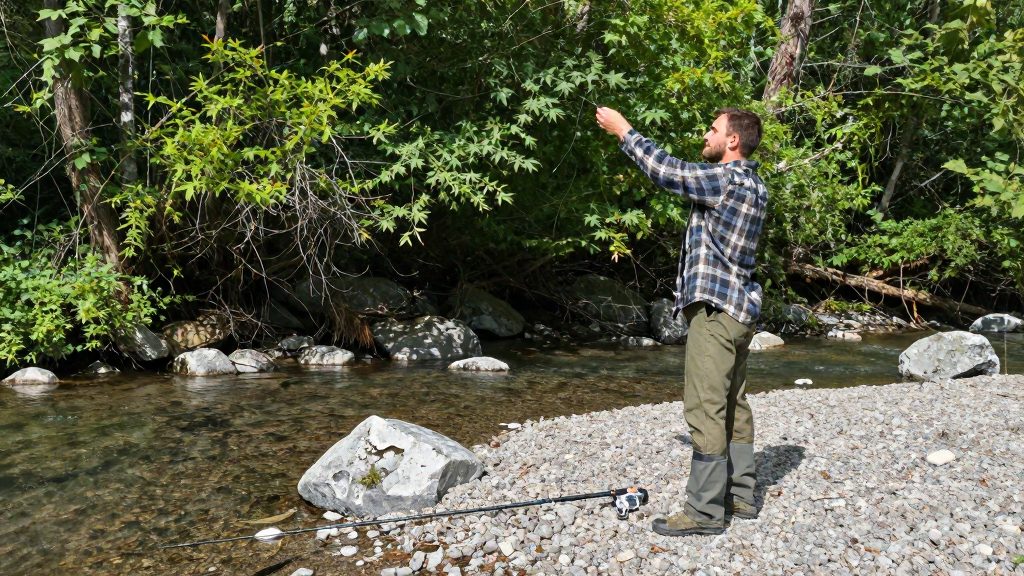
A nightcrawler rig works in creeks when the bait drifts naturally with the current, stays in the feeding lane of small trout, and uses as little tackle as possible. Creek trout take what the flow carries past them, so the rig should present a whole nightcrawler that moves like a free food item rather than a fixed object. Field & Stream (2026) notes that one rod, a few hooks, a bobber or two and a tub of nightcrawlers are enough to catch fish in creeks, and that trout are among the common creek species, including leftover stocked trout.
What makes a nightcrawler rig work in creeks?
Reading current speed for natural drift
Creeks change pace quickly, from fast riffles to slack pockets behind rocks. The current speed decides how much weight the rig needs and how the bait should travel. Match the presentation to the water you are fishing:
| Water type | Presentation goal | Adjustment |
|---|---|---|
| Fast riffle | Bait stays in the flow without skating away | Use enough weight to keep the crawler near the bottom |
| Moderate run | Bait drifts just off the bottom at the speed of the water | Adjust weight until the bait tracks with the current |
| Slow pool or eddy | Bait sinks slowly and hangs near cover | Reduce weight, or suspend the crawler under a bobber |
Watch the line as well as the bait. If the line pulls the crawler faster than the surrounding water, the rig is moving unnaturally and needs more weight or a shorter drift.
Why crawlers suit small and leftover trout
Nightcrawlers work well on smaller trout because the bait is soft, scented and easy for a fish to take in a single bite. Trout in creeks include leftover stocked fish that have spread into natural water, so a crawler matches the mixed sizes you will meet. Thread the crawler so it stays on the hook through the drift, and let the free end wave in the current. A loose, lively bait tends to attract attention more reliably than one that is bunched or tightly wrapped.
Keeping the rig simple with minimal components
Fewer components mean fewer snags on creek bottoms and fewer knots to check. Carry only what the water demands, and change one element at a time when the fish are not responding. Adding several extra parts at once makes it hard to tell which change helped.
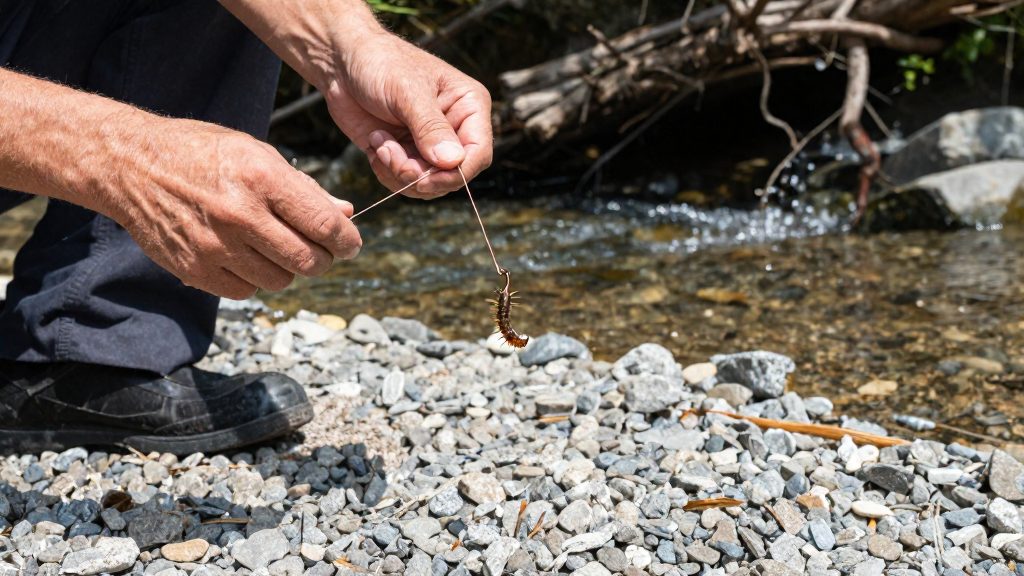
Split shot rig for bottom-hugging trout
A split-shot setup is a simple way to keep a nightcrawler near the bottom, where trout often hold in deeper water. According to Mystery Tackle Box (Brett Forde, 2020), this rig suits deeper water or fish holding near the bottom. Its main job is to place the bait where bottom-oriented fish are feeding, and the three adjustments below control that.
Placing the shot
Pinch a BB-sized split shot onto the line about 6 inches above the hook (Guidesly, 2021). Keeping that distance means the weight pulls the line down while the bait stays in the trout’s feeding zone rather than sinking into the bottom debris.
Crimp the shot with your fingers or a pair of pliers so it grips the line firmly. Check it after each few casts, since a loose shot can slide toward the hook or drift up the line.
Adjusting the sink rate
The shot also sets how quickly the bait falls. Adding or removing shot changes this speed, and Guidesly (2021) describes adding or removing shot as the way to adjust how fast the bait sinks.
| Goal | Adjustment |
|---|---|
| Bait sinks too slowly | Add shot |
| Bait sinks too quickly | Remove shot |
Make changes one shot at a time and observe how the crawler falls in the current before deciding on the next change.
Dragging or swimming the bait
Once the bait reaches the bottom, move it slowly so it stays just off the bottom. Mystery Tackle Box (Brett Forde, 2020) describes the technique as dragging or swimming the bait just off the bottom.
Lift the rod tip gently and let the current carry the line downstream, keeping the line taut enough to feel a bite. A crawler that rolls along the streambed tends to collect debris, so a slow, steady movement usually works better than a fast retrieve.
Bobber rig for pools and slow runs
A nightcrawler can be suspended under a bobber, such as the E-Z Trout Float, according to Mystery Tackle Box (Brett Forde, 2020). The float keeps the bait at a set depth instead of letting it sink to the bottom, which suits slow water where the bait needs to hang in front of trout. Guidesly (2021) describes the fixed or slip bobber rig as a classic setup that includes trout.
Fixed versus slip bobber setups
The two versions differ in how the float moves on the line:
| Setup | Float behaviour | Depth control | Typical use |
|---|---|---|---|
| Fixed bobber | Locked in place by a stopper | Set by the stopper position | Known depth, repeated casts to the same spot |
| Slip bobber | Line slides through the float, which stops against the stopper above it | Set by the stopper, moved as needed | Changing depth, fishing a run of varying depth |
With a fixed bobber, the float does not travel when you reel in or cast, so it is simpler to set up. With a slip bobber, the line runs through the float, and you can adjust depth without retying.
Component order
Guidesly (2021) lists the components as stopper, bead, sliding weight, swivel and hook. A typical order from the rod tip down is:
| Position | Component | Role |
|---|---|---|
| 1 | Bobber (fixed or sliding) | Floats the bait and shows bites |
| 2 | Stopper | Sets the depth or holds the float in place |
| 3 | Bead | Cushions the stopper knot so it does not wear |
| 4 | Sliding weight | Pulls the bait down to the working depth |
| 5 | Swivel | Stops line twist |
| 6 | Hook with crawler | Presents the bait |
Practical steps
- Hang the crawler on the hook so the bait hangs freely below the float.
- Set the stopper at the depth you want, then check that the bait suspends above the bottom.
- Test the setup in a bucket or quiet water before fishing, and adjust the stopper if the bait touches bottom.
Which hook size is best for creek trout?
For creek trout fished on a nightcrawler, the hook range to start with is size 4 to 8 in an Aberdeen or bait-holder pattern. Hook sizes run in reverse to what many beginners expect: the higher the number, the smaller the hook. A size 8 is the smallest hook in this range and a size 4 the largest.
Matching hook gape to trout size
Hook gape is the opening between the point and the shank. It should suit the size of the trout’s mouth:
- Small trout: choose a hook from the smaller end of the range, so the point and bend sit inside the mouth without filling it.
- Larger trout: move toward the larger end of the range, but avoid a gape so wide that the fish can take the bait without the point catching.
- Deep hooking: a hook that is too small for the fish can be swallowed, which makes release harder.
Compare the hook with the fish’s mouth before you cast, and adjust if the bait is regularly taken deep.
Choosing wire weight
Check the product label or the manufacturer’s instructions for the wire class of each pattern. Hook packs often describe wire as light, standard or heavy. Heavier wire resists bending but makes a larger hole in a small trout. For small creek trout, a standard or lighter wire in the chosen size keeps the rig simple and manageable.
How should you hook the worm?
Threading a nightcrawler comes down to one principle: pass the hook through the body once, close to the head end, and leave the rest of the worm free to move. A crawler threaded this way stays on the hook and moves naturally in the current. A crawler that is folded, bunched or wrapped around the hook looks stiff and tears easily.
Threading the crawler
- Hold the worm gently between a damp cloth or fingers so it does not split.
- Insert the point a short distance behind the head, then bring it out through the body.
- Slide the worm up the shank so the hook sits inside the body without the crawler bunching at the bend.
- Check that the worm lies straight along the hook, with the hook point still accessible.
This single pass is the key step. Each extra pass through the body opens another tear point and reduces the amount of worm that can move.
Leaving the free tail
Leave the rear section of the crawler unhooked. The free tail is what wriggles when the bait drifts or is worked slowly, and that movement is the main attraction for trout. Do not thread the hook back through the tail or double the worm over itself, because this restricts the movement that makes the bait look alive.
Re-baiting after tears or detachment
Check the bait regularly while fishing, especially after casts into snags or fast current. If the head has torn away, or the worm has slid off the hook, do not rethread the damaged piece. Remove the remnant, then re-bait with a fresh, intact crawler. Keep spare worms in a moist container so replacements are ready at the water’s edge.
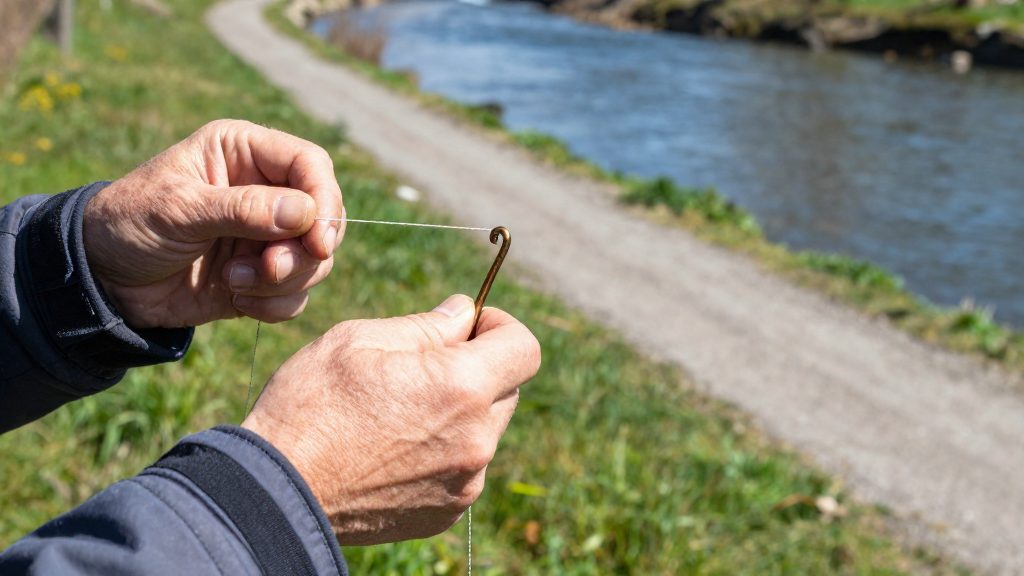
Where and when to fish a crawler
Trout in creeks take a nightcrawler well because the bait can be presented where they feed. Knowing which parts of the creek hold fish matters more than the amount of gear you bring.
Undercut banks and current seams
Undercut banks are places where the bank has been eroded beneath the surface, leaving an overhang that gives trout cover. Fish often hold in the shadow beneath them. Drop the nightcrawler just upstream of the overhang so the current carries it under the bank, rather than casting straight into the open channel.
A current seam is the line where fast water meets slower water. Food gets carried into the slow side, so trout position themselves along the edge. Fish the seam by letting the bait drift along the boundary, keeping the line tight enough to feel bites without dragging the bait across the current.
Seasonal water temperature and trout activity
Trout activity changes with the season and with water temperature, so the same spot can produce different results from one month to the next. Measure the water temperature with a simple thermometer, and compare readings from the same spot over several visits. Where you cannot measure temperature, watch for signs of activity such as rising fish or insects on the surface, and adjust how close to the bottom you fish.
Presenting near the bottom
| Element | Detail |
|---|---|
| Hook | Aberdeen or bait-holder, size 4 to 8 |
| Weight | One BB-sized split shot pinched on the line |
| Shot position | About 6 inches above the hook (Guidesly, 2021) |
Clear versus stained water
Clear water lets trout see your line and bait from further away, so keep your approach low and avoid casting shadows over the pool. In stained water, fish rely less on sight, so you can place the bait closer to likely holding spots. Check the water before you fish: if you can see the bottom at a depth you can wade, the water is clear enough for a careful approach.
Are nightcrawlers legal where you fish?
Whether you can fish with nightcrawlers in a creek depends on the rules that apply to your exact location, not on the bait itself. Live bait rules and permit requirements are set locally, so a nightcrawler that is allowed on one creek may be restricted on another. Check the rules for the specific water before you leave home. This takes a few minutes and avoids fishing illegally.
Checking local live bait regulations
Start by confirming that live bait regulations allow nightcrawlers on the creek you plan to fish. Check these points for your stretch:
- Whether live bait is permitted on that creek
- Whether any restrictions apply to particular waters or seasons
- Whether there are limits on moving bait from one area to another
- Whether any sections are closed to fishing
Keep a copy of the current regulations with you, either printed or saved on your phone, so you can check them on site if you are unsure.
Permit requirements for creek fishing
In the US you generally need a state fishing license, and some states or waters also require a trout stamp or special permit. Confirm this for the specific water with your state wildlife agency. A license that covers lakes or rivers may not automatically cover a small stream, and public access points can carry their own conditions. Carry your permit while fishing, and look for posted signs at the access point, since local notices can add rules that are not in the general regulations.
Contacting the local fisheries authority
When the rules are unclear, contact the fisheries authority responsible for the water. Give the creek name and the area where you plan to fish, state that you intend to use nightcrawlers as live bait, and ask whether any permit or bait limit applies. A written reply, such as an email, gives you a record of the answer if you are questioned later.
| Check | What to confirm | Where to look |
|---|---|---|
| Live bait use | Whether nightcrawlers are permitted on the creek | Local regulations for the water |
| Permit | Whether a licence or stream-specific permit is needed | The licensing section of the local authority |
| Bait transport | Any limits on carrying bait between areas | Regulations or the local authority |
| Closures | Seasonal or site-specific closures | Current notices from the local authority |
Catch and release with live bait
Live nightcrawlers are easy for trout to swallow, so the main risk when releasing a fish is a deep hook: a hook lodged in the throat or gills causes far more damage than one caught in the lip. Check where the hook sits before you decide how to unhook. A hook visible at the corner of the mouth can usually be backed out. A hook that is out of sight, or that has been swallowed, should not be pulled, because tearing tissue causes more harm than leaving the hook in place; cut the line close to the hook instead.
Barbless hooks make release faster and gentler. Without a barb, the hook slides out with light pressure instead of catching on flesh. Some anglers pinch the barb down with pliers on an existing hook, but a purpose-made barbless hook is more reliable.
Quick unhooking reduces the time the fish spends out of water. Work with the trout in the water where you can, use long-nosed pliers or a hook remover, and keep your movements steady rather than rushed. Cut the line close to the hook if the hook cannot be removed cleanly.
Handling trout with wet hands protects the fish’s protective slime coat. Dry hands strip this layer and can leave the trout vulnerable to infection. Wet your hands before touching the fish, and support it horizontally, never by the gills. Wet your hands before touching the fish, and support it horizontally, never by the gills or tail.
| Hook position | Recommended action |
|---|---|
| Visible at the corner of the mouth | Back the hook out with pliers, keeping the fish in water if possible |
| Deep in the throat or gills | Cut the line close to the hook and release the fish |
| Hook can be seen and removed without tearing tissue | Remove it quickly, then release |
Frequently asked questions
What is the simplest nightcrawler setup for creek trout?
Field & Stream (2026) describes a minimal kit of one rod, a few hooks, a bobber or two, and a tub of nightcrawlers, and says this covers the common creek species, trout included. A beginner can start with one hook and one float, then add weight when the current or depth requires it.
How do I set the weight on a split-shot nightcrawler rig?
Pinch a BB-sized split shot onto the line about 6 inches above the hook, according to Guidesly (2021). Mystery Tackle Box (Brett Forde, 2020) pairs this with an Aberdeen or bait-holder hook in size 4 to 8. To change how fast the bait sinks, add or remove shot.
Do I need a permit to fish a creek for trout?
It depends on the water. In the US, you generally need a state fishing license, and some states or specific waters also require a trout stamp or special permit. A license that covers lakes or rivers may not cover a small stream, so check the current rules with your state wildlife agency before you fish.