A spinning reel is usually the simpler first choice for a beginner, because it has fewer settings to get right before a first cast works. A baitcasting reel is still a workable starting point if you are ready to tune its brakes and control the spool with your thumb. It handles heavier lures and larger fish more comfortably, but its learning curve is steeper. Choose the reel type that matches the lures and fish you plan to target.
Baitcasting or spinning reel: which should you start with?
Learning curve
A baitcasting reel has a spool that rotates with the line, so it needs active setup and control.
A spinning reel has no spool that rotates with the line during the cast. Most beginners reach consistent casts with it sooner.
Lure weight range
Lure weight changes how a baitcaster should be set up:
- Beginners on a baitcaster are advised to start with heavier lures such as jerkbaits, spoons or heavier jig heads (Happy Angler).
- Lighter lures are harder to cast with a baitcaster because they need less spool tension to be cast, and the spool then tends to overrun. Lure weight figures for each reel type are not given in the sources, so check the rod and reel manufacturer’s guidance for the lure weight range.
Fishing styles where spinning is the better start
Spinning suits anglers who fish light lures or want a simpler setup for their first season. Baitcasting suits those who fish heavier lures and larger species. Based on the sources:
| Fishing style | Better first reel | Reason |
|---|---|---|
| Light lures and general shore fishing | Spinning | Fewer brake and tension settings to learn |
| Heavier lures, such as jerkbaits or spoons | Baitcasting | Heavier lures suit tighter spool tension |
| Heavier line and larger baits for pike or salmon | Baitcasting (round reel) | Round reels hold more line and suit heavier line and larger baits (Bass Pro Shops 1Source, 2026-04-03) |
Low-profile or round reel?
A low-profile baitcasting reel has a compact, flat body with the spool sitting low between the side plates. A round reel has a taller, more rounded body with a deeper spool. The two shapes differ in how they sit in the hand, how much line they carry, and which fish they suit best.
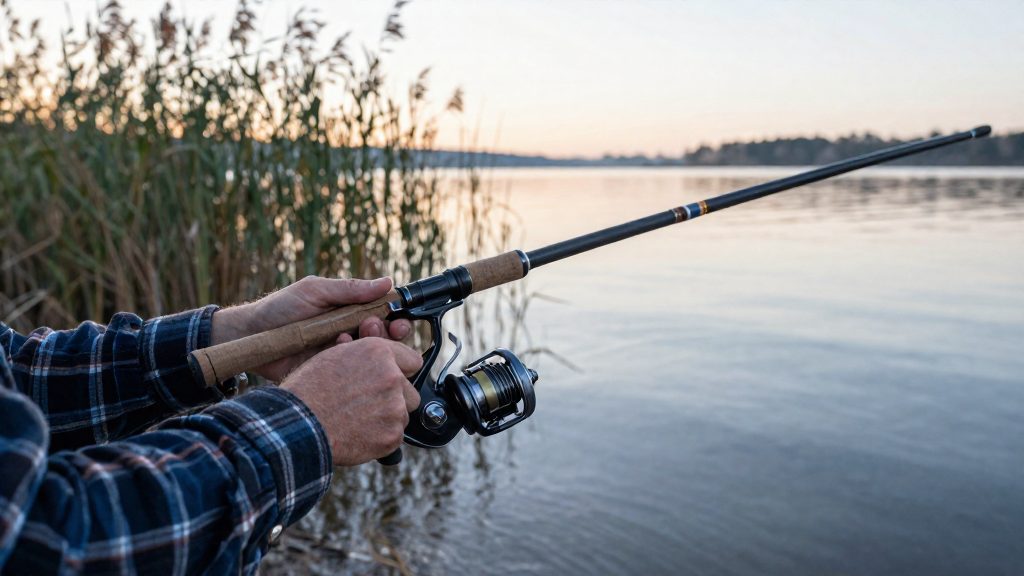
Low-profile reels are the most popular type of baitcaster. Their shape lets you palm the reel: you hold it in the palm with the handle and the thumb resting on the spool. This grip keeps the reel stable during the cast and makes it easier to control the spool with your thumb. Round reels sit higher in the hand and are less suited to palming.
Line capacity is the main trade-off. Round reels hold more line than low-profile reels, which makes them the better choice when you need line in reserve or use heavier line. Low-profile reels carry less line, which suits lighter, everyday line weights for lure fishing. Check the line capacity printed on the spool or in the manufacturer’s specifications before buying, and match it to the line weight you plan to use.
Species should drive the choice:
| Body shape | Hand fit | Line capacity | Typical use |
|---|---|---|---|
| Low-profile | Palmed in one hand, thumb on spool | Lower | Bass and crappie |
| Round | Held higher, more secure grip | Higher | Heavier line and larger baits, such as pike, muskie, salmon and steelhead |
What gear ratio should a beginner choose?
A baitcasting reel’s gear ratio tells you how many times the spool turns for each full turn of the handle. A 6.4:1 reel turns the spool 6.4 times per handle turn. A higher number recovers line faster, which suits lures you retrieve quickly. A lower number turns the spool more slowly, which suits lures you crank with steady, deliberate pulls.
For a first reel, the Mystery Tackle Box guide recommends a mid-range ratio of about 6.2:1 to 7.0:1 for a multipurpose baitcaster. This band covers most common presentations, so you avoid buying a reel that is too specialised before you know which lures you use most.
Bass Pro Shops 1Source (2026-04-03) identifies three ratios as the most common in baitcasting:
| Gear ratio | Lure type | Why it fits |
|---|---|---|
| 5.4:1 | Crankbaits | Slower spool speed gives more control when pulling a diving lure through the water |
| 6.4:1 | Most lures, fast and slow presentations | The most common ratio, and the most versatile choice for a beginner |
| 7.1:1 | Spinnerbaits and buzzbaits | Faster line pickup keeps the blades and skirts working at a quicker retrieve |
If you are unsure, start with a 6.4:1 reel. It sits inside the mid-range band and handles both fast and slow retrieves. Once you know your favorite lure style, you can choose a different ratio for that technique.
How do brakes and spool tension prevent backlash?
Backlash happens when the spool keeps turning after the lure stops, so line piles up on the spool faster than it can be controlled. Brakes and spool tension slow the spool during the cast, while your thumb handles the final stop. Together they keep the spool’s speed in step with the lure’s flight.
Baitcasting reels use two main brake designs, and the sources name both:
| Brake type | How it works | Adjustment |
|---|---|---|
| Centrifugal | Pins press against the spool, and the force grows as the spool spins faster | Pin settings, adjusted on the reel |
| Magnetic | Magnets restrain the spool directly | A dial |
According to Guidesly (2021), magnetic braking systems restrain the spool to reduce bird’s nests, which are tangled knots of line. Centrifugal brakes achieve the same goal with pins, so either design can work when it is set to suit your lure.
The spool tension knob is the first adjustment to make. Heavier lures pull line off the spool faster, so they need tighter tension. Lighter lures need looser settings, because too much resistance stops them from flying far. When you switch to a heavier lure, tighten the knob before your next cast.
Thumbing is the main backlash control. Bass Pro Shops 1Source (2026-04-03) states that thumbing is still the most important way to prevent backlash. To thumb, lightly press your thumb on the spool’s edge as the lure lands, so the spool slows and stops with the lure. Brakes reduce the work your thumb has to do. They do not replace it, so keep thumbing on every cast.
Bearings, frame and drag worth paying for
Three features on a baitcasting reel are worth a closer look before you spend more: the frame material, the bearings and the drag. The frame changes the price most directly, while bearing quality and drag smoothness affect how the reel performs when you actually fish.
Graphite versus aluminum frames
Graphite frames cost less than aluminum ones, according to Guidesly (2021). For a beginner, that makes graphite the lower-cost option, and the frame material is one of the few features that changes the price noticeably at a similar level of build.
No weight figures are given here, so compare the listed weight of each model on the manufacturer’s spec page before deciding. A lighter reel is easier to hold through a long session, but weight alone does not show whether a reel is well built.
Bearing quality over bearing count
According to Bass Pro Shops 1Source (2026), bearing quality matters more than bearing count. Look for reels with shielded, double-shielded or sealed bearings. Shielding and sealing keep grit and water out of the bearing, which helps the spool turn smoothly over time. Be cautious of reels that promote a large number of bearings in their listing, because the number alone says little about how the reel will perform.
Star drag during fish runs
The drag controls how much line a fish can pull off the spool under load. Setting it correctly stops the line from breaking when a fish runs, and a smooth drag gives line out steadily instead of in jerks.
To check your drag before a trip:
- Tie on your line and tighten the drag star so the spool resists when you pull line by hand.
- Pull firmly on the line. It should slip out evenly, without catching or stopping.
- Set the drag well below the breaking strength printed on the line packaging, so the line does not snap when a fish runs.
- Test again with the spool loaded, because line on the spool changes how the drag feels.
A drag that is set too tight will break the line on the first hard run, while one set too loose can let a fish gain line on you.
How much should a first baitcaster cost?
For a first baitcaster, the right budget depends mainly on how often you plan to fish. The Mystery Tackle Box guide suggests spending about $100 if you fish more than 35 days a year. That figure is a guide, not a fixed price. Prices vary by brand and retailer, so compare the specifications before comparing prices.
Matching the budget to your fishing frequency
- Occasional anglers: The guide gives its roughly $100 figure for anglers who fish more than 35 days a year, so a lower budget is a reasonable starting point if you fish less often.
- Regular anglers: Past 35 days a year, the guide’s roughly $100 benchmark is the reference to aim for.
- Either way: Keep part of the budget for line, a spare spool and accessories.
Checking line capacity against the price
The guide describes a typical first multipurpose baitcaster as one that holds about 110 to 120 yards of 10 to 14 lb line. Use these figures to confirm that a reel suits your target fish and lures.
| Specification | Typical value for a first multipurpose baitcaster |
|---|---|
| Line weight | 10 to 14 lb |
| Line capacity | About 110 to 120 yards |
| Budget if fishing more than 35 days a year | About $100 (Mystery Tackle Box) |
Budgeting for a spare spool and line
Line is the consumable part of the setup, so plan for replacing it. A spare spool lets you switch between line weights or fill a fresh spool while the first one is being used, without buying a second reel. Check the price of the spool made for your specific model, because spare spools are model-specific. Budget for new line at least once a season, and fill the spool to the rated capacity rather than underfilling or overfilling it.
Set up and cast your first reel
Setting up a baitcasting reel for a beginner comes down to four steps: spool the line evenly, set the brakes to a conservative starting point, make your first casts with a heavier lure before moving to lighter ones, and ease the brakes as your skill grows. Most early problems, such as the spool overrunning into a tangle, come from brakes set too loose or line wound unevenly. Work through the steps in order.
Step 1: Spool the line evenly
- Place the spool on the spool holder or a pencil, and feed the line through the rod’s guides so you know the line is running in the right direction.
- Tie the line to the spool arbor with a secure knot, then wind it on.
- Keep light, steady pressure on the line with your fingers while you turn the handle. The line should lay flat and neat on the spool rather than in loose coils.
- Stop filling the spool just below its lip. Overfilling makes the line pull unevenly as it leaves the spool.
Step 2: Set the starting brakes
Baitcasting reels have two brake adjustments you will use from the start:
| Adjustment | Beginner starting point | Source |
|---|---|---|
| Spool shaft brake (side-plate or adjustment knob) | Tighten until the spool has barely any side play when you wiggle it | Happy Angler |
| Casting brake with pads | Start with half the pads engaged | Happy Angler |
| Magnetic casting brake | Set the dial at its midpoint | Happy Angler |
Tighten the spool shaft brake first, then set the casting brake. Set this way, the spool keeps some resistance during the cast, which slows it before it overruns.
A loose setting that works with a light lure can let the spool spin freely when you throw something heavier.
Step 3: Make your first casts
Practice in an open area with no obstacles behind you. Make each cast with a smooth, controlled motion rather than a hard throw.
If the spool overruns, which shows up as a tangle of line on the spool, stop the cast and tighten the casting brake a small amount. Make one adjustment at a time and test again.
Step 4: Ease the brakes as your skill grows
Once your casts land consistently, ease the casting brake so it applies less resistance. Reduce the magnetic dial setting or remove pads one step at a time, testing after each change. Stop easing off as soon as the spool starts to overrun or backlash returns.