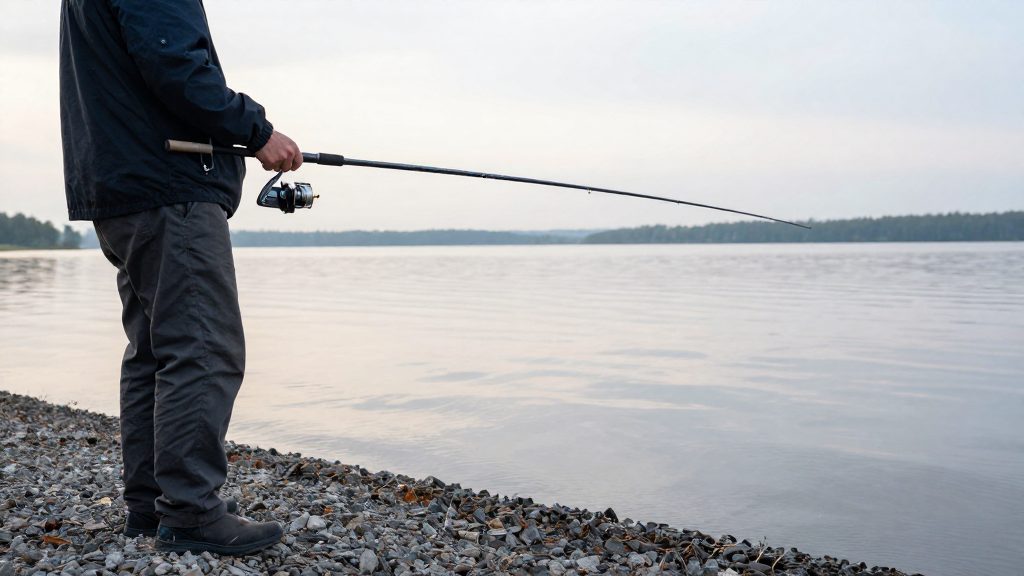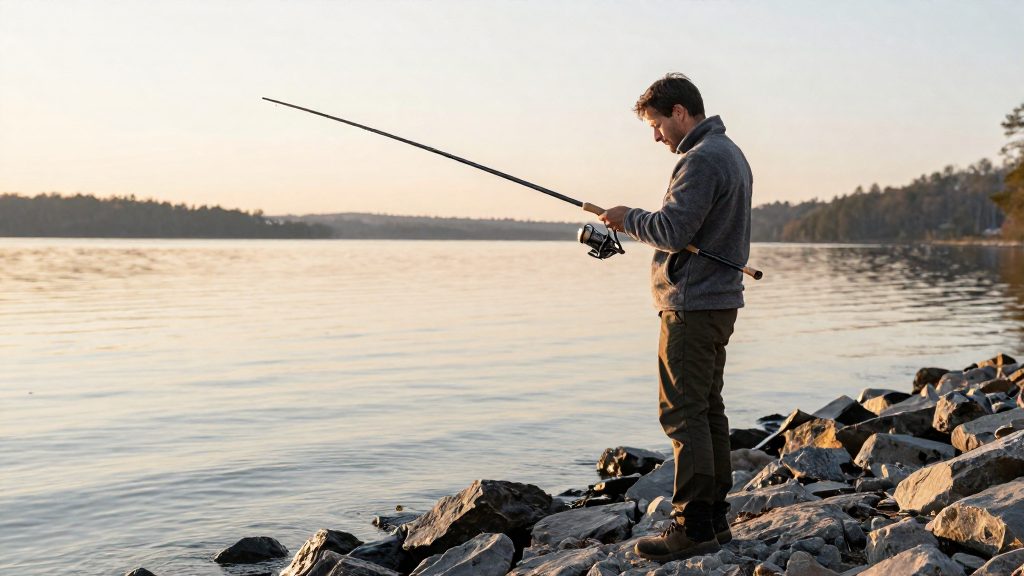
Look at three things before comparing models: a lure weight rating that covers the lures you plan to throw, a blank and components that feel sound, and a handle and reel seat that are comfortable and secure with a 2000–3000 size spinning reel.
What makes a good beginner bass spinning rod?
Lure weight rating and what it means
The lure weight rating is the range of lure weights the manufacturer says the rod casts well. It is normally printed on the blank near the handle or in the product listing. Two rating examples from Outdoor Life show how ranges differ:
| Rating | Lightest lure | Heaviest lure | Outdoor Life’s price tier |
|---|---|---|---|
| 1/4–1/2 oz | 1/4 oz | 1/2 oz | Budget, under $100 |
| 3/16–1/2 oz | 3/16 oz | 1/2 oz | Mid-range |
Lures outside the rated range may not cast well, and lures above the upper limit risk stressing the rod, so stay within the maker’s rating. Choose a rating whose floor suits your lightest lures and whose ceiling covers your heaviest. A wider range gives more flexibility, but the rating only tells you lure weight, not how the rod feels when fighting a fish.
Blank material and component build quality
The blank is the tubular body of the rod. Inspect it in the shop if you can. Look for an even finish, no visible cracks, and clean, flush joints where the sections connect. Sight down the blank to check the guides line up along the same axis. Each guide should be wrapped evenly and fixed firmly, with no loose or lifting wraps. On a multi-piece rod, a loose joint or any play in the sections is a reason to choose another rod.
If the material is not stated on the label or product page, check the manufacturer’s specifications before buying.
Handle and reel seat comfort
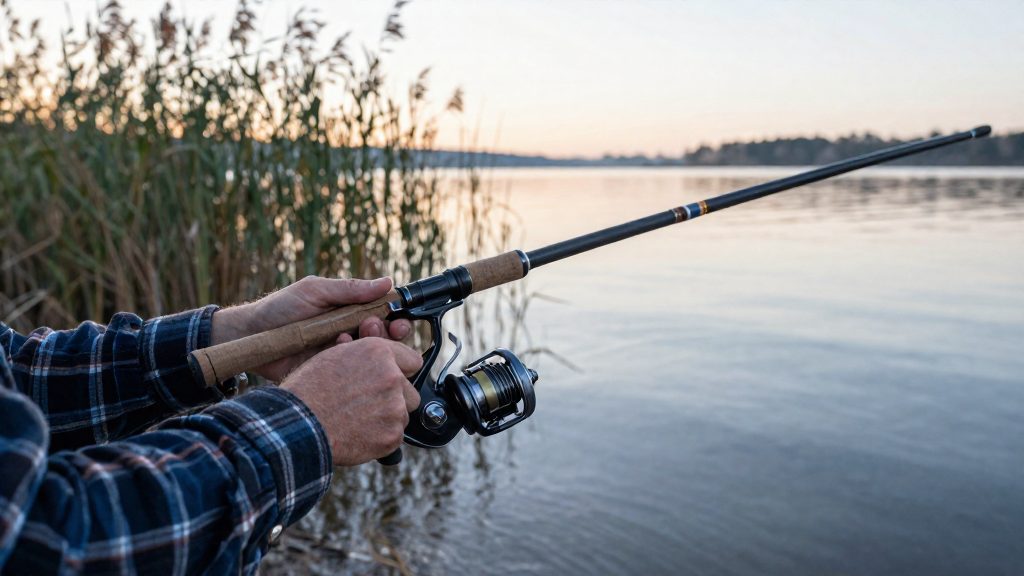
Hold the rod in your casting grip and check how the handle sits in your palm. The grip should be smooth, with no rough edges, and long enough for your hand to rest comfortably with the reel foot in place.
Check the reel seat with the reel you intend to use. A 2000–3000 size spinning reel should slide onto the seat without forcing and lock down with the locking nut tightened, with no rotation or wobble under gentle pressure. A reel that moves on the seat can loosen during a cast or fight, so retighten the nut after the first few sessions.
Why start with a spinning rod?
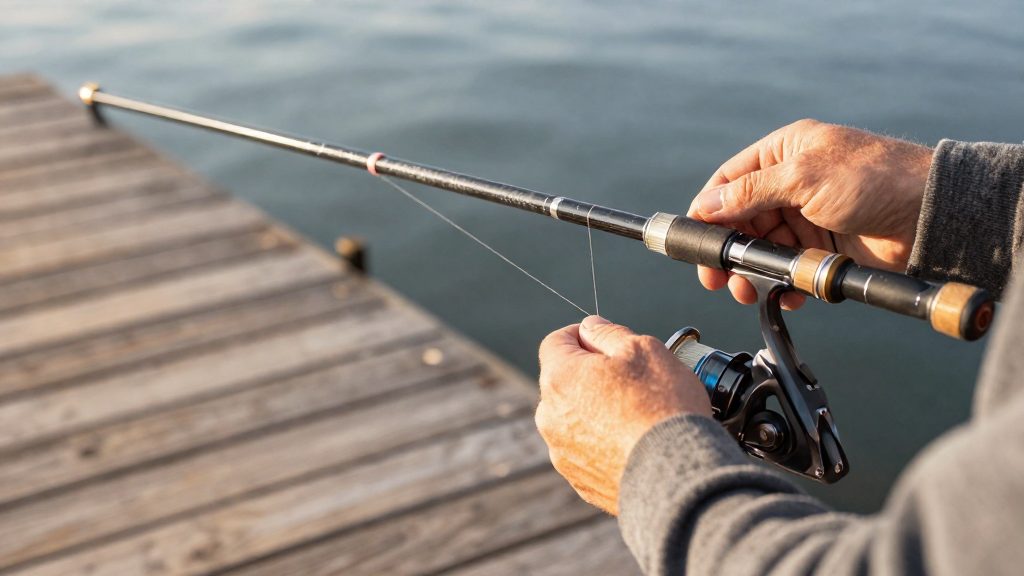
Tackle Warehouse advises beginners to start with a spinning rod, calling it the industry standard for most beginners and generally easier to learn to cast. For a first bass setup, that matters because a predictable cast lets you spend your time on the water working out where fish hold, not untangling line. Spinning gear gets there through two design differences from baitcasting outfits: an easier casting learning curve and a lower risk of backlash.
Easier casting learning curve
On a spinning reel the spool does not rotate during the cast. The lure’s weight pulls line off the spool, so there is no spinning spool to keep in step with the lure. A beginner mainly needs to learn timing: open the bail, hold the line against the rod with your index finger, bring the rod back, then release the finger on the forward stroke. Errors are easy to see and correct, and a short cast that lands softly still teaches you something.
Lower backlash risk than baitcasting reels
Backlash is the tangle that forms when the spool turns faster than the line leaves it. It is the main reason newcomers struggle with baitcasting reels, because their spool is the part that spins. The spinning reel removes that rotating spool from the cast, so the usual beginner problem is loose line coils rather than a bird’s nest that must be cut out.
How open-faced line pickup works
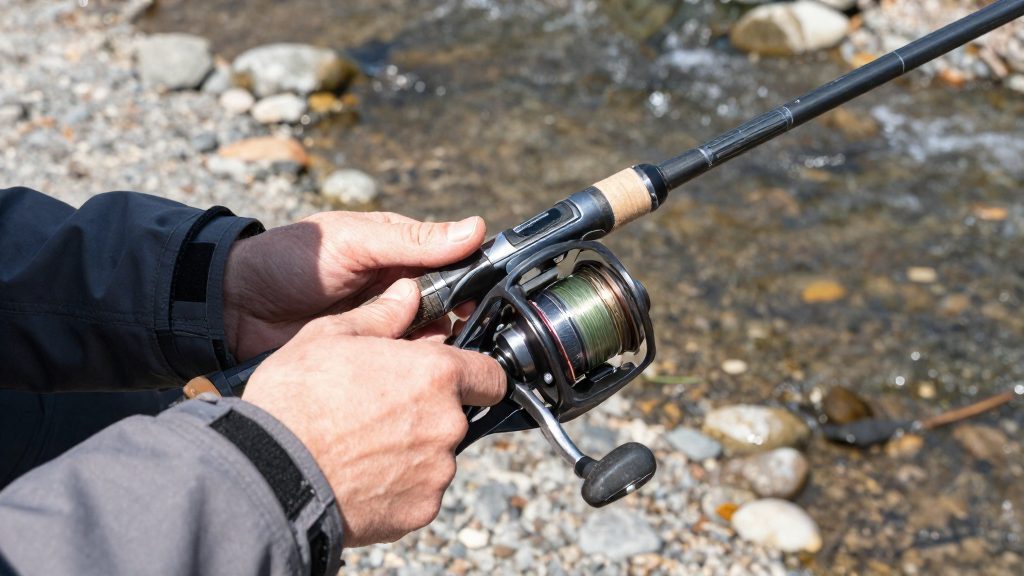
A spinning reel is an open-faced design: the spool is fixed to the reel body and exposed at the front. During the cast, line comes off the front edge of the spool. To retrieve, the bail, the wire arm you flip over before casting, must be closed. A pickup pin then travels around the spool and guides line back onto it as you turn the handle.
Choosing a rod length between 6’6” and 7’0”
Tackle Warehouse recommends a beginner spinning rod between 6’6” and 7’0”. Neither end of that range is wrong for bass, so the practical question is where in the range you should sit. Your height and the techniques you plan to use decide that more than any fixed figure does.
How angler height shifts the choice
Tackle Warehouse suggests that taller anglers may prefer the longer end of the range and shorter anglers the shorter end. A rod that suits your build is easier to cast accurately and to control when a fish runs close to the bank.
Matching length to technique
Outdoor Life’s reviews show how the range plays out in real rods:
| Model | Length | Power and action | Lure weight | Price note |
|---|---|---|---|---|
| Falcon BuCoo SR BRS-4-17 | 7’0” | Medium power, moderate action | 1/4–1/2 oz | Budget, under $100 (Outdoor Life, 2026-07-14) |
| St. Croix Victory VTS73MXF | 7’3” | Medium power, extra-fast action | 3/16–1/2 oz | Mid-range (Outdoor Life, 2026-07-14) |
The St. Croix model sits just above the 7’0” upper limit of Tackle Warehouse’s range, so it is worth checking the exact length before comparing it with shorter rods.
Medium power and fast action explained
A rod’s power and action are the two ratings that determine how it bends under load and how quickly it recovers. For a beginner bass setup, medium power paired with fast action is the combination Tackle Warehouse recommends for beginner techniques such as the drop shot, shaky head, Ned rig, neko rig, Texas rig and split shot.
Medium power: bend and lure weight fit
Power describes how much force the blank needs before it bends. A medium-power rod flexes under moderate loads, so it suits lighter lures than a heavy-power rod designed for large, heavy baits. The lure weight rating printed on the rod shows the range the maker intended. Outdoor Life’s budget pick, the Falcon BuCoo SR BRS-4-17, is a medium-power rod with moderate action, rated for 1/4–1/2 oz lures. Its moderate action does not meet the fast-action recommendation for these techniques, so it is a compromise: the bend is spread further down the blank than on a fast-action rod. Its best overall pick, the St. Croix Victory VTS73MXF, is also medium-power but is rated for 3/16–1/2 oz lures, so it reaches slightly lighter weights at the bottom of its range (Outdoor Life, 2026-07-14).
Fast action: tip bend and sensitivity
Action describes where along the rod the bend concentrates. A fast action rod bends mainly in the upper section, leaving the lower blank stiffer. This tip-focused bend responds quickly when you set the hook, and the tip gives you a clearer feel for small movements at the lure. The tip can therefore help show light contact and subtle bites compared with a rod that bends through its full length.
Action is separate from power. Outdoor Life describes the St. Croix Victory as extra-fast and the Falcon BuCoo as moderate-action, so two rods with the same medium power can respond very differently at the tip. Extra-fast is faster than the fast action Tackle Warehouse recommends, so check that its very tip-heavy bend suits you.
| Model | Length | Power | Action | Lure weight rating |
|---|---|---|---|---|
| Falcon BuCoo SR BRS-4-17 | 7’ | Medium | Moderate | 1/4–1/2 oz |
| St. Croix Victory VTS73MXF | 7’3” | Medium | Extra-fast | 3/16–1/2 oz |
Why fast action suits finesse presentations
Finesse rigs use light weights and slow, controlled movement, so the angler has to detect bites that are often faint. A fast-action tip helps in two ways: it shows light taps on the line, and it converts a quick lift into a firm hook set. Medium power keeps the rod manageable with light lures while still giving enough backbone to control a bass once it is hooked.
Which reel and line should you pair with it?
Tackle Warehouse recommends pairing a beginner spinning rod with a 2000–3000 size spinning reel, spooled with monofilament or fluorocarbon. Braid can come later, with a fluorocarbon leader, when you want more sensitivity. The reel size and line type both affect how the rod loads, how much the system stretches when you strike, and how easily you feel a bite.
Reel size: 2000 to 3000
Reels in this range suit the light to medium lures a beginner typically throws at bass. Check the size stated on the reel and in the manufacturer’s listing before buying, so the reel matches the range you need.
Mono or fluorocarbon mainline
Both are simple to handle and easy to tie. The key difference from braid is stretch. The line itself gives under load, which helps a beginner who is still learning when to set the hook.
Braid with a fluorocarbon leader
Braid is the upgrade step, and you feel bites and bottom contact more clearly with it. Because braid stretches less, the rod has less give to work with, and Outdoor Life notes the rod may need more flex in that setup. When you switch to braid, check the rod’s stated action and power on the manufacturer’s label before you rig it.
| Line | Role in this setup | Stretch compared with braid |
|---|---|---|
| Monofilament | Beginner mainline on the spool | Stretches more |
| Fluorocarbon | Beginner mainline, or the leader in a braid setup | Stretches more |
| Braid with fluorocarbon leader | Later upgrade for sensitivity | Stretches less |
Best budget and best overall picks
Outdoor Life (2026-07-14) names two rods for bass beginners: the Falcon BuCoo SR BRS-4-17 as its budget pick and the St. Croix Victory VTS73MXF as its best overall. Both are spinning rods. The two rods differ in length, action, lure weight rating and price.
| Spec | Falcon BuCoo SR BRS-4-17 | St. Croix Victory VTS73MXF |
|---|---|---|
| Length | 7’ | 7’3” |
| Power | Medium | Medium |
| Action | Moderate | Extra-fast |
| Lure weight rating | 1/4 to 1/2 oz | 3/16 to 1/2 oz |
| Price | Under $100 | Mid-range |
| Outdoor Life pick | Budget | Best overall |
Falcon BuCoo SR BRS-4-17
The BuCoo is the lower-cost option. Outdoor Life suggests pairing it with the Daiwa Fuego LT, an affordable reel that keeps the total outfit cost low.
St. Croix Victory VTS73MXF
The Victory is the higher-priced rod in this pair. Its extra-fast action concentrates the bend closer to the tip than the BuCoo’s moderate action does.
How much should a beginner spend?
Most of the rods Outdoor Life (2026-07-14) reviewed cost $100–$200, and it placed its budget pick under $100, so a beginner can start below that range. Outdoor Life gives no exact price for the mid-range St. Croix, so check the current listing.
Budget versus mid-range trade-offs
| Price band | Position in the reviews | Trade-off to weigh |
|---|---|---|
| Under $100 | Outdoor Life’s budget tier (2026-07-14) | Lowest entry cost; confirm the rod’s power and action suit your main technique |
| $100 to $200 | Where most rods reviewed by Outdoor Life (2026-07-14) sit | Higher cost, but the rod is still judged on how well its power and action match your fishing |
Price alone does not decide suitability, so a cheaper rod that fits your method can outperform a pricier one that does not.
Splitting a first budget across tackle items
- Set a total budget for the whole outfit. Include the reel, line and a starter selection of lures, not only the rod.
- Choose the rod price band first. Decide whether you want a budget rod under $100 or a pricier rod in the $100–$200 band where most of the reviewed rods sit, then check the power and action against the techniques you plan to use.
- Price the reel and line before buying the rod. Their cost comes from the same total, so a rod at the top of the range can leave less for them than expected.
- Keep a reserve for lures and terminal tackle. This lets you fish on the first outing without buying extra items immediately.
- Revisit the rod if your line setup changes. Avoid spending heavily on a rod until you know your line setup.
How do rated lure ranges apply to finesse rigs?
For a medium-power, fast-action beginner rod, the best lure choices are light finesse presentations. The common thread is a light, soft lure that the rod can cast accurately and control, so it makes sense to pick lures by technique first and then check them against the rod’s rated range.
Soft plastics for Ned and neko rigs
Ned and neko rigs both rely on soft plastics. Choose a soft plastic whose shape matches the technique, and confirm the rigged weight before casting.
Shaky head and drop shot lure picks
A shaky head pairs a soft plastic with a jig head. Two rods in the reviewed set show how rated ranges compare:
| Rod | Length | Power and action | Rated lure range | Price position |
|---|---|---|---|---|
| Falcon BuCoo SR BRS-4-17 | 7 ft | Medium power, moderate action | 1/4 to 1/2 oz | Budget, under $100 |
| St. Croix Victory VTS73MXF | 7 ft 3 in | Medium power, extra-fast action | 3/16 to 1/2 oz | Mid-range |
Any shaky head jig head within each rod’s rated range suits that rod: 1/4 to 1/2 oz for the Falcon BuCoo, and 3/16 to 1/2 oz for the St. Croix Victory.
Choosing lure size inside the rated range
Start near the middle of the range for general use, use the lighter end for small, slow presentations, and move toward the heavier end when you need more casting distance or faster sinking. Check the product label or manufacturer’s instructions for any limit the maker sets beyond the rating.
Frequently asked questions
Is a moderate-action rod like the Falcon BuCoo SR BRS-4-17 still a good first bass rod?
It is a workable starting point, but it is a compromise. The Falcon BuCoo SR BRS-4-17 is a 7’ medium-power rod with moderate action, so its bend runs further down the blank than the fast action Tackle Warehouse recommends for beginner techniques such as the drop shot and shaky head. Outdoor Life (2026-07-14) placed it in its under-$100 budget tier and rated it for 1/4–1/2 oz lures. The St. Croix Victory VTS73MXF is extra-fast, but at 7’3” it sits outside the 6’6”–7’0” length range.
How do I check whether a rod will cast the lures I plan to use?
Find the lure weight rating printed on the blank near the handle or in the product listing, then compare its lightest and heaviest figures with the weights of your lures. Lures outside that range may cast poorly, so stay within the maker’s limits. If the rating is missing from both the blank and the listing, check the manufacturer’s specifications before you buy.
Why do beginner guides usually point to a spinning rod over a baitcasting setup?
Tackle Warehouse describes the spinning rod as the industry standard for most beginners and generally easier to learn to cast. On a spinning reel the spool stays fixed during the cast, so line leaves freely and tangles less often than on a baitcaster. Pair the rod with a 2000–3000 size spinning reel to match the setups in this guide.