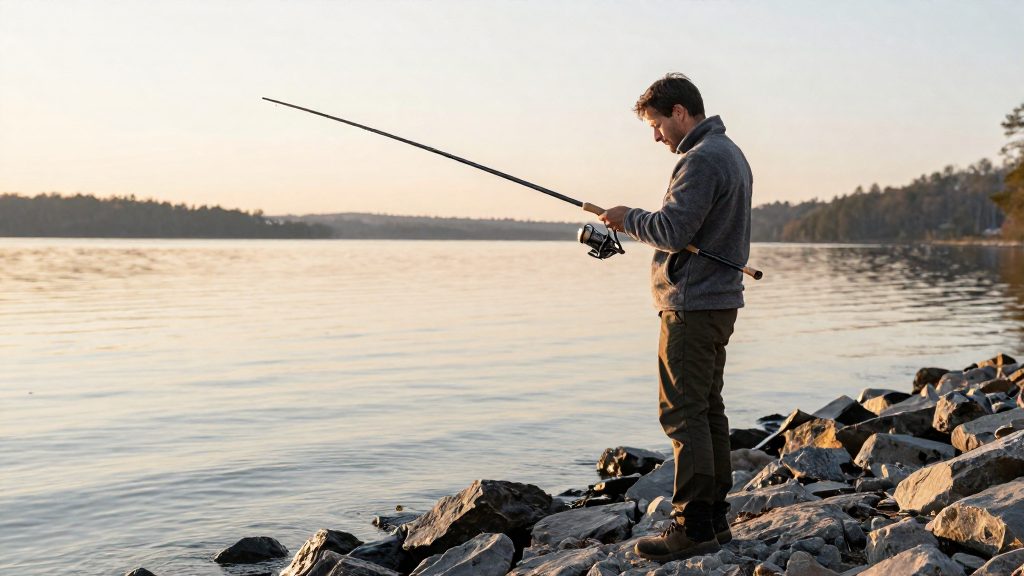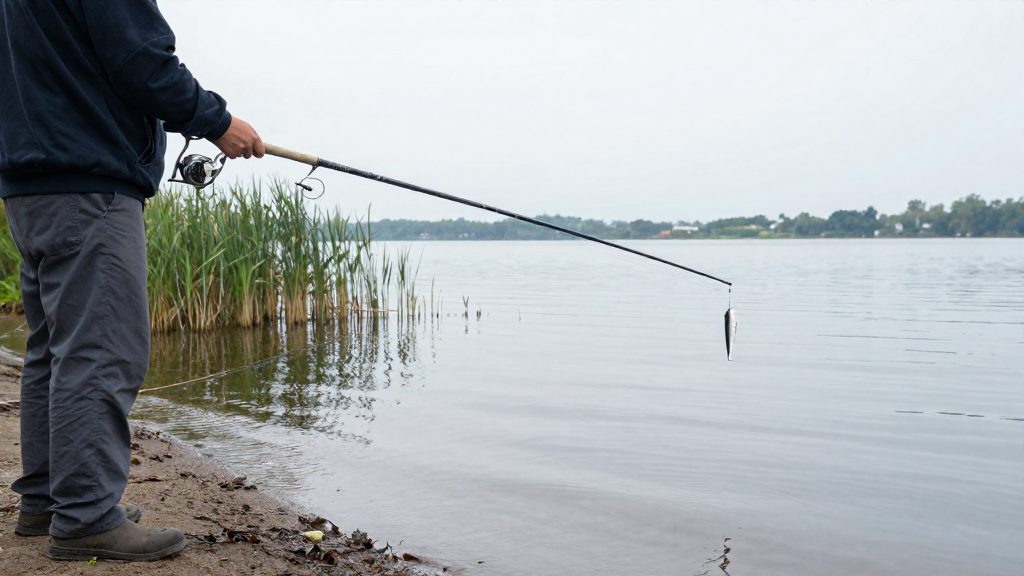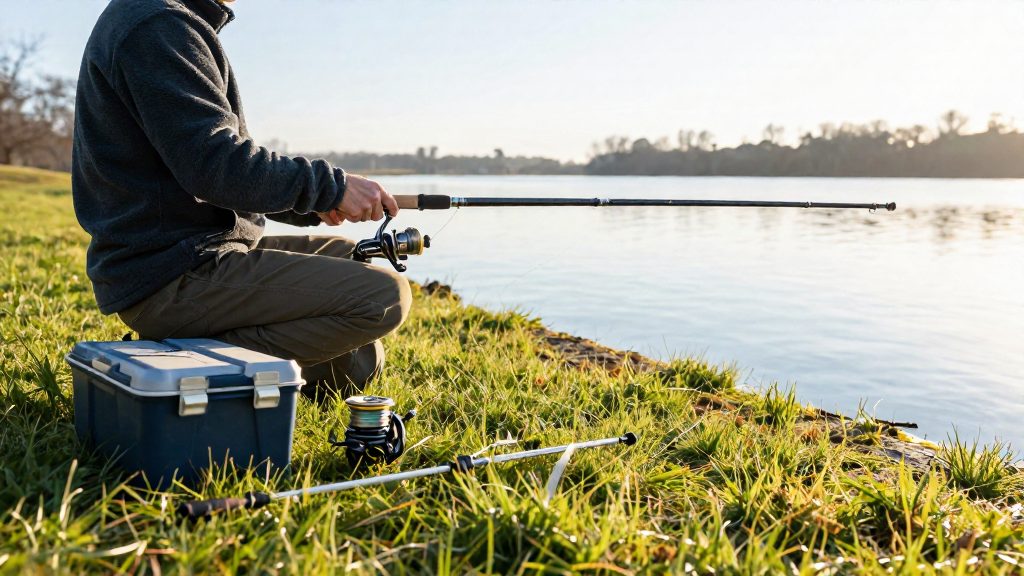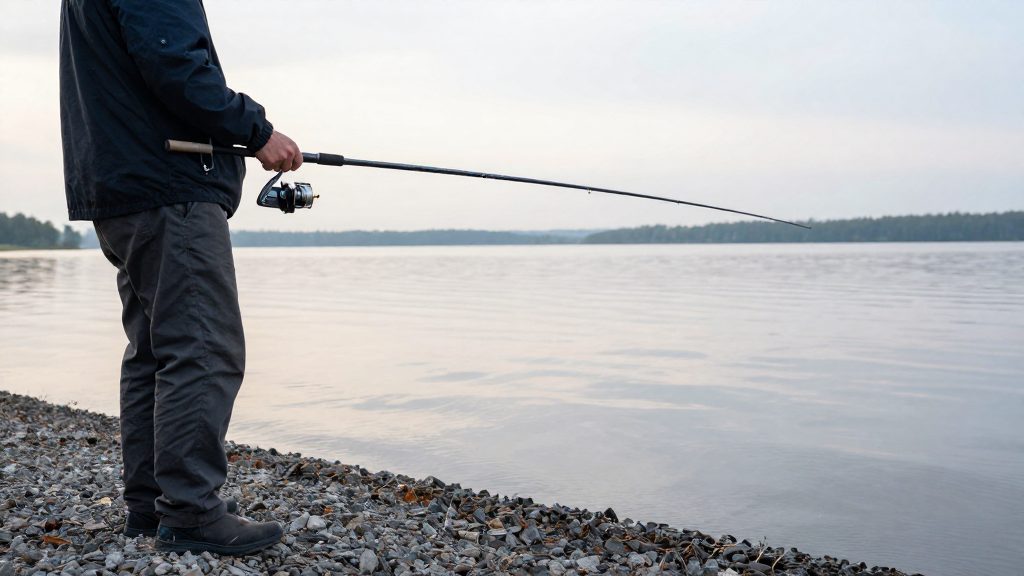
What makes a good shore pike rod?
A shore pike rod is defined by three build features: the blank, the handle and reel seat, and the guides. Each one affects how the rod handles heavy lures, how comfortably you hold it during long casting sessions, and how well it survives pike’s teeth and abrasive braided line.
Blank materials: carbon, glass and composite
The blank is the tubular body of the rod, and its material sets the balance between stiffness, weight and sensitivity.
| Material | Typical trade-off for pike |
|---|---|
| Carbon | Stiffer and lighter, with direct feedback on lure action and strikes. Less forgiving on hard hook-sets, so check the blank after use. |
| Glass (fibreglass) | More flexible and forgiving, which can help when a pike shakes its head. Heavier and less sensitive. |
| Composite (carbon-glass blend) | Aims to combine the feel of carbon with some of glass’s durability. Quality depends on the manufacturer’s blend. |
Check the manufacturer’s label for the exact material. Do not assume a blank is carbon from its colour or finish.
Handle and reel seat ergonomics
A reel seat must lock the reel foot firmly so it cannot rotate under load. Test this by tightening the locking nut and turning the reel body by hand. The handle should be long enough for a two-handed grip when fighting a fish from the bank, and the cork or foam grip should sit where your hand naturally rests. Waders or a wading position change how you hold the rod, so test the handle in the conditions you fish.
Guide type and wire-frame durability
Guides carry the line along the blank and take most of the wear from braid. Look for:
- Stainless steel frames, which resist bending and corrosion better than lighter alloys.
- Secure guide feet that are wrapped and epoxied neatly, with no lifting or gaps.
- Hard inserts (ceramic or similar), which resist grooving from braid.
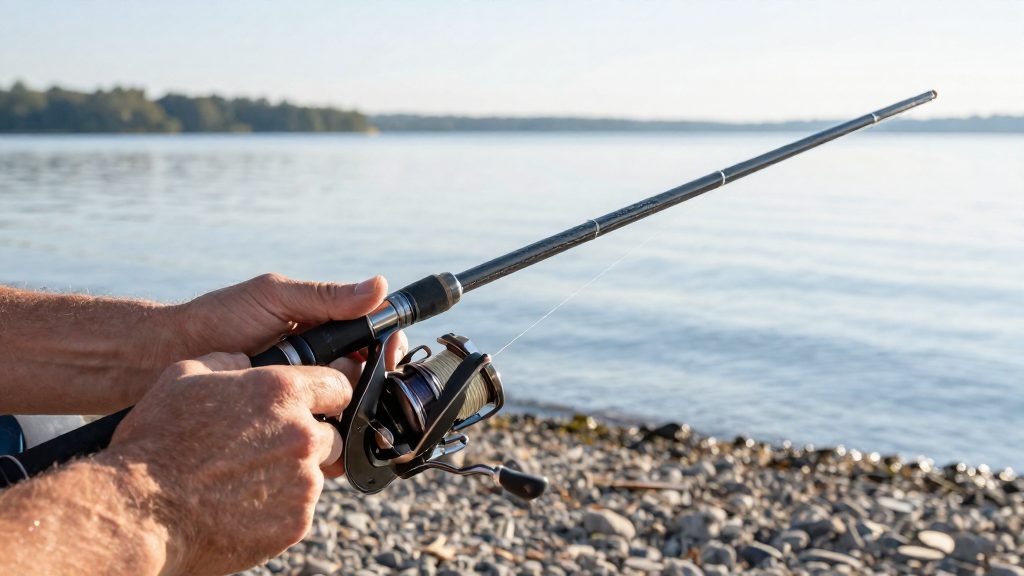
How long should a spinning rod be for shore pike?
For pike, the starting point is a spinning rod of 8 to 9 ft (243 to 274 cm). Rapala’s rod-selection guide gives this length for pike and other big predators, paired with fast action, heavy to extra-extra-extra heavy power, and a casting weight of up to 130 g, about 4.6 oz (Rapala, 2026). Length matters first because it sets how far a lure travels and how much line you control from the bank.
Shore fishing covers a wider shore range. Rapala (2026) lists 8 to 14 ft (243 to 426 cm) as the range for fishing from the bank or with waders. The table below shows how the two ranges relate.
| Length | Metric | What Rapala (2026) links it to |
|---|---|---|
| 8 to 9 ft | 243 to 274 cm | Recommended length for pike and big predators |
| 8 to 14 ft | 243 to 426 cm | Overall range for shore fishing, from the bank or with waders |
Within the shore range, length becomes a trade-off between reach and control. A longer rod adds distance and helps you lift line out of the water, but it also takes more room behind you on each cast.
Matching the rod to your position
Your casting room decides how much of the range you can use. Before you commit to a length, check the area behind you:
- Narrow bank or dense bushes: stay near the shorter end of the range so the rod tip does not catch on vegetation or the bank during the backcast.
- Open bank with clear space: stay within the 8 to 9 ft (243 to 274 cm) recommended for pike. The extra room lets you cast that length freely, but it is not a reason to go longer.
- Wading: Rapala (2026) includes waders in its general shore range, but for pike the recommended length is still 8 to 9 ft (243 to 274 cm). Check the backcast space around you in the water and on the banks.
To test your room, make several slow practice backcasts with an empty rod at the length you intend to use. If the tip stops well clear of anything behind you, the length suits the spot.
Power and action for pike
For pike, power and action affect hook-setting and how much lure weight a rod can handle more than almost any other specification. Rapala’s rod-selection guide (2026) recommends a fast-action rod in the heavy to extra-extra-extra heavy power range for pike and other big predators. That combination gives a blank stiff enough to drive a hook into a pike’s bony, tough jaw and handle larger lures without bending past its limit.
Power ratings for pike
Power describes how much force the whole blank resists before it bends. Ratings run from lighter to heavier, and pike work sits at the heavy end of that scale:
- Heavy: the lowest power in the heavy to extra-extra-extra heavy range Rapala gives for pike
- Extra heavy: a stiffer blank for larger lures and faster retrieves
- Extra-extra-extra heavy: the stiffest option in Rapala’s range, for the heaviest lures and the most powerful fish
Choose a power level that matches your heaviest lure and the size of the pike you expect. A rod that is too soft will absorb the hook-set and may not move a large fish away from snags.
Fast action for hook-setting and casting
Action describes where the blank bends. A fast action rod bends mainly in the top third, so the tip flexes while the lower section stays stiff and does the lifting. This gives three practical benefits:
- A quick, direct hook-set when a pike strikes, with less lost motion between the angler’s wrist and the hook
- A more controlled cast with heavier lures, because the rod loads and releases energy quickly
- Better sensitivity to bites and lure action, since the tip transmits movement cleanly
Fast action is also what Rapala specifies for pike, which makes it the default starting point when you compare rods.
Power rating versus test curve
The power label is a general category, and the test curve printed on the blank gives more precise information. Labels are set by each manufacturer, so two rods both marked Heavy may not feel identical.
Which lure weight should you match?
A spinning rod’s casting weight rating, printed on the blank as a range in grams, sets the lightest and heaviest lure it can load and cast properly. For pike, the key figure is the upper limit. According to Rapala’s rod-selection guide (2026), pike and big predators call for a rod with a casting weight of up to 130 g. That number is a ceiling, not a target. Most of your casts should fall within the rated range, and you should never exceed the maximum.
Reading the rating against your lures
- Find the casting weight range printed on the rod blank.
- Check the weight of each lure you plan to use, from the packaging or the manufacturer’s listing.
- Confirm that the lures you use most often fall inside the range, not only the heaviest ones.
Pike lures cover a wide weight range, from lighter lures used with a slow retrieve to heavy spoons and large swimbaits. A rod that handles the full range gives you more options from the bank. If your lures are mostly light, a rod rated toward the lower end of the range will feel more responsive with them.
Matching weight to wind and distance
Wind and casting distance change which lure weight works best within the rated range:
| Condition | Lure choice within the rated range |
|---|---|
| Calm water, short casts | A lighter lure, easier to control on the retrieve |
| Headwind | A heavier lure, which resists wind drift better |
| Long casts from the bank | The heaviest lure the rod loads comfortably |
Work through the choice in three steps:
- Start with the lure weight you would use in calm conditions.
- Move to a heavier lure within the range when wind pushes against your cast.
- Stop at the rated maximum. Casting above it overloads the blank and can damage the rod.
Which reel and line pair with a pike rod?
A spinning reel for pike should match the rod’s power class and hold enough line for a long run. A small, light-tackle reel will not suit a heavy-power pike rod, so choose a reel built for heavier loads.
Matching reel size to line capacity
Check the line capacity printed on the reel or in the manufacturer’s specifications. Then confirm the spool holds that amount at the line diameter you plan to use. A spool capacity that is too small leaves you without enough line when a pike makes a long run toward cover.
Braided versus monofilament line
The two line types behave differently on the same spool:
| Factor | Braided line | Monofilament line |
|---|---|---|
| Diameter for a given breaking strength | Thinner | Thicker |
| Length that fits one spool | Greater | Smaller at the same diameter |
| Stretch under load | Very low | Noticeable |
| Shock absorption | Relies on the drag | Built into the line |
Because braid is thinner, one spool carries more metres for the same reel size. Its low stretch means the drag setting has to absorb the pike’s sudden surges. Monofilament stretches, which cushions the strike and the first run. Read the breaking strength on the label rather than judging by diameter alone.
Setting the drag and filling the spool
- Fill the spool so the line sits just below the lip. Overfilling causes line to cross and tangle on the cast.
- Tie the line to the spool, reel in until the spool is full, and keep steady tension on the line.
- Set the drag so the line slips off under a hard pull. Test it by holding the rod, pulling line by hand, and checking that it peels off smoothly.
- Loosen the drag when the rod is stored, so the washers do not stay compressed.
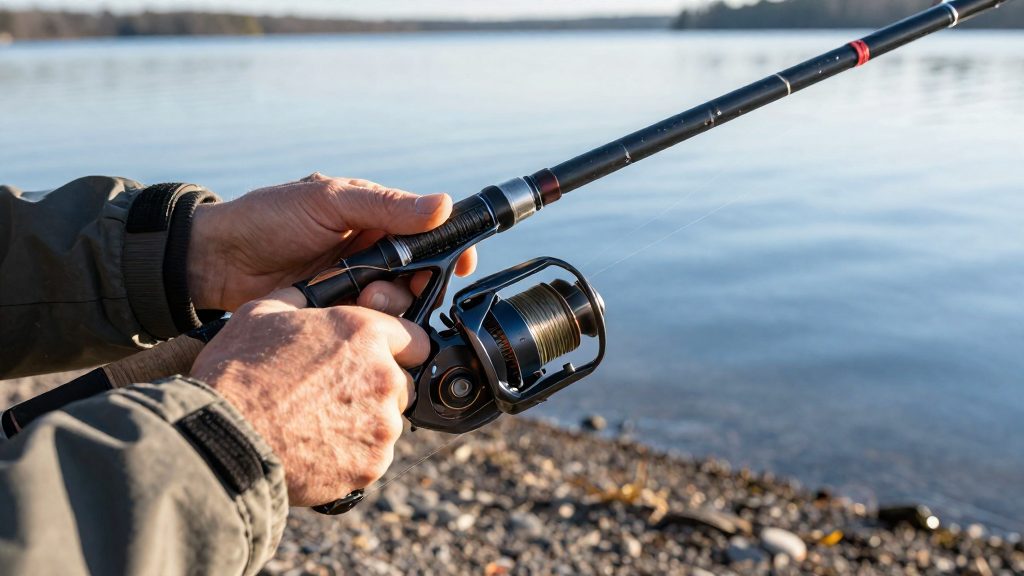
Do you need a wire or fluorocarbon leader?
For pike, the leader is the section of line that meets the teeth, so it needs to resist cutting. Pike teeth slice through ordinary monofilament and braid, which is why a wire leader is the standard protection in pike fishing. Fluorocarbon has low visibility in clear water, but pike teeth cut it too, so it should not be your only defence against a pike.
| Leader type | Resistance to teeth | Handling | Typical use |
|---|---|---|---|
| Single-strand stainless wire | High | Stiff; kinks if twisted repeatedly | Pike and other toothed predators |
| Braided stainless wire | High | More flexible, so lures move more naturally | Lure fishing where action matters |
| Fluorocarbon | Low against pike teeth | Supple and low-visibility | Smaller, non-toothed species in clear water |
Single-strand wire is the simplest choice for shore pike. It resists teeth well but holds kinks, so replace it once it bends sharply. Braided wire flexes more and suits lures that need a natural swim. It can fray if it catches on a snag or a tooth, so inspect it after every fish.
Knot and crimp choices for wire
Wire cannot be tied like monofilament. Attach it with a crimp sleeve and a swivel, or use a twisted connection only where the manufacturer allows it. Crimp with a proper crimping tool, and choose a sleeve sized to the wire diameter as stated in the sleeve manufacturer’s instructions. Check each crimp before fishing: look for cracks, flattening that narrows the wire, or loose strands.
Spinning rod or baitcaster for pike?
For a beginner fishing from the bank, a spinning setup is the easier starting point. Its fixed spool lets line leave freely during the cast, which removes most of the tangling risk that comes with a baitcaster. A baitcaster can cast heavier lures accurately once you have practised, but the early learning period is harder. Both setups can handle pike, so the choice depends mainly on how much time you can spend practising before your first sessions.
| Aspect | Spinning setup | Baitcaster setup |
|---|---|---|
| Spool type | Fixed spool; line comes off the front | Revolving spool; line comes off the top |
| Backlash risk | Very low | Present until thumb control is learned |
| Learning curve | Shorter | Longer, because the thumb must regulate the spool |
| Casting accuracy early on | Easier to get consistent casts | Improves steadily with practice |
Casting accuracy and control
With a spinning reel, you open the bail, cast, and close it again. Nothing on the spool moves independently of the line, so the lure follows the rod tip with little input from your thumb. Accuracy comes from the arm and timing, which most beginners develop quickly.
With a baitcaster, the spool spins as the lure flies out. Your thumb must slow the spool just before the lure lands. Too little pressure and the spool overruns; too much and the lure stops short. Accuracy therefore depends on thumb control, which takes repeated casts to develop.
Learning curve and backlash risk
Backlash happens when the spool keeps turning after the lure has stopped, and the line loops back on itself into a tangle. On a baitcaster, this is the most common early problem. Setting the spool brake to a stronger level and using a lighter lure in the first sessions reduces the number of tangles. Follow the reel manufacturer’s instructions for adjusting the brake.
On a spinning reel, the main early issue is line twist, not backlash. For a beginner, that makes spinning the lower-risk option at the start.
Rod power requirements for baitcasting
Baitcasting rods for pike should be judged on the same criteria as spinning rods: fast action, a heavy to extra-extra-extra heavy power rating, and a casting weight range that covers your lures. Check these values on the blank or in the manufacturer’s specifications.
Care tips for your pike rod
A pike rod works hard, so a short routine after each session prevents most avoidable damage. Start with a post-session rinse: wipe the blank, handles and reel seat with a damp cloth to remove grit, slime and salt residue, since these can dull the finish and work into the joints over time. Then dry every part before storage. Separate the sections, which keeps moisture from being trapped where they fit together, and lay them on a dry towel or rod rack until no water remains.
Guide inspection should be a habit, not an occasional task. Run a fingertip along each ring and check the inserts for grooves, chips or cracks, and look for loose or lifting frame wraps. A damaged guide can cut a line during a hard cast or a fight with a pike. Check the rod tip too: look for hairline cracks, flat spots or a tip that no longer returns to a straight line when flexed gently.
Rod length matters for storage. Store the rod on a horizontal rack or in a rod tube, away from doors and car trunks where it can be knocked or bent.
Cleaning and protecting the reel seat
The reel seat is where the reel locks onto the rod, and dirt collecting there can make the reel feel loose or grind. Unscrew the reel, wipe the seat and the reel foot clean, and remove any grit from the threads. Check that the locking nut or hood still tightens smoothly. Avoid soaking the seat in water, and dry it completely before refitting the reel.
Check the manufacturer’s instructions for any product-specific cleaning or lubrication advice, since handle and seat materials vary between rods.
Frequently asked questions
What length spinning rod suits pike fishing from the bank?
Rapala recommends a 8–9 ft (243–274 cm) rod for pike and other big predators. The wider 8–14 ft range it lists is general guidance for shore and wading fishing, so a longer rod is not automatically better for pike (Rapala, 2026).
What does “fast action” mean on a pike rod?
Fast action means the tip section bends while the lower blank stays stiff. This gives a quicker response to strikes and a firmer hook-set on large lures.
What power rating and lure weight should I look for?
Rapala’s guidance for pike points to heavy to extra-extra-extra heavy power, with a casting weight of up to 130 g (about 4.6 oz). Check the power and lure-weight markings printed on the blank, and avoid lures heavier than that range.