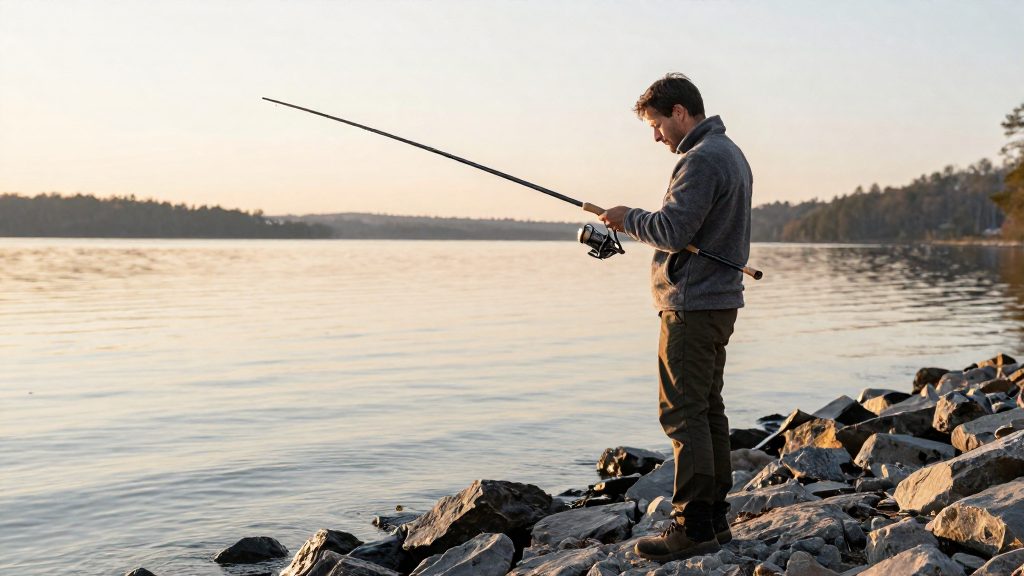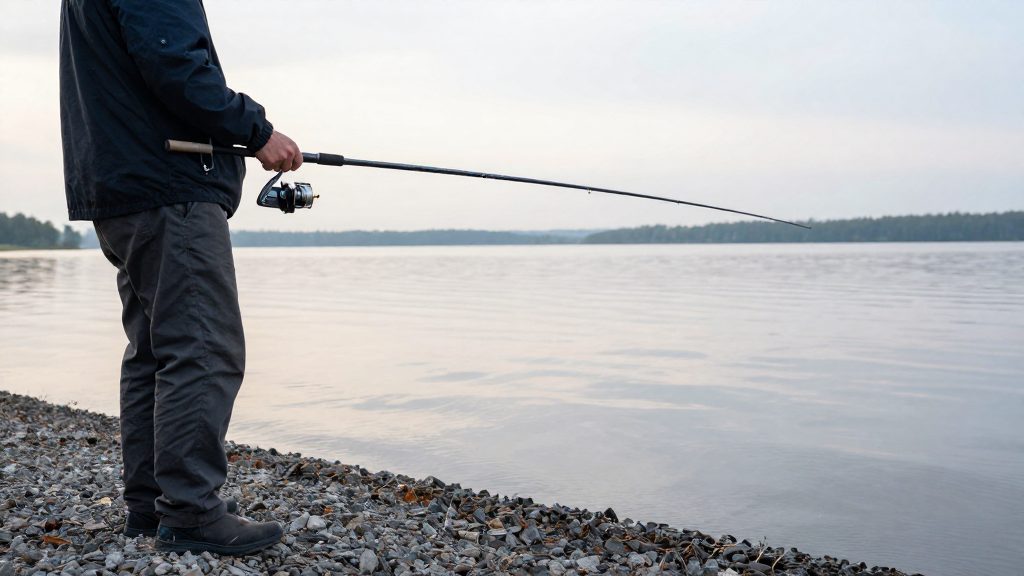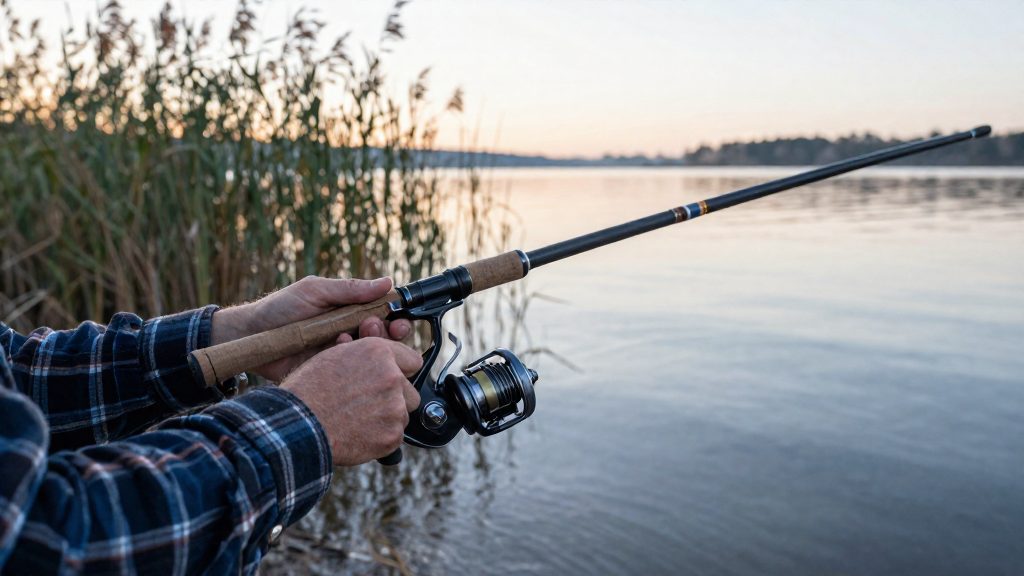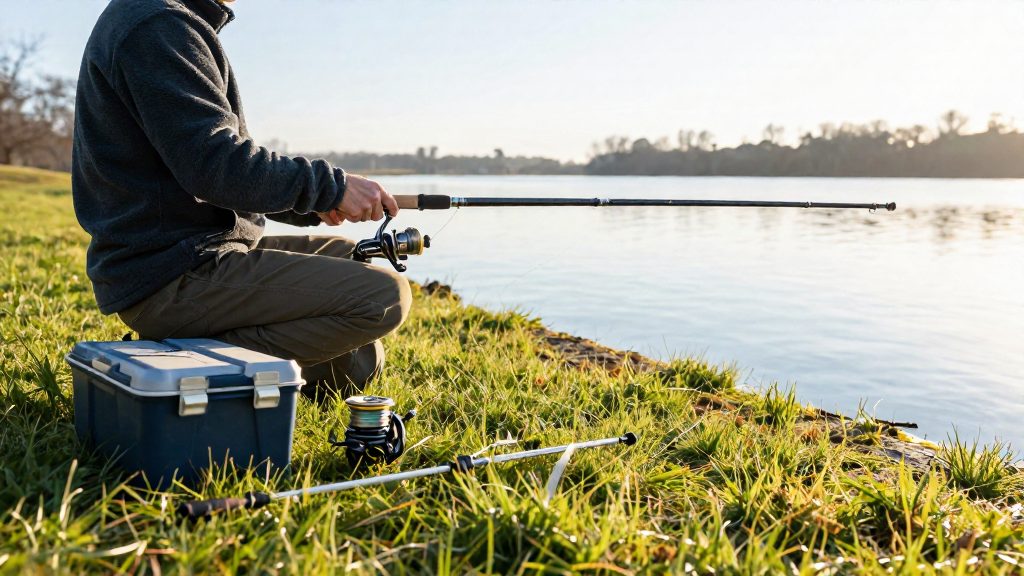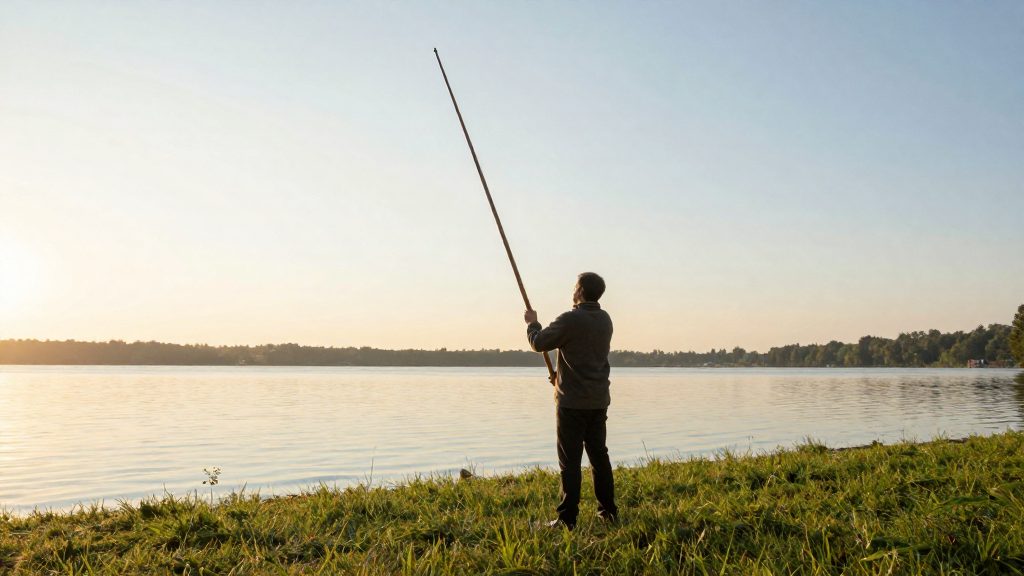
Rod length mainly changes three things: how far you can cast, how much leverage you have over a fish once it is hooked, and how precisely you can work a lure close to you. Longer rods favour casting distance and leverage, while shorter rods favour close control. Knowing which of these matters most on your water lets you judge length before you compare specific models.
Why does rod length matter?
Casting distance and hook-set range
Longer rods add casting distance. According to Daiwa (Scandinavia), they also help with hook sets at range, which makes them well suited to high banks, rocks and open shorelines, where you often need to put a lure well out from your position. On a narrow bank with a short cast, that extra reach offers little benefit.
Leverage when fighting fish
A longer rod gives you a longer lever against the fish’s weight and movement. SAIL (2024) notes that rods of 7’–7’6” help with longer casts and leverage when fighting a fish. Leverage helps when fighting a hooked fish, which is why SAIL links 7’–7’6” rods to it.
Control for finesse jig work
Shorter rods give more control for finesse jig fishing. SAIL (2024) lists 5’4” to 6’ for this style, where small, precise lure movements matter more than distance. For small, brushy streams, SAIL suggests 5’6” or 6’ for the same reason: tighter casting and tighter control near cover.
| Rod length | Main advantage | Typical use (per source) |
|---|---|---|
| 5’4”–6’ | More control | Finesse jig fishing; small, brushy streams (SAIL, 2024) |
| 7’–7’6” | Longer casts and leverage | Fighting fish; longer casting (SAIL, 2024) |
| Longer rods (no specific length given) | Distance and hook-set range at range | High banks, rocks and open shorelines (Daiwa (Scandinavia)) |
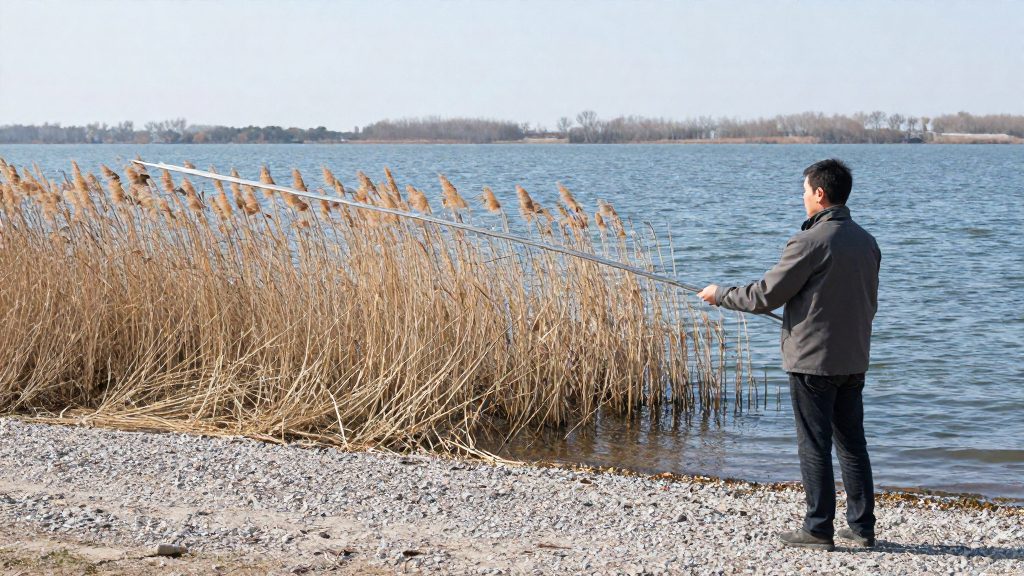
What rod length is best for beginners?
For most first-time anglers, a rod of about all-round length 7 to 8 feet (210 to 240 cm) is the most practical starting point. Daiwa describes this range as a very good all-round choice for most beginners (Daiwa (Scandinavia)). A single rod in this range can cover the general fishing a beginner does, so there is no need to buy several specialist rods at the start.
Why mid-range lengths work
A mid-range length balances three things: distance, control and handling. Within the 7 to 8 ft band, shorter rods generally give more control and longer rods more reach, so choose according to your spot.
Reference lengths compared
| Source | Recommendation | Length (feet) | Length (cm) |
|---|---|---|---|
| Daiwa (Scandinavia) | All-round rod for most beginners | 7 to 8 ft | 210 to 240 cm |
| SAIL (2024-03-22) | Beginner spinning rod, medium-light or medium power, fast action | 6’6” | about 198 cm |
| SAIL (2024-03-22) | Bass casting rods | 7’ to 7’11” | about 213 to 241 cm |
The SAIL spinning rod sits just below the Daiwa range, which shows that the exact figure depends on the type of rod and the fishing planned.
Converting rod labels to centimetres
Feet-to-centimetre conversion lets you compare rods sold with different units. Multiply the feet by 30.48, then add 2.54 cm for each inch:
- 7 ft = 7 × 30.48 = 213.4 cm
- 6’6” = (6 × 30.48) + (6 × 2.54) = 198.1 cm
- 7’6” = (7 × 30.48) + (6 × 2.54) = 228.6 cm
A rod labelled 7’6” is about 15 cm longer than a 7 ft rod, so check the centimetre figure on the product label or manufacturer’s listing before deciding.
How does fishing location change the choice?
Where you stand decides how much room your rod has to move, and that shifts the ideal length in one direction or the other. Shorter rods are easier to handle in tight spaces, such as a shore with trees behind you. The location factor works in both directions, so start by checking the bank before you check the rod.
| Fishing spot | Rod length direction | Why |
|---|---|---|
| High banks, rocks, open shorelines | Longer | More room behind and in front of you, and longer reach to the fish |
| Shore with trees behind you | Shorter | A long rod can strike branches on the backswing |
| Small, brushy streams | 5’6” or 6’ | SAIL (2024) suggests these lengths for this water type |
Open water gives you space to use a longer rod. High banks also raise your position, so a longer blank helps you reach the fish from above the water. Rocks and open shorelines have the same effect, because you can cast and work the lure without obstacles.
Tight spots are different. When trees, bushes or a wall sit directly behind you, a shorter rod keeps the tip from catching on cover during the backcast. Shorter rods are also easier to control in confined areas.
Small brushy streams combine both problems: the water is narrow and the banks are crowded with vegetation. SAIL (2024) suggests 5’6” or 6’ for these conditions, which is short enough to work between the cover and still allows accurate casts.
Rod length by fish: bass, trout, panfish, walleye
The SAIL chart (2024-03-22) gives a spinning rod length for each of four common freshwater targets. Panfish take the shortest rod at 6 ft 6 in, bass take 7 ft, and trout and walleye fall between 6 ft 6 in and 7 ft. These lengths sit at or just below the 7 to 8 ft (210 to 240 cm) all-round range: panfish at 6 ft 6 in is the shortest, and bass at 7 ft is at the bottom of that range.
| Target fish | Suggested spinning rod length (SAIL, 2024-03-22) |
|---|---|
| Panfish | 6 ft 6 in |
| Bass | 7 ft |
| Trout | 6 ft 6 in to 7 ft |
| Walleye | 6 ft 6 in to 7 ft |
Panfish: 6 ft 6 in, light power
The chart pairs the 6 ft 6 in length with light power for panfish. A light rod suits small fish and small baits, and it keeps the setup manageable over a full session.
Bass: 7 ft, medium-light to medium power
For bass, the chart suggests 7 ft with medium-light to medium power. The extra length over panfish gives a little more reach when you need to cast further.
Trout and walleye: 6 ft 6 in to 7 ft
Trout are matched to light to medium power across the same 6 ft 6 in to 7 ft span. Walleye are listed at 6 ft 6 in to 7 ft, and the chart does not specify a power rating for them, so check the power marking on the rod blank before buying.
Within each species range, a choice of 7 ft gives more reach, while 6 ft 6 in keeps the rod lighter to handle.
Choosing within the range
Move toward 7 ft when your spot allows open casting and you need extra reach. Keep the rod length you can comfortably control for the whole session.
Should kids use shorter rods?
Yes. SAIL (2024) suggests a length of 5 ft 4 in to 6 ft (about 163 to 183 cm) for children, which is shorter than the rods it recommends for adults. The main reason is control. A shorter rod is lighter in the hand and easier for a child to point, cast and keep steady, so they can concentrate on the fish and the line rather than on managing the rod.
Length should follow the child rather than a fixed age. Two children of the same age can differ by several inches in height, so the rod that suits one may be too long for the other. Use these checks when choosing:
| Check | What to look for |
|---|---|
| Height | The rod should sit comfortably at the child’s side when held upright, with the tip not far above their head. |
| Grip | The child should hold the cork handle with a relaxed hand and reach the reel without stretching. |
| Reel position | The reel should sit where the child can turn the handle smoothly without changing their grip. |
| Casting space | A rod that is easy to swing in open ground may need shortening when fishing near bushes or a bank with overhanging trees. |
Shorter rods are practical for small waters and for younger anglers who fish close to cover.
Ask the child to make a few smooth casting motions and wind in. If the rod feels heavy or the tip drifts well above their head, a shorter length is probably the better fit.
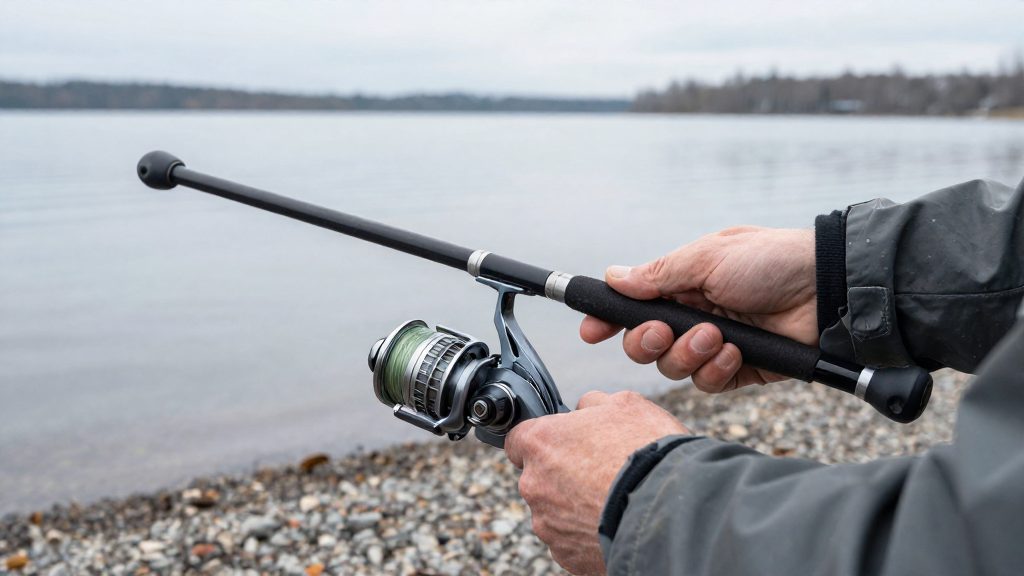
Does rod length match power and action?
Length alone does not define a beginner spinning rod. SAIL (2024) pairs length with a power rating and an action rating, and its beginner recommendation combines all three: about 6’6” in medium-light or medium power with fast action. Reading these markings together, rather than choosing by length, keeps the rod matched to the fish and lures you plan to use.
Power describes how much force the blank needs before it bends, from light to medium and above. Action describes where along the blank the bend happens. Both labels usually appear alongside the length on the rod or its packaging.
What SAIL’s chart pairs with each target
| Target fish | Length (SAIL, 2024) | Power (SAIL, 2024) |
|---|---|---|
| Beginner, general use | 6’6” | Medium-light or medium, fast action |
| Panfish | 6’6” | Light |
| Bass (spinning) | 7’ | Medium-light to medium |
| Trout | 6’6” to 7’ | Light to medium |
SAIL’s chart also lists 6’6” to 7’ for walleye, without a power rating in the same entry. For children, SAIL suggests lengths of 5’4” to 6’. For finesse jig fishing, the same chart points to 5’4” to 6’ for more control.
Reading the labels together before buying
- Start from your target fish. Use the length range and power band that match it in the table above.
- Check that the power label sits inside that band. A rod marked light suits panfish and trout, while a medium-light or medium rating fits the bass and beginner pairings.
- Check the action label. SAIL’s beginner pairing uses fast action.
- Compare the lure weight range printed by the manufacturer with the lures you intend to cast. A rod outside that range will feel wrong even if its length and power look correct.
- If a marking is missing or unclear, check the manufacturer’s instructions or contact the retailer before purchase.
Spinning rod or casting rod?
The two main formats differ in where the reel sits on the rod. A spinning reel hangs below the rod blank, while a baitcasting reel sits on top of it. That position changes how the rod feels in your hand and which length range suits the setup.
| Format | Reel position | Length range cited | Source |
|---|---|---|---|
| Spinning | Hangs below the rod blank | SAIL’s chart lists 6’6” to 7’ for spinning rods by target fish | SAIL (2024) |
| Spinning, longer end | Hangs below the rod blank | 7’ to 7’6” for longer casts and leverage when fighting a fish | SAIL (2024) |
| Bass casting | Sits on top of the rod blank | 7’ to 7’11” | SAIL (2024) |
SAIL’s beginner recommendation is a spinning rod of about 6’6” in medium-light or medium power with fast action.
Casting rods in the bass category run longer and are built around a baitcasting reel on top of the blank. SAIL’s chart lists 7’ to 7’11” for bass casting rods.
The choice comes down to where you fish and how much control you want:
- Spinning: the reel below the blank is easier to learn with, and the 7 to 8 ft range covers most shore situations.
- Casting: SAIL’s chart lists 7’ to 7’11” for bass casting rods, which use a reel on top of the blank.
Test before you buy
Handling a rod in a shop is the simplest check on whether its length suits you. SAIL recommends trying a rod and reel combo in store (SAIL, 2024-03-22), because a rod that looks right on the rack can feel wrong once it is in your hands. Pick up the length you have shortlisted.
Try a rod and reel combo in store
Test the rod with the reel you plan to use, not on its own, because the reel changes how the setup feels. Ask staff whether you can make a few casting motions with the rod, or at least a slow overhead movement with no lure attached. If the shop does not allow this, hold the rod in the position you would use to cast and check how far it reaches before it feels awkward in a confined space.
Check balance with the reel mounted
With the reel fitted to the reel seat, rest the rod on one finger or hold it by the handle where your hand would naturally sit. Note whether the rod sits level, tips toward the tip section or tilts toward the handle. A rod that feels heavy at the tip tends to tire the wrist during long sessions, while one that balances near the reel seat is easier to hold steady when you fish.
Handle the rod for comfort over a full grip
Wrap your fingers fully around the cork handle in your normal fishing grip and check that the handle fits your hand without pressing into the palm. Then hold the rod out in front of you for a few minutes, as you would while waiting for a bite. If your forearm or wrist starts to ache quickly, the length or weight is probably not right for you, even if the rod looked suitable on the shelf.
Frequently asked questions
What length should a complete beginner buy first?
Daiwa (Scandinavia) describes a rod of about 7 to 8 feet (210 to 240 cm) as a very good all-round choice for most beginners. SAIL (2024) points to a spinning rod of about 6’6” in medium-light or medium power with a fast action as a starting point.
Is a shorter rod a better choice if I fish from a narrow bank?
Often, yes. Daiwa (Scandinavia) notes that shorter rods are easier to handle where there are trees or obstacles directly behind you, such as on a narrow shore. For children, SAIL (2024) suggests lengths of 5’4” to 6’.
Does the species I target change the rod length?
It can. SAIL (2024) lists 6’6” for panfish with light power, 7’ for bass in medium-light to medium power, and 6’6” to 7’ for trout in light to medium power. For bass casting rods, SAIL gives 7’ to 7’11”. Check the power rating printed on the rod blank, since it matters as much as length for the fish you expect.