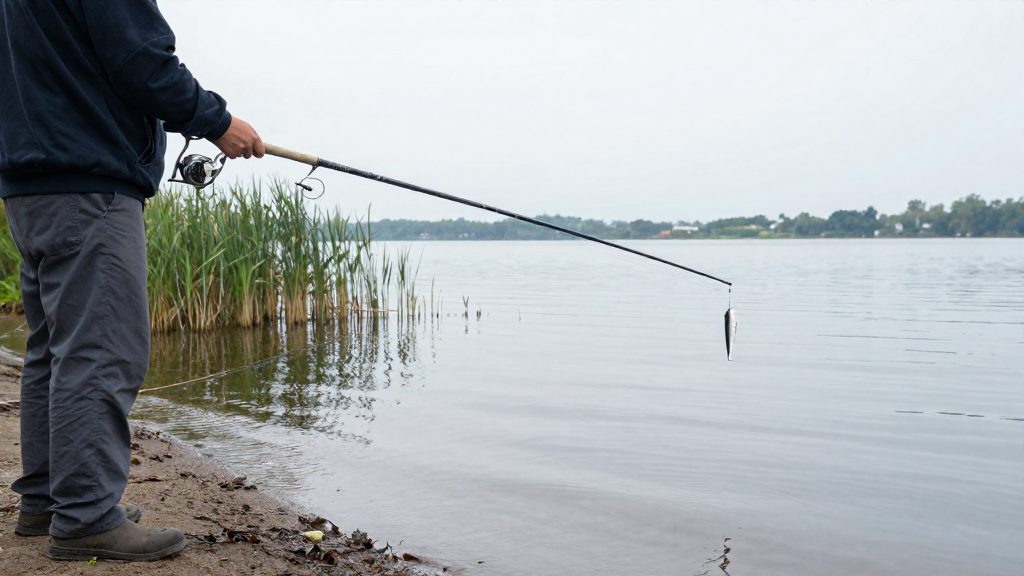
How to Catch Pike With Spoon Lures From the Bank
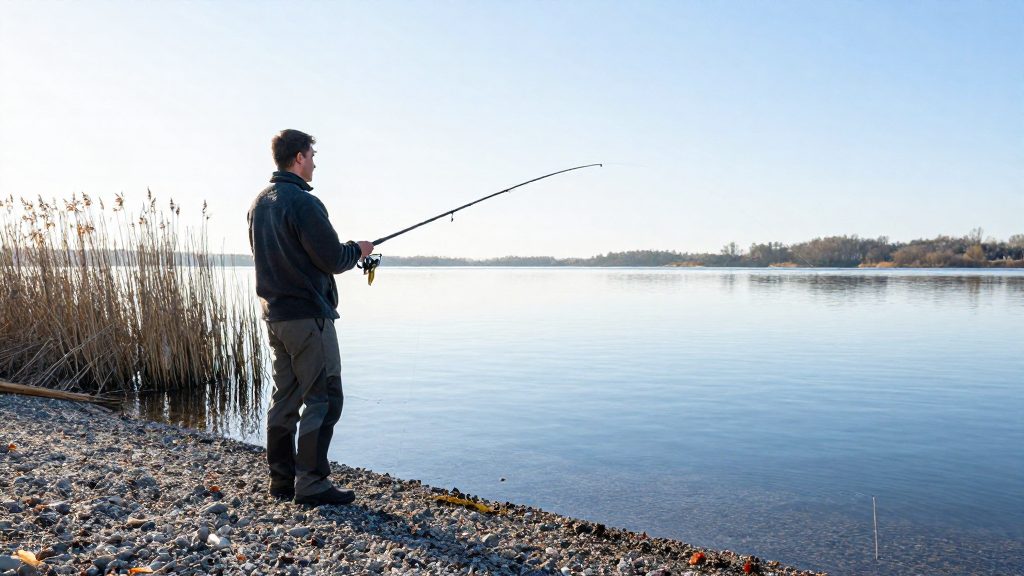
Pike strike spoons because a moving metal blade produces flash and vibration, which can attract a predator from a distance. Pike are ambush feeders that often hold near shallow shoreline edges, such as weed beds, reed lines and cabbage, especially early in the season, and a spoon cast from the bank can reach that zone and move through it. The strike is a feeding reaction to a bright, erratic object that resembles a prey fish.
Why Spoons Work for Pike From Shore
Flash and vibration as strike triggers
A spoon is a curved metal blade. As it moves, it reflects light in bursts and sets up vibration in the water. Both signals stand out against the natural background, so a pike can notice the lure even when it is some distance away.
Ambush behaviour along shallow edges
Pike wait at the boundary between cover and open water, where they can strike prey that passes. Outdoor Canada (2015) describes a Williams Whitefish with a single hook and a white curly-tail grub fished along the deepest cabbage edges, and says it works from ice-out through summer into early autumn.
Why spoons suit long bank casts
A spoon’s compact metal body carries well on a cast, so it can reach an edge from the bank without wading. This lets the angler place the lure beyond the fish and bring it back across the edge zone. The same cast can cover several spots along the shoreline in a short time, which makes spoons practical for fishing from land.
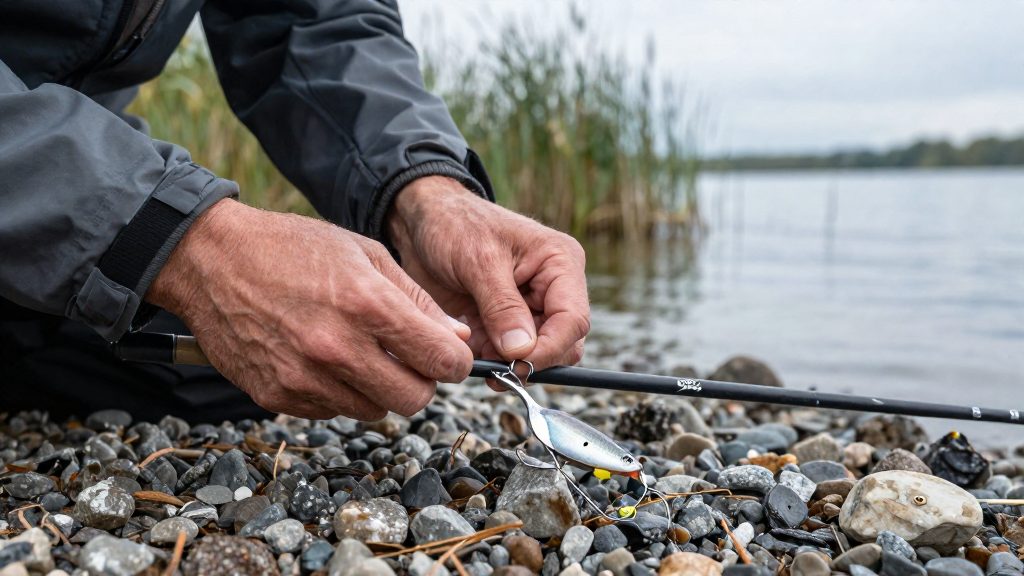
Which Spoon Should You Choose?
Pike spoons differ mainly in body shape, which decides how they move through the water and where they work best. Choose the body first, then the weight, then the finish for the water you are fishing that day.
Body Shapes at a Glance
| Body type | Example models | Where it suits |
|---|---|---|
| Wide-body wobbler | Dardevle, Five of Diamonds | Slow to medium retrieves over 3–8 ft shallows |
| Narrow S-curve | Syclops, Kastmaster | Fast retrieves |
| Single-hook weedless | Johnson Silver Minnow | Dense cabbage and reeds |
Wide-body spoons wobble with a broad action, which suits slow to medium retrieves over shallows. The narrow S-curve profile is built for faster movement. The weedless design exists for cover that would snag a standard spoon, so pick it when weed is the main obstacle.
Weight and Size by Pike Size
Most pike spoons fall between 3/4 and 1-1/8 oz, according to Cobham River Lodge (2026-06-10). For trophy pike over 40 in, the same source extends the upper end to 1-1/4 oz and recommends a length of 4–6 in. Heavier spoons reach deeper water and carry further on the cast, so step up in weight when you are fishing wind or deeper channels. Keep the spoon size proportional to the fish you are targeting.
Choosing the Finish
The finish of the spoon controls how much light it reflects, so match it to the water:
| Water condition | Finish |
|---|---|
| Tea-stained water | Copper or brass |
| Clear water | Silver or gold |
| Bright, high sun | Yellow-and-black contrast |
The same source gives these pairings. In tea-stained water, the duller metallic tones blend with the colour of the water. In clear water, bright silver or gold stands out. Under high sun, the yellow-and-black contrast stays visible.
Rod, Line and Leader Setup
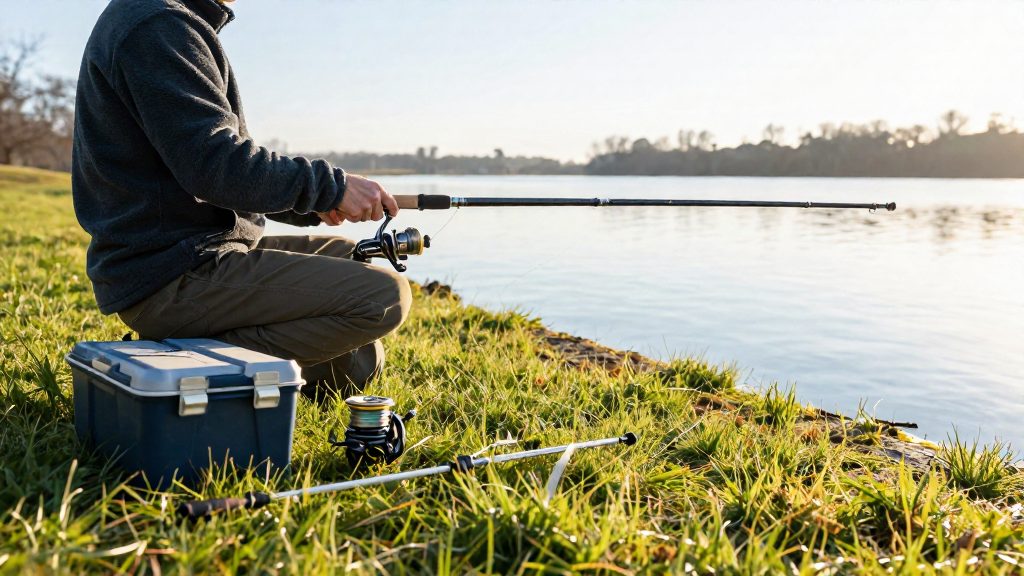
A practical setup for heavy spoons cast from the bank combines a medium-heavy baitcasting rod of 7.5 to 9 ft, 40 to 50 lb braid as the main line, a ball-bearing swivel, and a one-foot fluorocarbon leader of 80 lb. According to Outdoor Canada (2015), this is the suggested gear for spoon fishing pike. Each part has a separate job: the rod provides the power to cast and work a heavier spoon, the braid carries the load, the swivel manages line twist, and the leader sits between the swivel and the spoon. Matching these parts to one another matters as much as the choice of any single item.
Rod Power and Action
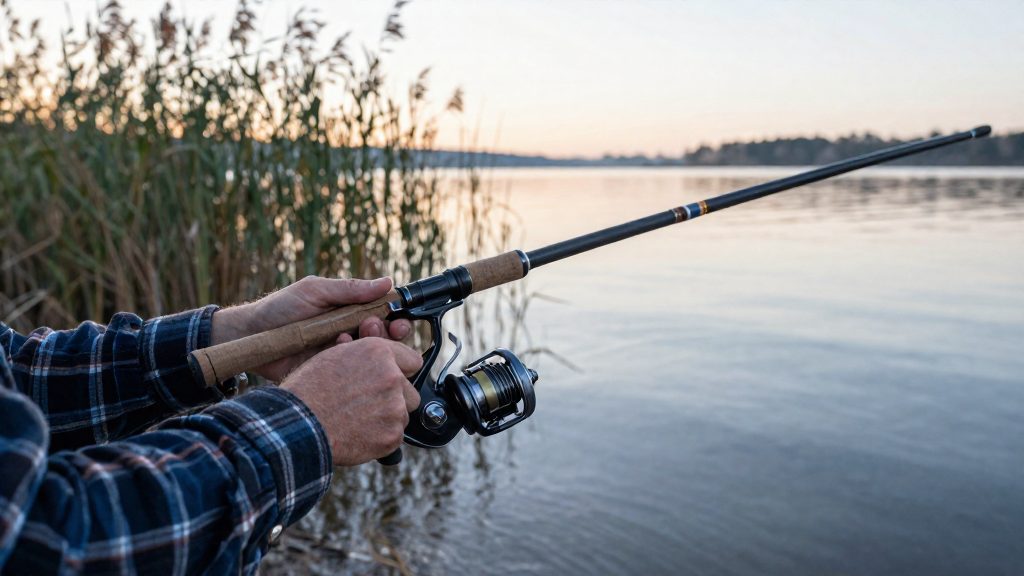
The rod is the starting point. The suggested rod is a medium-heavy baitcasting model between 7.5 and 9 ft long. The longer end of that range adds casting distance from the shore, while the shorter end gives more control when you work the spoon close to cover. Power and action ratings are printed on most rods, so check the manufacturer’s label before buying and confirm the rod is rated for lures in the weight range you plan to use.
Main Line: Braid
Braid in the 40 to 50 lb class is the main line recommended for this type of fishing. Braid has very little stretch, so bites transmit directly to the rod tip. Outdoor Canada (2015) notes that braid can be cut if it tangles in weeds.
Ball-Bearing Swivel
Cobham River Lodge (2026) recommends tying the main line to a ball-bearing swivel rather than directly to a split ring. The swivel reduces line twist, which builds up during retrieves and pauses. Tie the braid to the swivel’s eye, then attach the leader to the swivel’s other end.
Leader
The suggested leader is one foot long and made of 80 lb fluorocarbon. The leader sits at the spoon end of the rig because fluorocarbon at 80 lb resists pike teeth and abrasion where the line is most exposed.
| Component | Suggested specification | Source |
|---|---|---|
| Rod | Medium-heavy baitcasting, 7.5–9 ft | Outdoor Canada (2015) |
| Main line | Braid, 40–50 lb | Outdoor Canada (2015) |
| Connection | Ball-bearing swivel, tied to the main line | Cobham River Lodge (2026) |
| Leader | Fluorocarbon, 80 lb, about 1 ft | Outdoor Canada (2015) |
Where to Cast From the Bank
Pike from the shoreline usually sit where cover meets open water, so the first task is to find that boundary and then set your cast so the spoon runs along it. Three features do most of the work: weed edges, drop-offs and shallow shelves. Once you have identified one, the angle of your cast decides how long the spoon stays in the strike zone.
| Feature | Where to cast | Why it holds fish |
|---|---|---|
| Outer edge of cabbage beds | Along the deepest edge of the weed, not into the middle | Pike hold where cabbage meets open water |
| Shallow shelf, about 3–8 ft | Along the shelf, at a slow to medium retrieve | Shallow lip above the drop-off |
| Drop-off from shallow to deep | Across the step, so the spoon passes from one depth to the other | Predators wait at the change in depth to intercept baitfish moving between zones |
Weed edges
Look for the outside margin of a weed bed, where the cabbage ends and open water begins. Pike rarely sit in the thickest weed, so casting into the centre wastes time. Work the line along the margin instead.
Drop-offs and shallow shelves
On a bank that steps down, the shelf is the shallow lip above the drop. Cast so the spoon crosses the step rather than staying on one level.
Casting parallel to the shoreline
A cast thrown straight out at right angles to the bank crosses a feature in a single pass and then leaves it. Casting parallel to the shoreline, or at a shallow angle to it, keeps the spoon in the same depth band for the whole retrieve. This gives a pike more chances to strike along one edge.
Reading wind for bank position
Wind can push surface water and baitfish toward the shore it blows onto. Before you walk the bank, note the wind direction and consider trying the downwind shore, where food may collect. Confirm by watching where fish follow or strike, and move if the wind shifts. If the wind is blowing onto a weed line or a shelf, start your casting there. Confirm by watching where fish follow or strike, and move if the wind shifts.
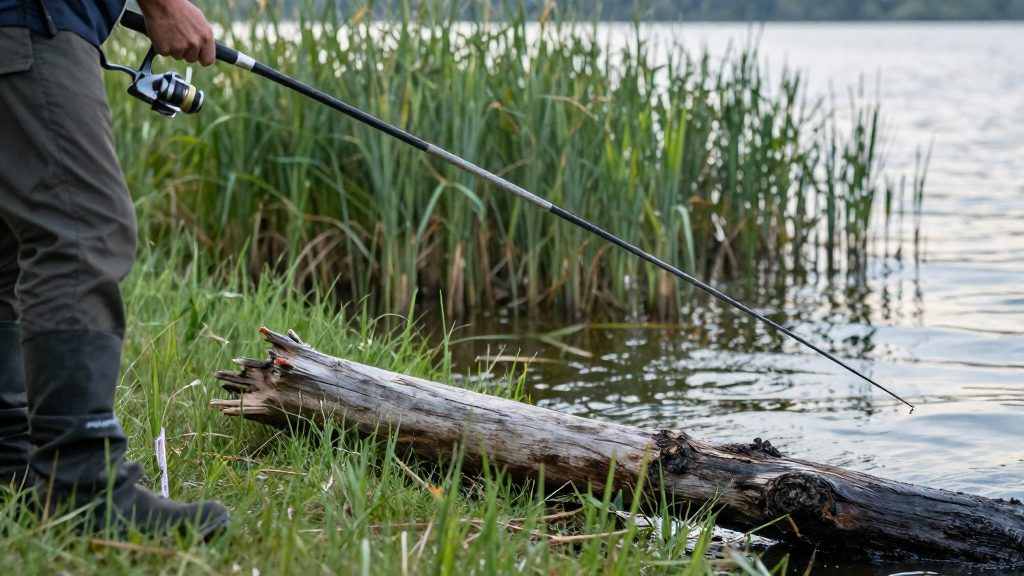
How Do You Retrieve a Spoon for Pike?
The retrieve decides how a spoon moves through the water, and for pike the most useful pattern is the stall-and-flutter. According to Cobham River Lodge (2026), this sequence works well: cast, crank the spoon 4–5 ft, pause so it flutters down, then snap the rod. The same source notes that most trophy bites come on the pause, so the fall is where the retrieve earns its strikes.
Matching Speed to Spoon Type
Spoon shape sets the pace. Wobblers reward a steady, unhurried crank that keeps their wide body working. Narrow S-curve spoons hold their action at speed, so they suit a brisk retrieve with short pauses between sections of the crank.
The Stall-and-Flutter Sequence
- Cast beyond the target and let the spoon reach a steady depth.
- Crank 4–5 ft to build the spoon’s action.
- Stall by stopping the reel, so the spoon drops and flutters.
- Snap the rod tip upward to lift the spoon, then resume cranking or let it fall again.
Reading Strikes on the Fall
The pause is the moment to pay attention. Keep the line under light tension while the spoon flutters, and watch the line and rod tip for any change: a stop, a sideways movement, or unexpected weight. Treat any change as a possible strike and reel down firmly into it before lifting the rod.
Avoiding Snags and Weeds
Pike spoons snag most often in dense cabbage, reeds and submerged weed beds. Hook choice, dressing and retrieve path each address a different snag source, so they can be combined.
Single Siwash Hook with a Crushed Barb
Stock spoons carry a treble hook, which catches on every stem it passes. Cobham River Lodge (2026) suggests swapping the treble for a single siwash hook with the barb crushed.
Williams Whitefish with Grub Dressing
Outdoor Canada (Gord Pyzer, 2015) describes a Williams Whitefish with its treble replaced by a single hook dressed with a white curly-tail grub.
Keeping the Spoon Above the Weed Tops
The weed-top retrieve keeps the spoon above the stems rather than dragging it through them. Outdoor Canada (Gord Pyzer, 2015) advises keeping the Whitefish moving briskly just above the weed tops. When the lure fouls, pop the rod sharply to shed the weed before reeling on.
Handling and Releasing Pike Safely
Safe handling of pike caught from the shore comes down to three things: keeping the fish in the water as much as possible, supporting its body properly, and getting the hook out quickly. Pike have sharp, backward-pointing teeth and a strong, muscular body, so protecting both the angler and the fish means controlling the head and body from the start. Check your state fish and wildlife agency’s regulations for licence, size and bag limits before you keep or release any fish.
Unhooking with Long-Nosed Pliers
Unhook the pike while it is still in the water, if the spoon and the fish allow it. Lower the rod tip so the line goes slack, then use long-nosed pliers to grip the hook shank, and keep your fingers out of the mouth and away from the gills. Turn the hook back along the path it entered the mouth. Pliers keep your fingers away from the teeth, which is the main hazard during unhooking. If the hook is deeply set or the fish is thrashing, cut the line close to the hook rather than pulling the mouth open or tearing the flesh.
Keep a pair of pliers and a hook-removal tool in your pocket, not in a bag you have to open on the bank.
Supporting the Pike Horizontally
Once the fish is out of the water, support it along its full length. Place one hand under the belly just behind the pectoral fins, and the other under the body near the tail, without gripping the jaw or gills. Keep the body horizontal and avoid letting the tail drop, since an unsupported body can bend and put strain on the spine.
Wet your hands or a glove before touching the fish. Dry hands remove the protective slime layer from the skin. Keep the fish close to the ground and hold it low so that a sudden flick does not send it off the bank.
Minimising Time Out of Water
Plan the release before you lift the fish. Have the pliers, camera and any measuring tool ready so the fish is out of water only for the time needed to unhook it.
- Keep the fish in the water, in a wet rubberised landing net, while you work, and lift it only for the quick photo.
- Take any photo quickly, with the fish supported, then return it.
- Release the fish facing into the current or gently moving water, holding it upright and moving it slowly back and forth until it swims away under its own power.
Avoid holding the fish up for a long photo session. The less time it spends in air, the better its chances of recovering after release.
Frequently asked questions
Which spoon weight should a beginner start with for pike from the bank?
Cobham River Lodge (2026) recommends spoons of about 3/4 to 1-1/8 oz for pike. For fish over 40 in, it suggests a slightly heavier spoon of 3/4 to 1-1/4 oz, measuring 4–6 in long.
How do I choose a spoon finish for the water I’m fishing?
Match the finish to water clarity. Copper or brass suits tea-stained water, silver or gold suits clear water, and yellow-and-black contrast suits bright, high sun.
How do I work a spoon so it triggers a strike?
Cast, then crank the reel about 4–5 ft before pausing so the spoon flutters down. Snap the rod after the pause, since Cobham River Lodge (2026) notes that the pause is where many trophy bites occur.