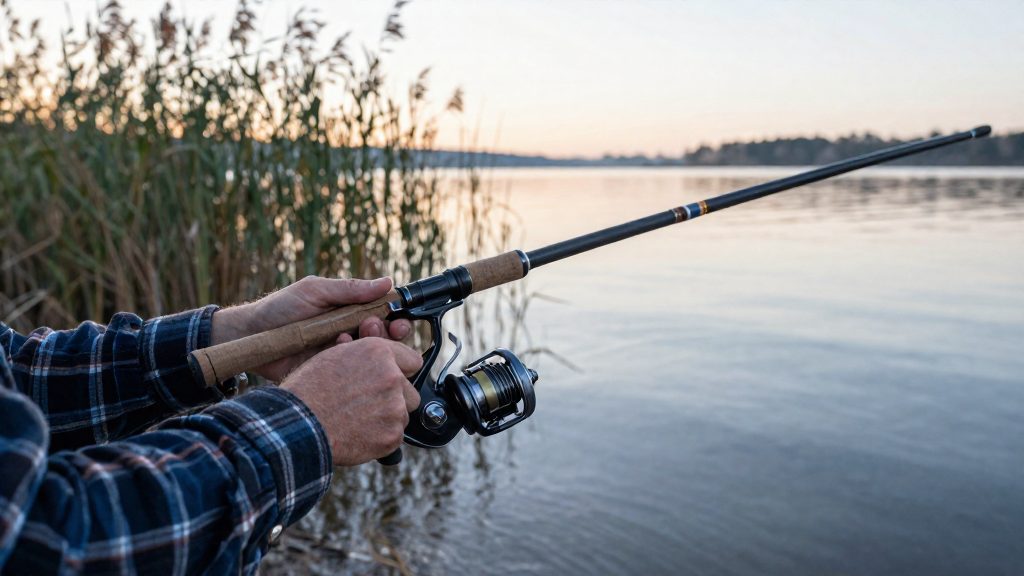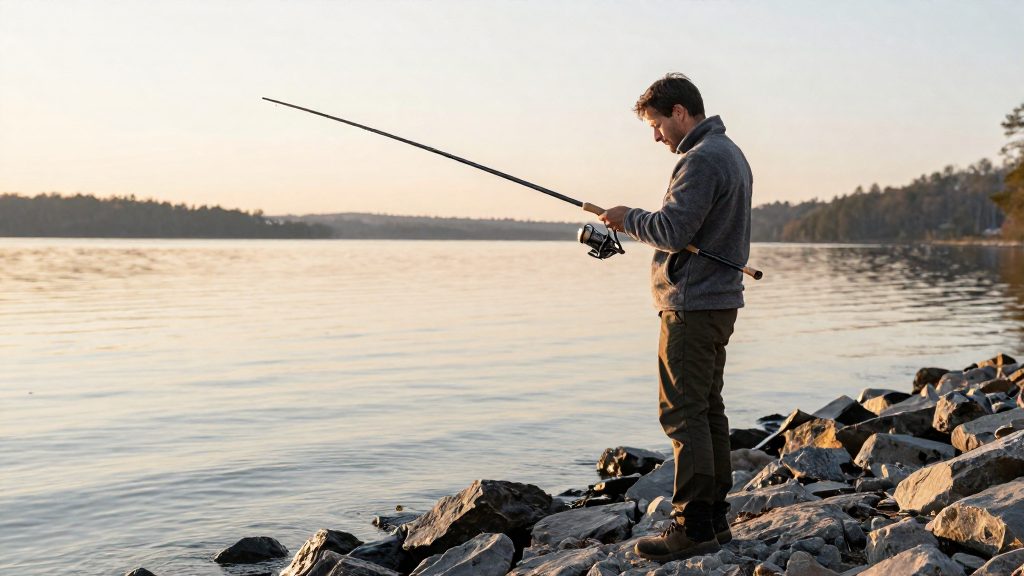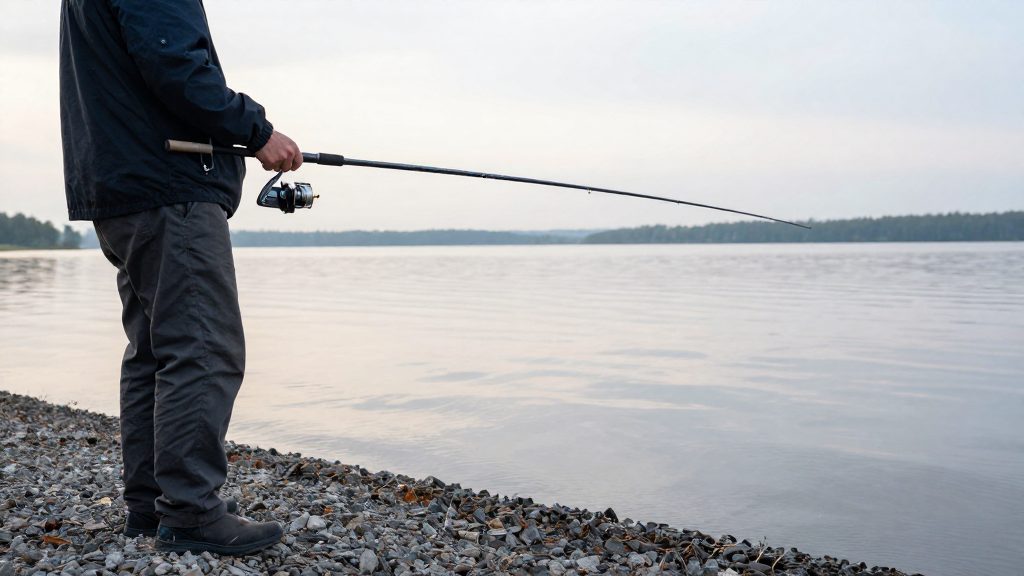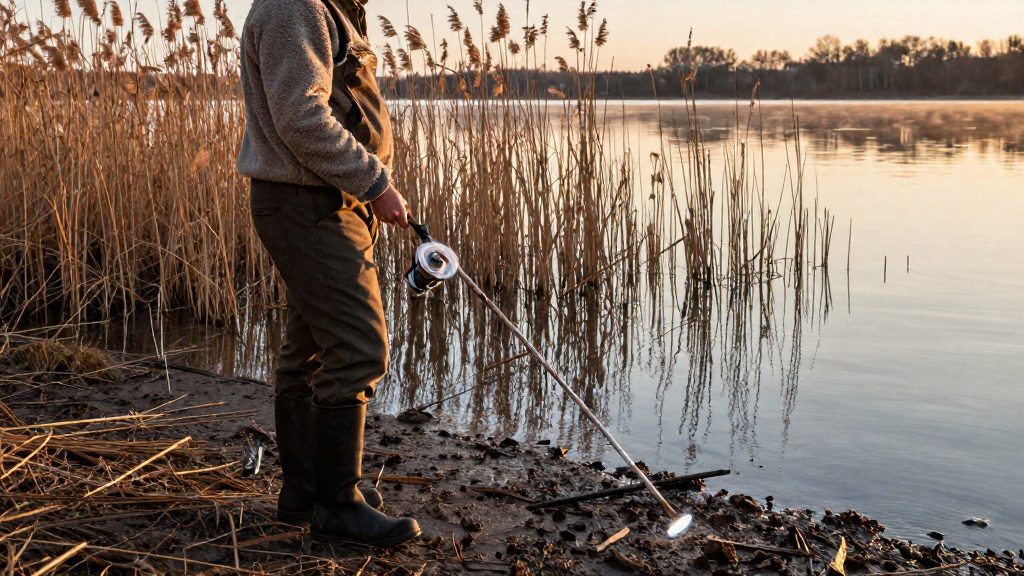
For bank crappie, FishUSA places crappie reels in the 500 to 2500 range and names the 1000 as the most popular all-around choice. For bank fishing specifically, FishUSA recommends a 2000 to 3000 spinning reel, and the 2000 also appears in the Mystery Tackle Box crappie pairing. Choose the size by how you fish, such as short-range jigging or longer casts from shore, rather than by brand name.
What reel size is best for bank crappie?
How the size numbers work
Reel sizes are model numbers, not measurements of the reel. Model numbers differ between manufacturers, but a smaller number means a smaller reel (Mystery Tackle Box, 2021-12-16). Compare sizes within one brand’s range, and check the manufacturer’s listing for spool capacity before you buy.
Matching the size to your fishing
| Size | Use described in the sources | Source |
|---|---|---|
| 500 | Short ultralight jigging and casting rods | FishUSA |
| 1000 | Most popular all-around choice; small panfish on ultralight setups | FishUSA; Mystery Tackle Box (2021-12-16) |
| 2000 | Crappie and white bass (Mystery Tackle Box); within FishUSA’s 2000 to 3000 bank range | FishUSA; Mystery Tackle Box (2021-12-16) |
| 2500 | Holds more line for longer rods; dock shooting | FishUSA; Mystery Tackle Box (2021-12-16) |
Where the bank recommendation goes beyond 2500
FishUSA’s bank recommendation runs up to 3000, which is above the 2500 ceiling of its general crappie range. If you regularly cast well past the edge of the water, the upper end of the bank range gives you more line capacity. For short, close casts and vertical jigging, a 1000 keeps the reel lighter.
Checks before buying
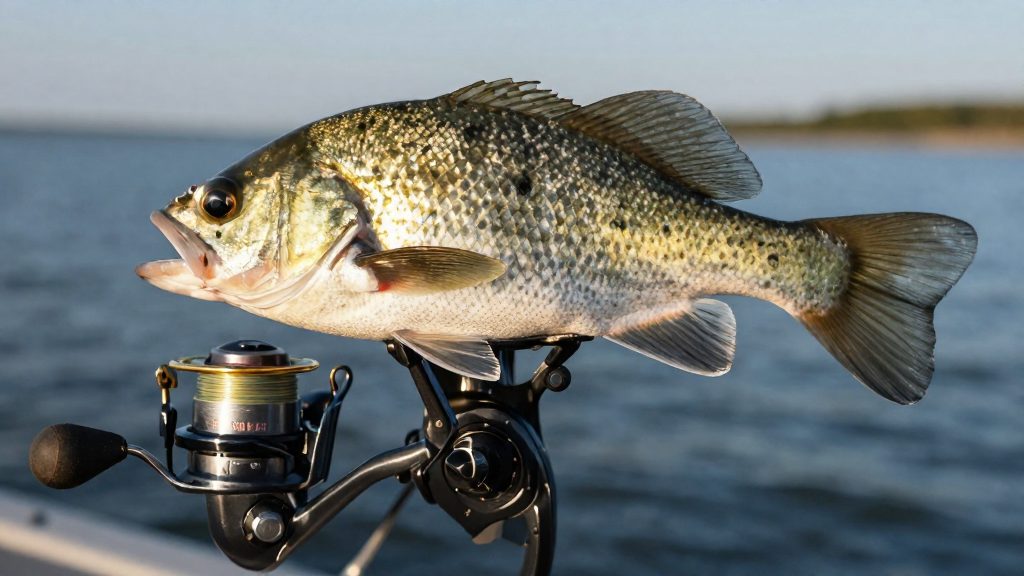
Why 2000 suits bank crappie
The 2000 size is the most practical starting point for bank crappie because it covers the main jobs an angler faces from shore.
Line capacity for longer casts and varied jigging
Bank anglers rarely fish a single distance. A 2000 spool carries enough line for longer casts toward cover or structure, and it still handles short, close-range jigging when fish are near the bank.
Spool size for mixed bank and dock sessions
Mystery Tackle Box uses a 2000 reel for crappie and white bass, but matches a 2500 to dock shooting with 6-pound line on a 7-foot light rod. A 2000 covers common bank-side work, while Mystery Tackle Box matches the larger 2500 to dock shooting.
Body weight over long sessions
A 2000 is generally a little heavier than a 1000, so check that it feels balanced on a 6- to 7-foot light rod through a full session of casting and jigging. Check the weight in person if you can, and hold the rod with the reel attached for several minutes to judge comfort.
Matching reel size to rod length
For bank crappie, pair a spinning reel size of 2000 to 3000 with a 6- to 7-foot light or ultralight rod, according to FishUSA. The reel’s job is to hold enough line for the rod’s casting range, and FishUSA notes that larger reels (2000 and 2500) hold more line for longer rods. FishUSA notes that 500 and 1000 reels suit short ultralight jigging and casting rods, while 2000 and 2500 reels hold more line for longer rods.
The table below shows how rod length, reel size and typical use line up across the sources:
| Rod length | Reel size | Typical use (source) |
|---|---|---|
| 6 to 7 ft, light or ultralight | 2000 to 3000 | Bank crappie (FishUSA) |
| 6 to 6.5 ft, light or medium-light | 2000 (listed as “20”) | Crappie and white bass (Mystery Tackle Box, 2021-12-16) |
| 8 ft | Not specified | Very long casts from shore (FishUSA) |
For the 8-foot rod, FishUSA recommends it only when you need distance from the bank. Check that the reel you choose has enough line capacity for the extra length, and confirm the figure against the manufacturer’s label.
Does a 1000 or 2500 reel make more sense?
For general crappie fishing, the 1000 is the most popular all-around size, but for the bank FishUSA recommends 2000 to 3000, so the 1000 is best kept for close-range, light work. FishUSA identifies it as the most popular all-around crappie reel size, and it pairs with the short, light rods used for close-range jigging and casting. The 2500 makes more sense when you need to cast farther or fish from a longer rod. Both sizes fall within the 500 to 2500 range FishUSA recommends for crappie reels, so the choice depends on how far you need to reach and which rod you plan to use.
| Factor | 1000 | 2500 |
|---|---|---|
| Typical role | Most popular all-around size | Suited to dock shooting and longer casts |
| Rod pairing | Short ultralight jigging and casting rods | Longer rods, such as a 7-foot light rod |
| Line capacity | Less line than 2000 and 2500 models | Holds more line than 500 and 1000 models |
| Example setup (Mystery Tackle Box, 2021-12-16) | 4.5- to 5.5-foot ultralight rod with 2- to 4-pound mono | 7-foot light rod with 6-pound line for dock shooting |
Choose the 1000 when you fish close to the bank, work jigs vertically, or prefer a light rod that is easy to hold for long sessions. Mystery Tackle Box recommends this size for small panfish on 2- to 4-pound mono, which suits fish that are not pulling hard and casts that stay short.
Choose the 2500 when you need distance. Mystery Tackle Box pairs it with a 7-foot light rod and 6-pound line for dock shooting, where you cast out past the structure and retrieve across open water. The larger spool holds more line, which helps when a fish runs far or when you need a longer cast. FishUSA notes that an 8-foot rod can help with very long casts from shore, but it does not specify a reel size for that rod.
Best line and leader for shore casting
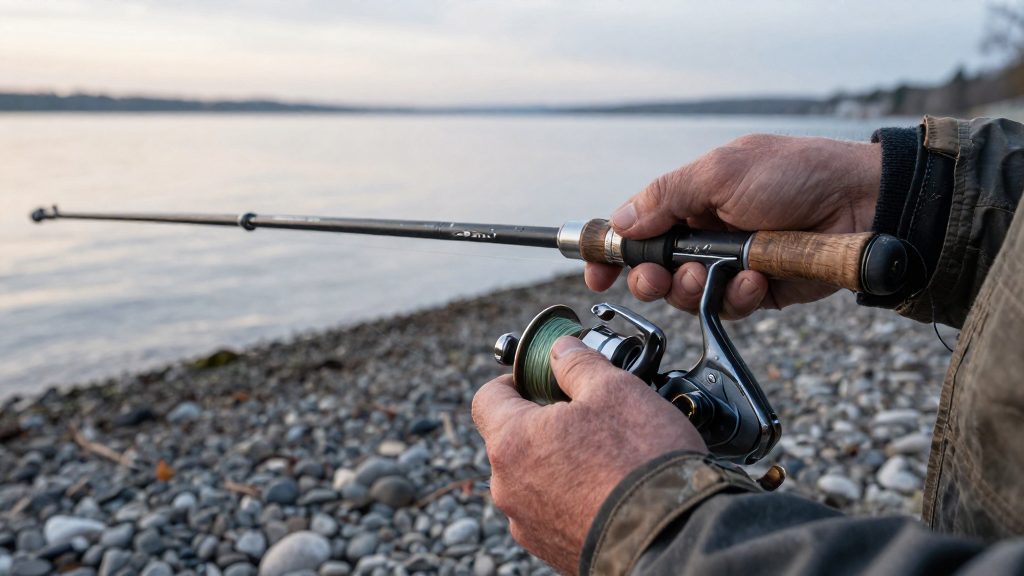
For bank crappie, FishUSA recommends a small-diameter braided main line tied to a 2- to 6-pound mono or fluorocarbon leader. The braid carries the cast and the strike, and the lighter leader sits at the lure or hook end, where crappie can see it. Mystery Tackle Box (2021-12-16) pairs a 2000-size reel with 4- to 8-pound line on a 6- to 6.5-foot light or medium-light rod for crappie and white bass.
Main line: small-diameter braid
Braid has very little stretch and a thin diameter for its strength, which is why FishUSA specifies a small-diameter braid for shore casting. FishUSA specifies small-diameter braid for this setup, so choose a braid labelled as fine or light rather than a heavy-duty saltwater or pike braid.
Leader: 2 to 6 pound mono or fluorocarbon
The leader is the section of line tied between the braid and the lure. Crappie are line-shy in clear water, so a lighter leader is less visible. FishUSA lists monofilament and fluorocarbon as the two suitable materials. Monofilament is more forgiving and easier to handle, while fluorocarbon sinks faster and is less visible underwater.
Line rating on 2000 class reels
Mystery Tackle Box (2021-12-16) gives 4- to 8-pound line as the range for a 2000 reel. Compare this with FishUSA’s general crappie range of 2 to 6 pounds: the two ranges overlap at 4 to 6 pounds, and the Mystery Tackle Box range extends up to 8 pounds.
| Component | Recommended specification | Source |
|---|---|---|
| Main line | Small-diameter braid | FishUSA |
| Leader | 2 to 6 lb mono or fluorocarbon | FishUSA |
| Line for 2000 class reel | 4 to 8 lb | Mystery Tackle Box (2021-12-16) |
Gear ratio and spool-fill tips
FishUSA recommends a gear ratio of about 5.0:1 to 6.2:1 for crappie reels. The ratio tells you how many times the spool turns for each full turn of the handle. A ratio near 5.0:1 retrieves line more slowly, which gives you more control when you work a jig with small, deliberate movements. A ratio near 6.2:1 brings line in faster, which helps when you need to take up slack quickly or keep a lure moving steadily on the retrieve. The ratio sets how fast the line comes in, not how much line the reel holds. Line capacity depends on spool size.
Filling the spool correctly
FishUSA advises filling the spool to just below the spool lip. Stopping there leaves room at the edge of the spool, where overfilled line is more likely to spring off during the cast and form loops or wind knots.
| Step | What to do |
|---|---|
| 1 | Tie the line to the spool arbor with a secure knot. |
| 2 | Wind while keeping steady tension, so the line lays flat and even. |
| 3 | Stop when the line sits just below the lip. |
| 4 | Check the level and the evenness of the wraps before you cast. |
Preventing loops and wind knots while casting
Loops usually form when line comes off the spool faster than the lure carries it, so keep your thumb lightly on the line as the lure lands. Hold the rod at a steady angle during the cast and avoid letting the spool free-spin with no line control. Check the line after each few casts for twists or loose coils, and clear them before they tighten into a knot.
How do you set up a bank crappie rig?
For the rig, use the braided main line and 2- to 6-pound mono or fluorocarbon leader described above. The main line runs from the reel, and the leader carries the terminal tackle, so the connection between the two is where most setups fail. Tie each knot fully and check it before moving to the next step.
Joining braid to the leader
Braid is smooth and slips against many knots, so the join needs a knot that grips both materials, such as the double uni knot. Tie a uni knot with the braid around the leader, tie a second uni knot with the leader around the braid, wet both, pull each snug, then slide them together and trim the tags.
Attaching the jig or hook
Pass the free end of the leader through the eye of the jig or hook. Tie an improved clinch knot, wetting it before pulling it snug. Pull the standing line firmly and check that the knot has closed around the eye and that the tag end is trimmed.
Setting drag before the first cast
Drag controls how easily line leaves the spool when a fish pulls. Set it while the rig is still on the bank, before you cast:
- Tighten the drag knob gradually until it resists a steady pull by hand.
- Pull line off the spool by hand. It should slip under a hard tug rather than stay locked.
- Keep the drag loose enough that a sudden run does not snap the leader, and firm enough to control the fish during the fight.
- Check the reel’s manual or the manufacturer’s instructions for the drag system’s specific adjustment range.
Frequently asked questions
Should I pick a 1000 or a 2000 for bank crappie?
FishUSA recommends a 2000 to 3000 spinning reel for bank crappie fishing, while its general crappie range runs from 500 to 2500, with the 1000 as the most popular all-around size. A 1000 suits short, light, close-range jigging, so choose the 2000 if you fish from shore more than from a boat or dock.
Does a bigger reel help me cast farther from the bank?
A larger spool holds more line, which matters when you cast far or a fish runs hard. FishUSA suggests an 8-foot rod for very long casts from shore but does not name a reel size for that rod, so check the spool capacity listed by the manufacturer for the reel you are considering. Mystery Tackle Box (2021-12-16) uses the 2500 for dock shooting, a different job from bank casting.
What line weight can a 2000 reel handle?
Mystery Tackle Box (2021-12-16) pairs a 2000 with 4- to 8-pound line on a 6- to 6.5-foot light or medium-light rod, while FishUSA recommends 2- to 6-pound test for crappie reels. Only 4 to 6 pounds falls within both ranges, so when you choose line, check the line rating printed on your reel and rod and stay within it.