Fishing rods rarely break in storage from one dramatic event. Damage builds slowly through sustained bending, through point loads from weight resting on the blank, and through moisture build-up that promotes corrosion. A rod can look intact for months and then fail on the first cast. Knowing how each cause works shows which storage habits to avoid.
Why do fishing rods break in storage?
Storage damage comes from three main sources, plus temperature extremes that can weaken rod materials. Each one acts gradually, so the rod often shows no visible sign until it is already weakened.
Sustained bending from leaning rods in corners
A rod is built to flex under load and return to straight. When it is stood in a corner or leaned against a wall, it stays in a permanent curve for as long as it rests there. Public Storage (2026) advises against leaning several rods against a wall for long periods, and StoreYourBoard (2026) warns that leaning rods in a corner can cause warping. A blank that has taken a permanent set may not straighten again, and a warped rod loads and casts unpredictably.
Point loads from hanging or stacking heavy items
Hanging a rod by its tip concentrates the full weight of the blank on its most flexible section. Stacking heavy items such as tackle boxes, bags or other rods on top of stored rods creates similar point loads at a few contact points, which can deform the blank and damage the rod’s finish.
Corrosion and blank damage from moisture exposure
Moisture is the main cause of corrosion, particularly after saltwater use. Enclosed containers add a second risk: KayakGuru (2026) notes that rod tubes and holders suit transport but not long-term storage, because moisture can build up inside them.
| Cause | How it damages the rod | Storage habit to avoid |
|---|---|---|
| Sustained bending | Permanent curve (warping) in the blank | Leaning several rods against a wall for long periods |
| Point loads | Deformation at contact points; stress on the tip when hung | Hanging rods by the tip; stacking heavy items on rods |
| Moisture build-up | Corrosion; trapped damp inside sealed tubes | Long-term storage in rod tubes; storing wet rods |
| Temperature extremes | Weakened rod materials | Storing rods in a garage or basement that gets too hot or cold |
Clean and dry rods first
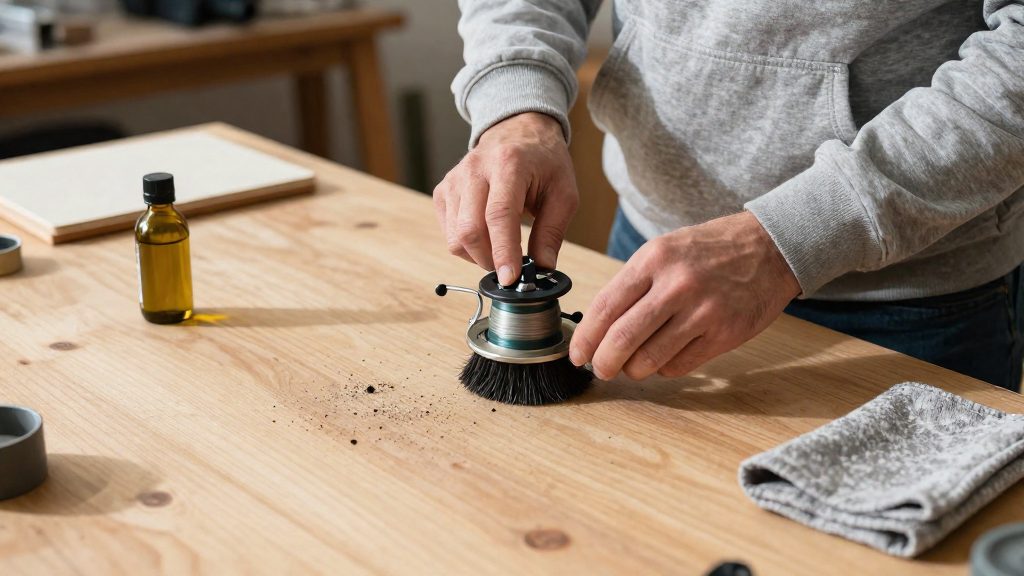
Before a rod goes into storage, remove any salt, sand or mud and make sure it is completely dry. Residue left on the blank, handles or reel parts is the main thing to clear before storage. According to StoreYourBoard (2026), rods should never be stored wet, and rinsing and drying them thoroughly is especially important after saltwater use to prevent corrosion. Making this routine part of every trip is the simplest way to avoid skipping it after a short session.
Wipe handles, reel seats and reels
Start by wiping the rod blank, the handles, the reel seat (the part that holds the reel foot) and the exterior of the reel with a soft cloth. A soft cloth removes surface dirt without scratching the finish. Public Storage (2026) recommends this wipe-down for rods, handles and reel exteriors before any storage.
Rinse away saltwater, sand and mud
Wiping alone does not remove grit that has settled into the handle or reel seat. Rinse these areas with clean water so residue does not stay on the gear. Public Storage (2026) advises extra attention after saltwater, muddy or sandy trips. For the reel itself, check the manufacturer’s instructions before rinsing, because some reels should not be soaked.
Dry everything fully
Let the rod and reel air-dry until no moisture remains on any surface, including the reel seat and handle, before putting them away. Wipe any remaining water from crevices with a dry cloth to speed things up.
| Area | Method | Priority after |
|---|---|---|
| Rod blank | Wipe with soft cloth, then rinse | Saltwater, sand, mud |
| Handles | Wipe, rinse, air-dry | Saltwater, sand, mud |
| Reel seat | Wipe, rinse, dry in crevices | Saltwater, sand, mud |
| Reel exterior | Wipe with soft cloth, check manufacturer rinse guidance | Saltwater, sand, mud |
Vertical or horizontal rod racks?
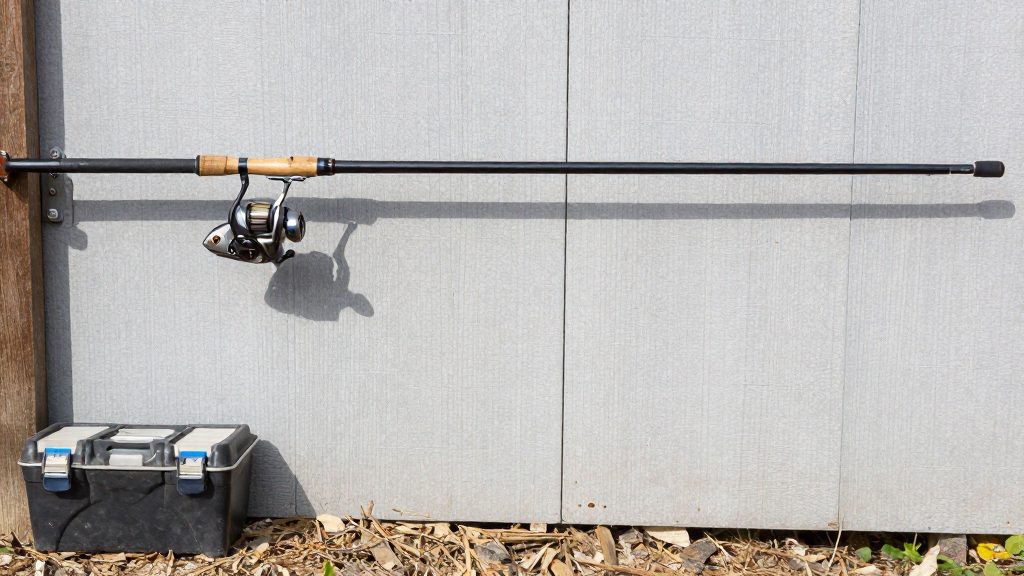
Horizontal and vertical rod storage both keep rods off the floor, but they trade floor space against reach. According to KayakGuru (2026), horizontal wall or ceiling racks save floor space, while vertical racks keep rods within easy reach but take up more floor space. Public Storage (2026) lists racks, wall holders, vertical stands and supported shelves as suitable options. The right layout therefore depends on how much floor area your garage, basement or shed offers and how often you need to grab a rod.
Horizontal wall and ceiling racks
Horizontal racks use the wall or ceiling, so they suit spaces where the floor is crowded. Because they free up floor area, they are the practical choice when rods are stored in a room that also holds other gear, such as a bike, a tackle box or a workbench. The rods stay grouped and off the floor, which is the main goal of any rod storage method.
Vertical racks and stands
Vertical racks keep each rod upright and within easy reach, so you can take one down without moving the others. The trade-off is floor space: a vertical stand occupies more of the floor than a wall-mounted layout. Choose vertical storage when floor area is not limited and rods are used often enough that quick access matters.
Supporting rods at the butt and midsection
Whatever the layout, support the rod at the butt and midsection, and never hang it by the tip. Use the holder’s cradles or clips at these two points so the rod’s weight is spread along its length rather than carried by one spot. Check that every holder is fixed firmly to the wall, ceiling or stand before loading rods onto it.
Protect tips and guides
Before a rod goes into storage, its guides and tip need a short check. Nicked guides can fray the line, and a damaged tip can be knocked further when the rod is stored with other gear. Most of the protection comes from inspecting the guides, securing any lure on the rod, and covering the tip.
Inspect the guides before storage
Run a finger or a soft cloth along the inside of each guide ring. Look for small chips, grooves or rough spots on the ring surfaces, and check the tip-top ring at the end of the rod. Do this before storing the rod, not after the next trip, because a rough guide will wear the line the next time you cast.
| Check | What to look for | Action |
|---|---|---|
| Guide rings | Chips, grooves or rough edges | Do not store the rod until the damage is assessed |
| Tip-top ring | Nicks at the end of the rod | Inspect before covering the tip |
| Line in the guides | Fraying or kinks where it meets a nick | Replace the line before the next session |
If you find a nick, take the rod to a tackle shop or a local rod repair service for an assessment before storing it.
Secure lures on the hook keeper
Do not leave a lure hooked into the guides or onto the line when you store the rod. If the rod has a hook keeper, a small clip or pad on the handle or blank, hook the lure onto it. This keeps the hook point away from the guides and stops the rod being snagged while it is handled. If your rod has no hook keeper, check the manufacturer’s instructions for the recommended storage position.
Protect the tip with covers
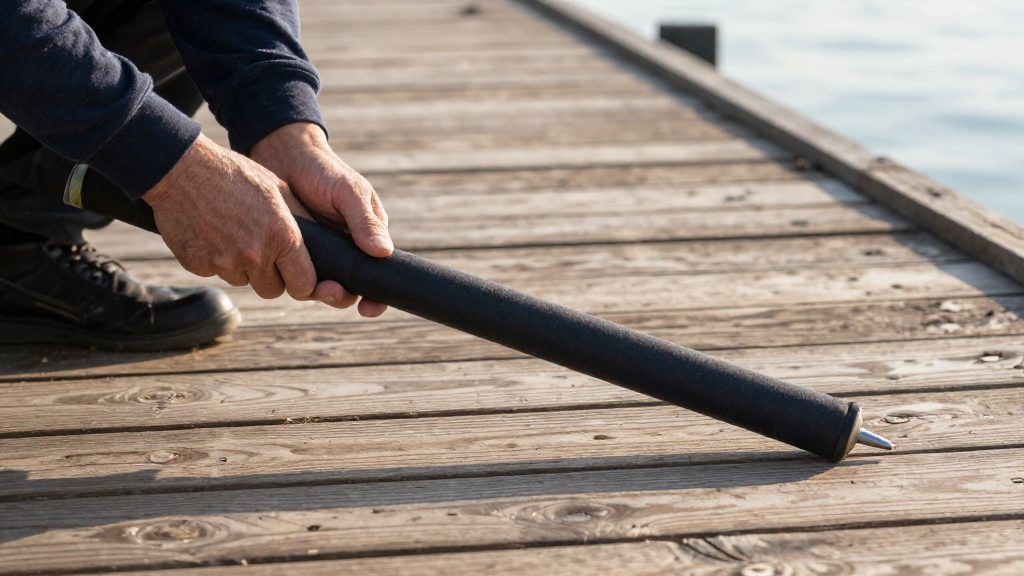
A tip cover is a simple sleeve or cap that slides over the tip section. It guards the tip against knocks when the rod is leaned, moved or stacked with other items. Before fitting a cover, make sure the tip and the cover are clean and fully dry, so moisture does not sit against the blank. Remove the cover before use and check the tip for marks each time you put it back into storage.
Where is the best place to store rods?
The best place for rods is somewhere the temperature stays steady and moisture stays low. According to KayakGuru (2026), a garage or basement works for rod storage as long as it does not get too hot or too cold, because extreme temperatures can weaken rod materials. Heat and cold both stress the blank, so a spot that swings between seasons, such as an unheated shed or a car left in the sun, is a poor choice even if it is convenient.
Garage or basement with stable temperatures
Choose the room in your home or garage that changes least over the year. Before you commit, place a thermometer in the spot and read it over several days, at different times of day, to see how much it moves. A room that stays within a narrow range is a better choice than one that is warm in summer and cold in winter.
Why heat and cold matter
Extreme heat and extreme cold both affect rod materials, which is why the goal is to avoid both extremes rather than to protect against one. Keep rods out of any area that becomes very hot or very cold, because extreme temperatures can weaken rod materials.
Moisture and rod tubes
Moisture is the second factor.
Rod tubes and holders are useful for moving rods, but they are not a long-term home. Moisture can build up inside them, so a damp rod sealed in a tube can stay wet for longer than an open one.
| Storage option | Suitability |
|---|---|
| Garage or basement with stable temperature | Suitable for storage |
| Area that gets too hot or too cold | Can weaken rod materials |
| Rod tube or holder | Suits transport, not long-term storage |
What about reels, line and hooks?
Reels, fishing line and hooks don’t share the same weak points as rods, but they suffer from the same main enemies: moisture, heat and sunlight. Storing each item in its own dry, closed space is the simplest way to protect them between sessions. The points below cover only these three categories.
Reels in dry, sealed cases
Store reels in a sealed case, a tackle box with a closing lid, or a zipped pouch. Don’t leave them loose in a bag where they can knock against metal lures or spare tackle. A closed case keeps dust and grit away from the drag washers and gears. Loosen the drag fully before storing the reel so the washers are not left under pressure for long periods.
Line spools kept away from heat and sunlight
Monofilament and fluorocarbon line can weaken when exposed to heat and UV light over time. Keep spools in a cool, shaded place such as a closed drawer or box. Avoid car interiors, sunny windowsills and sheds that heat up in summer. Keep spare spools in their original packaging or a sealed bag, and follow any storage guidance printed by the manufacturer.
Hooks and lures in separate compartments
Keep hooks and lures in separate compartments. Loose hooks tangle with each other and snag on the bodies of soft plastic baits, and the points can dull or bend in a crowded box. Use a divided tray or small compartment boxes, with hooks in their own slots and treble-hooked lures kept apart from them. Dry the hooks before storing them, because rust weakens the wire and makes a hook unreliable.
| Item | Where to store | Main risk |
|---|---|---|
| Reels | Sealed case or tackle box with a lid | Dust, grit and moisture in the gears |
| Line spools | Cool, shaded drawer or closed box | Heat and UV light |
| Hooks and lures | Separate, dry compartments | Tangling, dull points and rust |
Common storage mistakes to avoid
Careless storage can damage a rod between trips. Four habits undo careful preparation: keeping a damaged rod in use, leaving rods in a parked car, packing rods loose together, and storing rods wet or dirty. Each one exposes the blank, guides or handle to stresses that the rod is not built to absorb for long.
Assuming a damaged rod is safe until the next trip
A rod with a visible fault should not go back into the tackle bag just because it still casts. Damage that looks minor can worsen under load, and a rod stored with it may fail on the next outing. Set the rod aside, label it, and check the manufacturer’s instructions or contact the retailer about repair before using it again.
Leaving rods in parked cars
A parked car is not a controlled environment, since it heats up in summer and cools sharply in winter. Take rods out of the car once the session ends, and move them to a space that stays at a moderate temperature.
Bundling rods loose together
Tying several rods into a loose bundle, or letting them knock together in a bag, causes the blanks and guides to rub against each other. Keep the rods separated with soft padding or individual sleeves. Check the manufacturer’s guidance on the type of padding suitable for your rod.
Storing rods that are still wet or dirty
Frequently asked questions
Can I lean my rods in a corner if I only leave them there for a short time?
Standing rods in a corner, even briefly, can leave the blank with a permanent curve if it becomes a routine habit. StoreYourBoard (2026) warns that this can cause warping, so a vertical stand or wall rack is the safer choice.
Is a garage or basement a good place to store rods?
Yes, as long as the space stays neither too hot nor too cold. KayakGuru (2026) notes that temperature extremes can weaken rod materials, so check the room in both summer and winter before leaving rods there.
What should I check on a rod before I put it away?
Look along the guides for nicks, because a damaged guide can fray your line the next time you cast. If your rod has a hook keeper, secure the hook or lure in it so the rod stays tidy and the points do not catch on the blank or other gear.