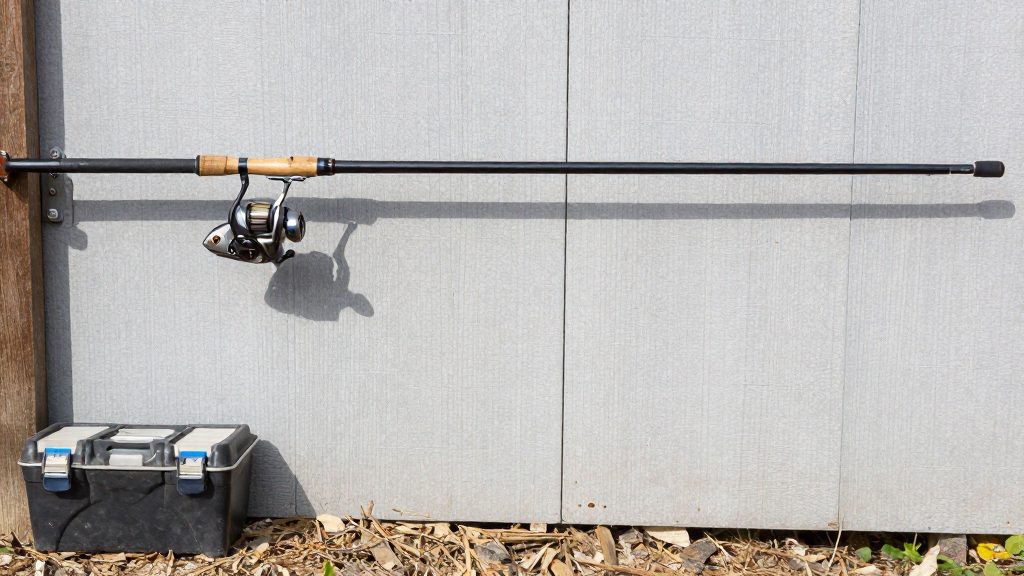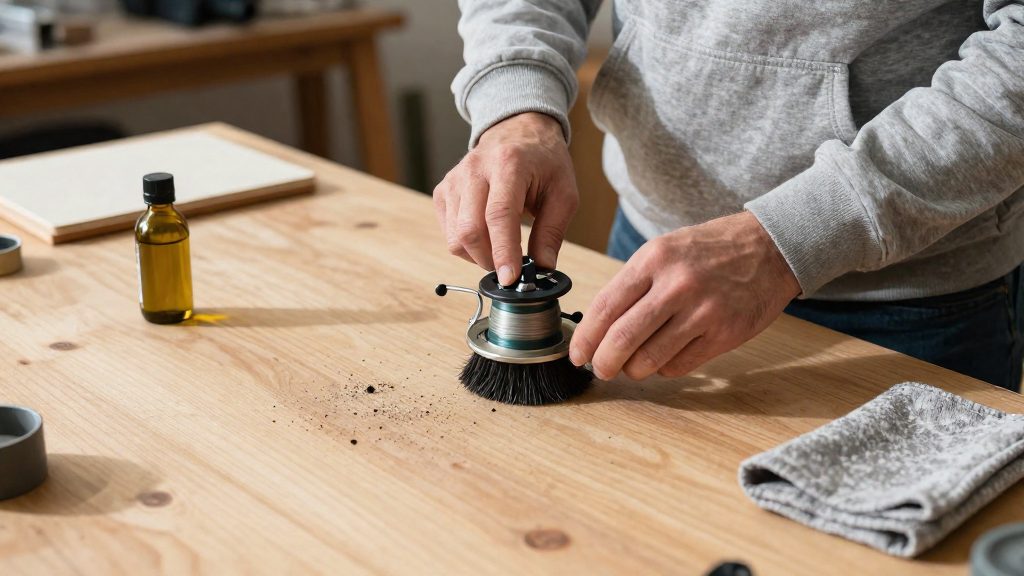
A spinning reel needs regular cleaning because salt, sand and grit work into the gears and bearings, and aged lubricant stops protecting the metal it coats. Over time these two problems lead to the reel’s main failure modes: corrosion and inconsistent drag. Wear builds up gradually, so a reel can keep turning while its internal parts deteriorate.
Why does a spinning reel need regular cleaning?
How salt and grit get into the gears
Salt and grit accumulate inside the gears and bearings, and each outing adds more. Particles that settle between gear teeth and in ball bearings act as an abrasive, grinding the metal every time the handle turns. Salt also attacks metal directly, which is why corrosion is one of the main failure modes.
What aged lubricant does
Lubricant does more than reduce friction. It forms a protective film over the metal parts. As oil ages, it thickens and loses that film, leaving bare metal in contact with grit and moisture.
| Factor | Where it acts | Effect on the reel |
|---|---|---|
| Salt | Gears and bearings | Drives corrosion of metal parts |
| Grit | Gears and bearings | Accumulates and abrades moving surfaces |
| Aged lubricant | Ball bearings, metal bushings, gears | Thickens and loses its protective film |
Corrosion and drag inconsistency
These three factors combine into the two main failure modes. Corrosion weakens metal parts over time. Drag problems tend to appear when the drag washers are affected. Leaving the drag tightened can compress or warp the washers, which is why the drag should be loosened before storage.
What you need before you start
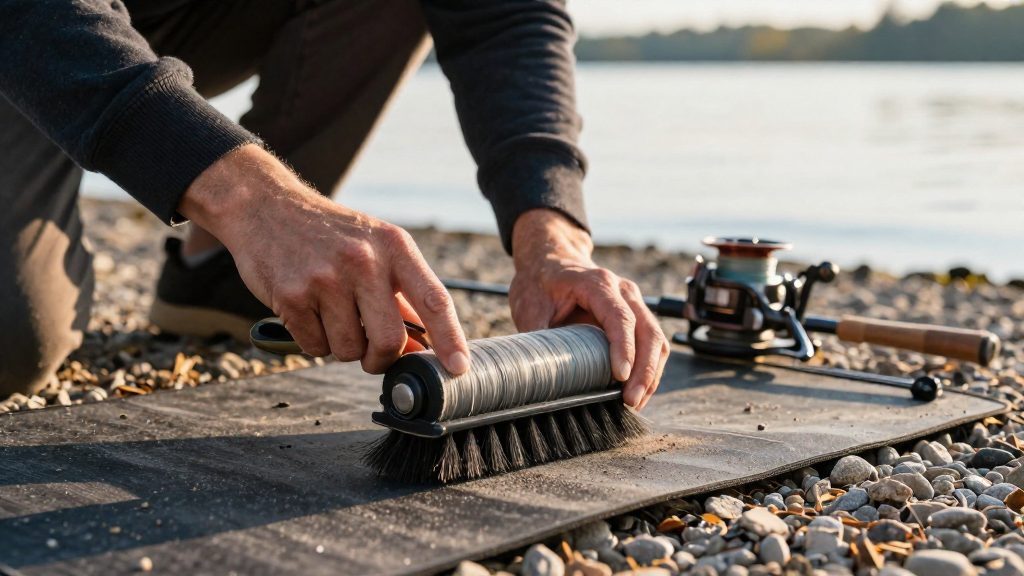
Gathering the right supplies before you open the reel keeps small parts from going missing and lets you work without interruption. Most of the preparation is about having the right materials and a clear place to lay them out.
Soft rags are the first item. Keep one damp rag for the outer body and a dry one for finishing.
Small brushes and a toothpick reach what a rag cannot: the gaps around the line roller, the bail hinge and the crevices where grit collects. A soft-bristled brush, such as an old toothbrush, removes loose debris. A wooden or plastic toothpick loosens packed dirt without scratching the metal.
A clean workspace with a parts tray keeps screws, washers and bearings in the order they came out. Choose a flat, well-lit surface away from sand and water. A tray with separate compartments makes it easier to group parts by location.
The reel maker’s manual or an exploded diagram shows how each part fits and where it sits. Find the model number printed on the reel body, then check the manufacturer’s website or the manual included with the reel for the matching diagram. Use the diagram as a reference throughout the job.
| Item | Purpose | Practical note |
|---|---|---|
| Soft rag | Wipes the body and exposed parts | Lightly moistened, never soaked |
| Soft brush | Removes loose grit | Dry use only |
| Toothpick | Clears packed dirt from crevices | Wood or plastic to protect metal |
| Parts tray | Keeps small parts in order | Compartments help group parts |
| Manual or exploded diagram | Shows part layout and order | Match the model number on the reel body |
How do you rinse and wipe a reel after fishing?
After each session, rinse the reel body gently at low water pressure or wipe it with a lightly moistened rag, and never use a pressure hose. The aim is to remove salt, sand and grit from the surface without pushing them toward the moving parts. This routine works on the reel as it sits on the rod, with no disassembly.
The routine has three steps:
| Step | Tool | Why this step |
|---|---|---|
| Low-pressure rinse | Gentle stream of fresh water | High pressure can force salt and dirt into the internal parts |
| Damp wipe | Rag, lightly moistened | Spraying or hosing drives grit into the gears |
| Dry wipe | Clean, dry cloth | Removes water left on the body before storage |
Low-pressure rinse: Run a gentle stream of water over the reel body, covering the handle, the foot of the reel seat and the body around the spool. Keep the flow low so that water runs off the surface rather than being pushed into seams and openings.
Damp wipe: Wet a rag, then wring it out until it is only lightly damp. Wipe the body, the handle and the exterior of the spool housing. Do not hose the reel down or use high pressure, because spray can carry grit into the gears; a gentle low-pressure rinse or a lightly damp rag are the two approaches the sources give. The rag does the work that a hose would otherwise do.
Dry wipe: Finish with a clean, dry cloth. Work over every surface where water can sit, including the crevices around the handle knob and the gaps where the body meets the reel seat. Leftover moisture is the main thing this step removes before the reel goes back into storage.
Treat the reel as an external item during this routine. Lubrication and internal parts are covered separately, so this routine should only involve water, a cloth and a dry wipe.
Which parts to oil and which to grease
Spinning reels use two lubricants for different jobs. Oil goes on moving metal contact points, such as bearings, hinges and rollers. Grease goes only on the drag washers. According to Louisiana Sportsman (2014), oil is applied to the drive-gear bearings, the drive shaft, the line roller and the bail hinges, while grease is reserved for the drag washers.
| Component | Lubricant | Amount | Notes |
|---|---|---|---|
| Drive-gear bearings | Oil | A couple of drops | Apply to the bearings that support the drive gear |
| Drive shaft | Oil | One drop | Apply to the drive shaft |
| Line roller | Oil | One drop | Apply to the roller’s pivot point |
| Bail hinges | Oil | One drop each | Treat each hinge side separately |
| Drag washers | Grease | Thin, even coat | Reinstall in their original order |
The drive-gear bearings take a couple of drops rather than a full application, so measure the oil in small amounts. The line roller and each bail hinge take a single drop, which keeps the bail arm and line roller moving without leaving excess oil on the spool area.
The drag washers are the only part that receives grease. Keep track of the order in which you remove them, because Louisiana Sportsman (2014) advises reinstalling them in their original order. Since the drag system relies on the washers sitting correctly against one another, changing their order can alter how the drag feels.
Before applying any lubricant, check the reel maker’s manual for the exact points and quantities.
How to service the spool, bail and line roller
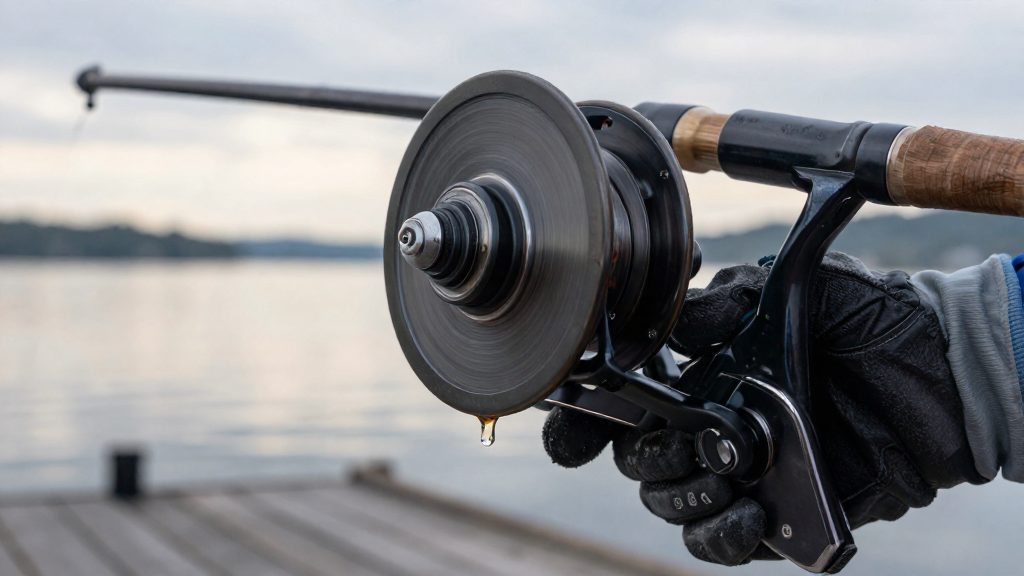
The spool, bail and line roller are cleaned as separate steps before any lubrication. Clearing grit, salt and line residue from these parts first means the oil you apply later is not mixed with debris. Work on a clean surface with the reel removed from the rod, and keep a soft rag and a small brush nearby.
Spool removal comes first. According to Salt Water Sportsman (2020), you remove the spool, and the drag knob only if needed. Spool release methods differ between models, so check the manufacturer’s manual before you pull the spool off the spindle.
Spool underside and spindle area are the zones most often missed. Once the spool is off, wipe its underside and the spindle where it sits. Use a small brush to lift grit from the edges of the spindle. Dry the surfaces with a clean, dry part of the rag before refitting the spool.
When to remove the drag knob
The drag knob is removed only when it blocks access to the underside of the spool or the spindle area. If you can clean those surfaces with the knob in place, leave it on. Removing it adds steps to reassembly, so do it only when the job requires it.
Wiping the line roller
The line roller collects debris and line residue, which can build up along its surface. Wipe it along its length to lift grit and any strands of line caught in its edges. Pick out fine line fibres with a soft brush or the corner of the rag. Dry the roller before you move on to any lubrication step.
| Component | Action | Tool |
|---|---|---|
| Spool underside | Wipe clean after removal | Rag |
| Spindle area | Remove grit and residue | Rag and small brush |
| Drag knob | Remove only if needed to reach the area beneath | Manufacturer’s manual for the release method |
| Line roller | Wipe free of debris and line residue | Rag and soft brush |
How often should you give a spinning reel a full service?
Oiling a spinning reel fits into a longer maintenance cycle. According to Salt Water Sportsman (2020), a full disassembly and cleaning should happen at least every two years, and preferably every year. The same article recommends that this overhaul be done by a professional during the winter off-season, when the reel is not needed on the water. Between these overhauls, the reel is kept in shape through routine checks, not teardown.
Maintenance intervals at a glance
| Interval | Task | Source |
|---|---|---|
| At least every two years | Full disassembly and cleaning | Salt Water Sportsman (2020) |
| Preferably every year | Full disassembly and cleaning | Salt Water Sportsman (2020) |
Why the off-season suits a full service
A full service takes the reel apart, so it is best scheduled when you will not need it. A professional service in the winter off-season means the reel is back before the next trip, not during one. If you choose to do the job yourself instead of using a professional, as the source recommends, pick a quiet period so the parts can be cleaned, dried and reassembled without rushing.
Routine checks between services
Between full overhauls, a quick check at the start of each season tells you whether the reel needs attention sooner. Turn the handle slowly by hand and listen for grinding or feel for a gritty, uneven turn. A reel that feels rough when turned by hand may need a full service sooner than the calendar suggests.
Adjusting the interval after salt or dirty water
The two-year limit is a ceiling, not a target. Reels used in salt or dirty water collect grit and salt faster than reels used in clean lakes, so the full service should come sooner. If you fish in salt water or in muddy, silty conditions, plan the professional overhaul for the next winter off-season instead of waiting for the full two-year cycle. Check the reel for grit more often during those seasons, since salt and sand do their damage between services, not only during them.
Storage tips and common mistakes
Most of the damage that shortens a spinning reel’s working life comes from a few storage habits and from oiling mistakes, not from use itself. The points below cover what to do before the reel goes back into the tackle box, and the errors to avoid. Guidance is from Salt Water Sportsman (2020) and Louisiana Sportsman (2014).
Loosen the drag before storage
Before the reel is put away, loosen the drag fully. Salt Water Sportsman (2020) warns that a drag left tightened can make the washers compress or warp. Warped washers do not sit flat, so the drag can behave unpredictably the next time it is used. Setting the drag to its lightest position takes only a few seconds and removes that risk.
Avoid over-oiling
Over-oiling is nearly as harmful as under-oiling. Salt Water Sportsman (2020) advises oiling ball bearings and metal bushings sparingly, using the reel maker’s oil or a quality aftermarket oil. Louisiana Sportsman (2014) gives a sense of scale: a couple of drops for the drive-gear bearings, and a single drop each for the drive shaft, the line roller and the bail hinges. Oil that is applied in excess does not add protection and can spread onto parts that were not meant to be lubricated. Apply oil to the points listed by the manufacturer, and wipe away any surplus.
Keep protectant away from line and grips
Protectant products are useful on the reel body, but they must stay off the fishing line and the handle grips. Salt Water Sportsman (2020) stresses this point because contact can contaminate the line and degrade the grip surfaces. Spray or apply protectant in a separate, ventilated area, and keep the spool and handle covered or turned away while you work.
Common mistakes at a glance
| Mistake | What the sources say | Correction |
|---|---|---|
| Protectant on line or grips | Must be kept off both (Salt Water Sportsman, 2020) | Apply protectant away from the line and handle grips |
Choose a suitable storage spot
Store the reel in a dry place inside the tackle box or a case, where it is protected from knocks and direct contact with other tackle. Check the reel maker’s instructions for any further storage guidance. If you are unsure whether a product is safe to use near your line or grips, read the product label or contact the manufacturer directly.
Frequently asked questions
How often should I fully clean and service my spinning reel?
A full disassembly and cleaning should happen at least every two years, and ideally once a year. Salt Water Sportsman (2020) recommends having it done by a professional during the winter off-season.
Can I hose my spinning reel down after a saltwater trip?
No. Rinse the body gently at low water pressure, or wipe it with a lightly moistened rag. Louisiana Sportsman (2014) advises against hosing the reel, because spray can push grit into the gears.
How much oil should I apply, and where does grease go?
Louisiana Sportsman (2014) suggests a couple of drops of oil on the drive-gear bearings and one drop each on the drive shaft, line roller and bail hinges. Excess oil causes nearly as many problems as too little, so apply it sparingly. Reserve grease for the drag washers only, and reinstall them in their original order.