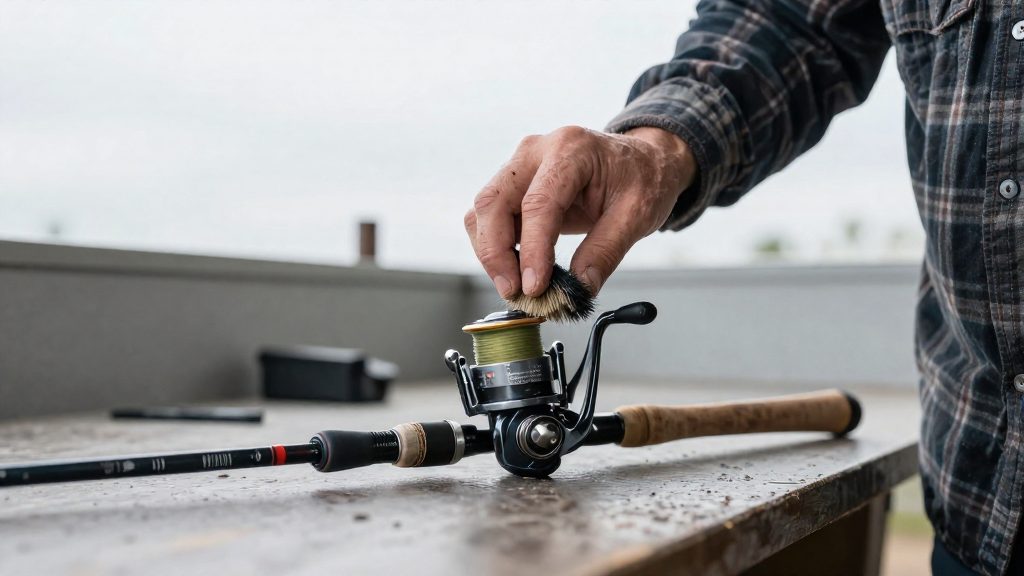
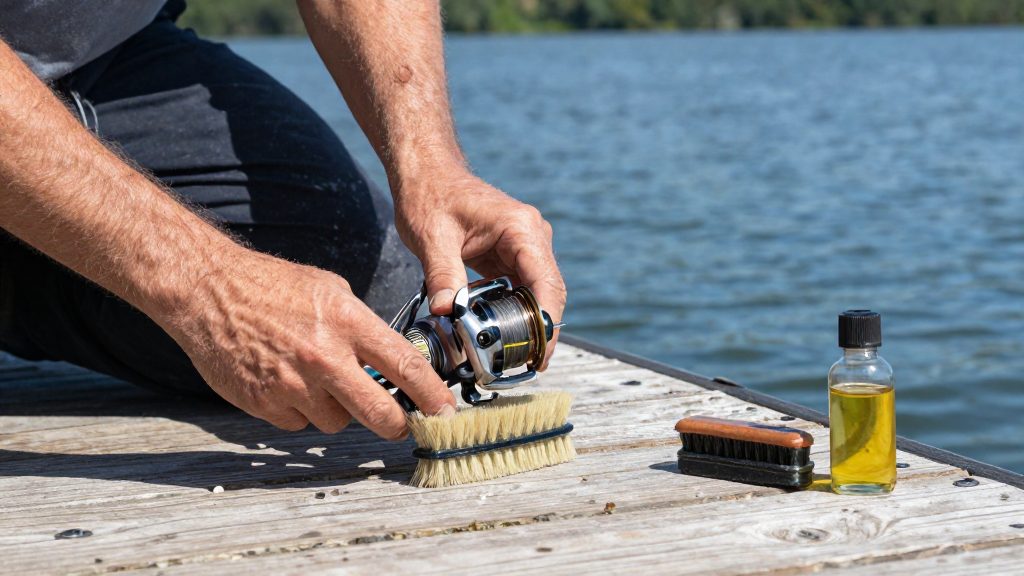
Before you open a baitcasting reel, gather a brush, soft cloths, cotton swabs, reel lubricant, a degreaser or mild soap, a clean work surface, screwdrivers and a parts tray. These are ordinary tackle and household supplies, not specialist equipment.
What you need to clean a baitcasting reel
Each item has a specific job during the session:
| Item | What it is for |
|---|---|
| Brush | Loosens dust, grit and dried debris from the frame before you wipe |
| Soft cloths | Wipe the frame, side plates and spool without leaving lint behind |
| Cotton swabs | Reach small recesses that a cloth cannot enter |
| Alcohol | Dampens the swabs for cleaning small bearings |
| Reel lubricant | Reel oil for most moving parts, and Teflon-based drag grease for the drag |
| Degreaser or mild soap | Removes old, hardened grime that dry brushing will not shift |
| Screwdrivers | Remove the covers and side plates |
| Parts tray | Holds screws and small components in the order they came out |
Choose a clean work surface away from sand, dust and open water so that grit does not get into the internals while you work. Keep a spare dry cloth nearby so you can wipe your hands and tools between steps.
How often should you clean a baitcaster?
There is no single cleaning schedule that fits every angler. The right interval depends on where the reel is used and how long it sits between sessions. A reel used in clear freshwater can go longer between full cleans than one dragged through silt, used in salt water, or left unused for months. Start from the usage conditions, then check the reel itself for warning signs.
| Usage condition | Suggested approach |
|---|---|
| Regular clear freshwater use | Full clean when performance changes or on a schedule you set from your own fishing frequency |
| Muddy or sandy freshwater | Clean sooner than usual, since grit gets into the spool and bearings |
| Saltwater use | Clean sooner than usual, since salt residue corrodes metal parts and dries out lubricant |
| Off-season storage | Clean before storing, so old lubricant and dirt are not left inside the reel |
Signs that a reel needs a full service
Some signs are more reliable than a calendar. A reel that needs a full service often shows one or more of these:
- Gritty or uneven feel when you turn the handle
- Grinding or rough noise from the spool or side plate area
- Slow or inconsistent spool rotation after a cast
- Drag that engages unevenly or feels different from one side of the setting to the other
- Visible rust, corrosion or sticky residue on metal parts
If you notice any of these, stop fishing with the reel and clean it before the next session. Continued use with grit inside the reel can wear the parts you are trying to protect.
Cleaning before off-season storage
Before storing a reel for a long period, clean it fully and let it dry completely. Store it in a dry place away from damp conditions. Residue left on the parts over the off-season tends to harden or cause corrosion, so a clean reel is easier to use when the season restarts.
How do you take a baitcasting reel apart?
Before you remove anything, find the manufacturer’s manual for your exact reel model. According to Cast and Spear, disassembly should follow that manual, so the order of removal matches how the reel was built. If you no longer have the manual, check the brand’s website for a parts diagram, also called an exploded view. It shows how the components stack and which screws hold each plate or cover.
Work on one part at a time. Remove a single component, set it aside, and only then move to the next. Cast and Spear recommends this approach so that parts don’t get mixed up. Leave the rest of the reel intact while you work on each section, so that the remaining parts stay in their correct positions.
Place removed parts on a tray in the order they came off. Use a clean, flat work surface and line the pieces up in a row. The last part you removed is the first one you will put back, so keeping the sequence visible makes reassembly much more straightforward. Small washers, spacers, and springs are easy to lose, so keep each one in the same row as the part it came from.
| Step | Action | Purpose |
|---|---|---|
| 1 | Read the manual or parts diagram for your model | Confirms the disassembly sequence |
| 2 | Remove one component | Keeps the rest of the reel intact |
| 3 | Place it on the tray in removal order | Preserves the reverse reassembly path |
| 4 | Repeat with the next component | Prevents similar parts from being mixed up |
Cleaning bearings, drag and worm gear
Component-level cleaning removes the grit and old grease that build up inside a baitcasting reel. According to Cast and Spear, the parts to clean are the bearings, the drag assembly and the worm gear, and each needs a different approach.
For the alcohol swab method, dip a cotton swab in alcohol and clean each bearing until the swab comes away clean. Let the bearing dry fully, then add a single drop of oil before reassembly. Cast and Spear recommends this one-drop approach, which avoids pushing excess lubricant into the bearing housing.
The drag needs more attention because its grease breaks down over time. Remove the old grease, clean the drag parts, and apply a fresh dab of Teflon-based drag grease. A small amount is enough, since the drag works by friction between washers. Cast and Spear also advises loosening the drag after casting, so the washers are not kept compressed while the reel is stored.
The worm gear is cleaned in place rather than taken apart. Scrub the worm gear assembly with a toothbrush and a solvent such as Simple Green, then wipe it clean with a dry cloth. Cleaning it while still assembled keeps the pawl and gear alignment intact.
| Component | Cleaning method | Lubrication |
|---|---|---|
| Bearings | Alcohol on a cotton swab, then dry | One drop of oil |
| Drag washers | Remove old grease, clean parts | Fresh dab of Teflon-based drag grease |
| Worm gear assembly | Toothbrush and solvent, in place | Not covered in this section |
Oil or grease: what goes where?
Baitcasting reels use two different lubricants, and they are not interchangeable. Reel oil is the default for most of the moving parts, while grease is reserved for the few spots that specifically need it. Matching each product to the right part keeps the reel running smoothly and avoids the buildup that attracts grit.
Light reel oil for most moving parts
Reel oil is the everyday lubricant for the bulk of the mechanism. According to Mystery Tackle Box, you should use reel oil on most moving parts. Apply it to the parts that move against each other, one part at a time, so you know which surfaces you have already covered. Work on a clean surface, and wipe away any excess so that oil does not collect on nearby parts.
Grease only where it is needed
Grease should be kept for specific points rather than spread across the whole reel. Mystery Tackle Box advises using grease only where it is needed. If you are unsure whether a part needs grease, check the manufacturer’s manual for your model and keep lubricant to a minimum. This keeps the reel’s internals from getting heavy with lubricant.
Keeping the anti-reverse bearing free of oil
The anti-reverse bearing is the one part that should stay free of oil. Cast and Spear advises against oiling it. When you lubricate the other bearings, keep the oil away from this one, and wipe off any oil that reaches it during cleaning.
| Reel component | Lubricant | Source |
|---|---|---|
| Most moving parts | Light reel oil | Mystery Tackle Box |
| Spots where grease is needed | Grease, only at those points | Mystery Tackle Box |
| Anti-reverse bearing | No oil | Cast and Spear |
Quick rinse and drying after a trip
A short rinse after each session keeps grit and salt residue from working into a baitcasting reel’s spool and gears. The routine below takes a few minutes and avoids the step that causes the most damage: soaking the internals. Daiwa Australia (2026) recommends a light, soap-free approach for this quick clean, which is different from a full strip-down.
Tighten the drag first
Before any water touches the reel, turn the drag knob clockwise to tighten it. Daiwa Australia advises tightening the drag before any water touches the reel. Keep the line on the spool during this quick clean; you are only removing surface dirt, not servicing the internals.
Use a light warm water mist
Use a spray bottle or a gentle mist of warm water, with no soap, no degreaser and no detergent. Soap leaves a film that attracts grit and can work into bearings. Mist the outer body, the side plates and the area around the spool lip, keeping the stream fine. On a baitcaster, the spool sits directly over the internal mechanism, so the water volume needs to stay low. Do not hose the reel and do not dip it in a bucket or a river.
Wipe the whole reel
Once the mist has loosened the grit, wipe the entire reel with a dry, lint-free cloth. Work around the handle, the crank knob, the spool edges and the frame, paying attention to the gaps where line and dirt collect. A cloth removes the water film and any residue before it can settle into the mechanism. If you have a cotton swab, use it to reach the narrow seams without pushing moisture inward.
Quick wind to distribute moisture
Give the reel a quick wind by turning the handle several times with the drag still tightened. This moves the gears and lets any remaining moisture escape from the moving parts instead of pooling in one spot. Keep the wind brisk and steady, and stop immediately if you feel any grinding or resistance. Grinding can mean grit has reached a gear and should be dealt with at the next full service.
Dry in a cool place
Leave the reel to air dry in a cool place, away from direct sunlight, heaters and hot vehicles. Heat can affect the lubrication and the internal parts, so avoid drying it near a heat source. Once it is dry to the touch, loosen the drag for storage, as Cast and Spear advises, and set it for fishing only before the next trip.
Reassembly and testing
Reassembly is where most cleaning errors show up. Refit parts in the reverse order you removed them. Before you tighten any screw, check the spool and gears. Make sure the spool sits correctly on its shaft, that the gears mesh cleanly without debris between the teeth, and that no part is missing or out of place. The pawl and worm gear assembly should stay in one piece, as Cast and Spear advises, so inspect it visually rather than taking it apart.
Once the side plates are secured, run a hand-cranking test. Turn the handle slowly and watch and feel how the spool turns. It should rotate smoothly, with no grinding, catching or rough spots. Turn it at a few different speeds and listen for noise that changes with the handle. Uneven resistance or a rough patch usually means a part is misaligned, a screw is overtightened, or a gear is out of mesh. Stop, recheck the assembly, and do not force the handle.
Next, confirm the drag engagement. Engage the drag and check that it takes hold evenly and releases cleanly. A drag that grabs unevenly or feels gritty needs to be taken apart again to check the washers and the grease. Only confirm smooth, even engagement here; follow your manual for setting the drag before fishing.
Common mistakes to avoid
Most avoidable wear on a baitcaster comes from three habits during cleaning and storage: putting on too much oil, spraying lubricant onto the reel body, and leaving the drag tightened. Each looks harmless after a single session, but the damage builds up over many trips.
Over-lubricating moving parts
Too much oil is the most common error. As Mystery Tackle Box advises, less is better. Excess oil does not stay where you put it. It can spread onto surrounding surfaces and attract dust and grit, which then sit in the gears and bearings and slow the reel down.
When you oil a bearing, one drop is the amount Cast and Spear recommends before reassembly. Wipe away any oil that spreads beyond the bearing.
Spraying lubricant straight onto the reel body
Spraying directly onto the reel is a second frequent mistake. According to Daiwa Australia (2026), lubricants and sealants should not be sprayed directly onto the reel. Spray them onto a clean rag and wipe the reel with it. This keeps the product where you control it, rather than letting it drift into openings you cannot easily wipe.
Leaving the drag tightened after casting
A drag left set tight keeps pressure on the braking parts between sessions. Cast and Spear advises loosening the drag after casting.
Frequently asked questions
Can I use household oil on my baitcaster?
Stick to reel oil for most moving parts, and apply grease only where the reel’s design calls for it. If you are unsure whether a part takes oil or grease, check the manufacturer’s manual before applying anything. Over-lubricating is a common mistake, so apply lubricant sparingly.
Should I strip down the pawl and worm gear assembly?
No. Leave the pawl and worm gear assembly in place, scrub it with a toothbrush and a solvent such as Simple Green, then wipe it clean. Taking it apart is hard to reverse, so it is best avoided during a routine clean.
Can I rinse my baitcaster after a trip?
Yes, but only with a light mist of warm water and no soap. Tighten the drag first, wipe the whole reel, give it a quick wind, and let it dry in a cool place, according to Daiwa Australia (2026). Never hose the reel or dip it in water, since the spool is exposed to the internals.