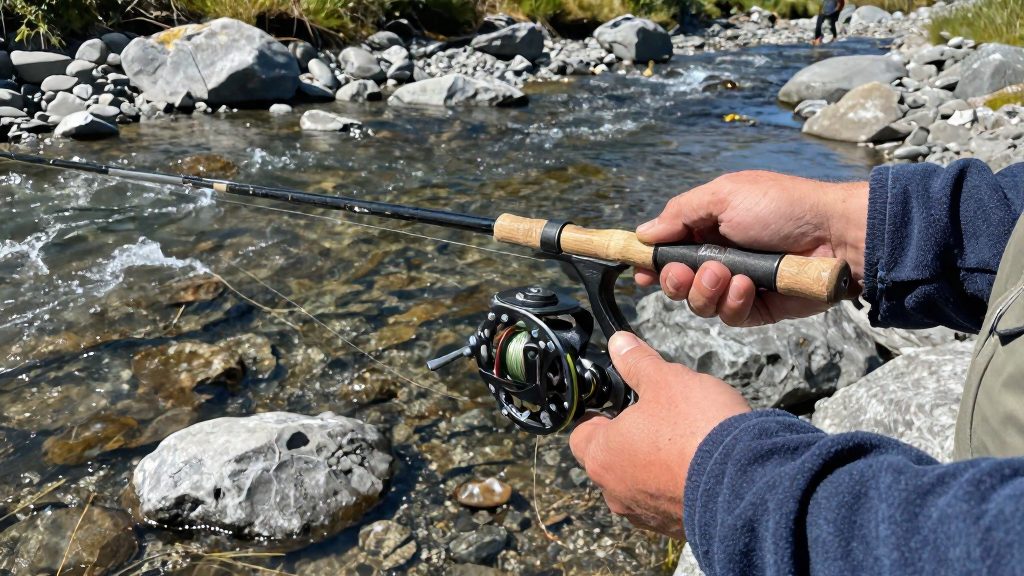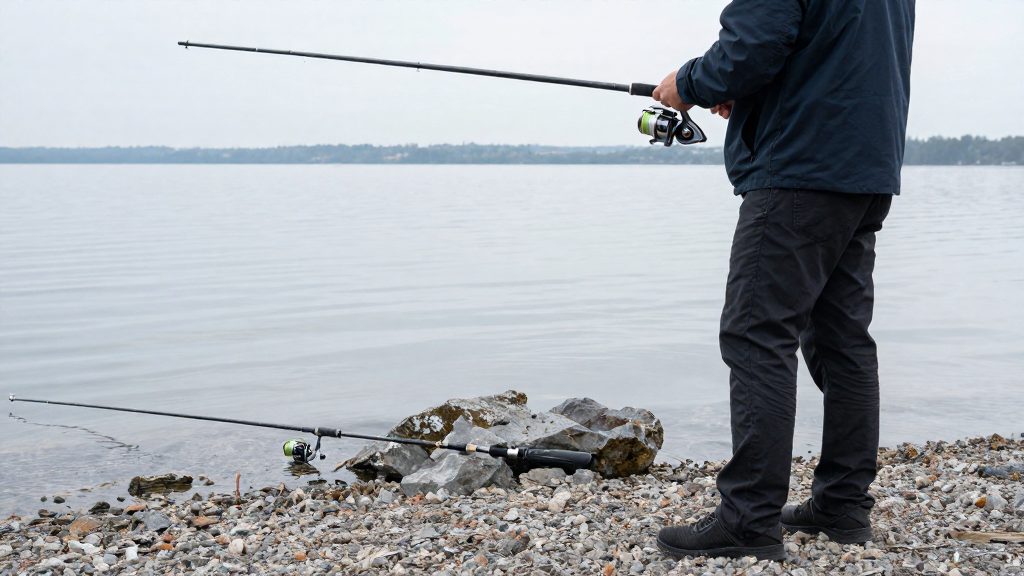
The fishing line is the only physical link between reel, lure and fish. It carries the reel’s pull out to the lure, sends the lure’s action back to your hand, and transmits the fish’s movement to the rod. Everything you feel in a shore session passes through it, so a weak or damaged line affects casting distance, lure control and hook-ups.
What does line do in shore casting?
How line links reel, lure and fish
- Reel: The line is wound onto the spool and runs through the rod guides. Retrieving with the reel pulls the lure through the water at a speed set by your hand.
- Lure: The line is tied to the lure, usually through a knot at the eye. How the line moves and tightens controls how the lure swims, wobbles or drops.
- Fish: When a fish takes the lure, the line carries that movement back through the rod to you. You can only react to a bite you can feel.
Line as the main feel and vibration link
Line is your main source of information about what is happening underwater. Taps from the lure hitting weed, gravel or bottom structure travel up the line, as do the small vibrations of a lure working properly. A slack or stretched line dampens these signals.
Stretch changes how the line transmits feel. According to Outdoor Life (2023), monofilament stretches significantly.
Common failure points during a typical session
| Failure point | Where it occurs | What to check |
|---|---|---|
| Knot slippage or weakening | Lure eye and spool connection | Retie the knot after every lure change and after a fish is landed |
| Abrasion | Rod guides and the line where it rubs against the rod tip | Run the line through your fingers regularly for flat or fuzzy spots |
| Nicks from structure | Rocks, weed beds and snags on the bottom | Inspect the last section of line after each snag |
| Wind knots and tangles | Spool and cast release | Check line lay on the spool and reduce cast power when casting into wind |
Check each failure point before every session, not only when you lose a fish.
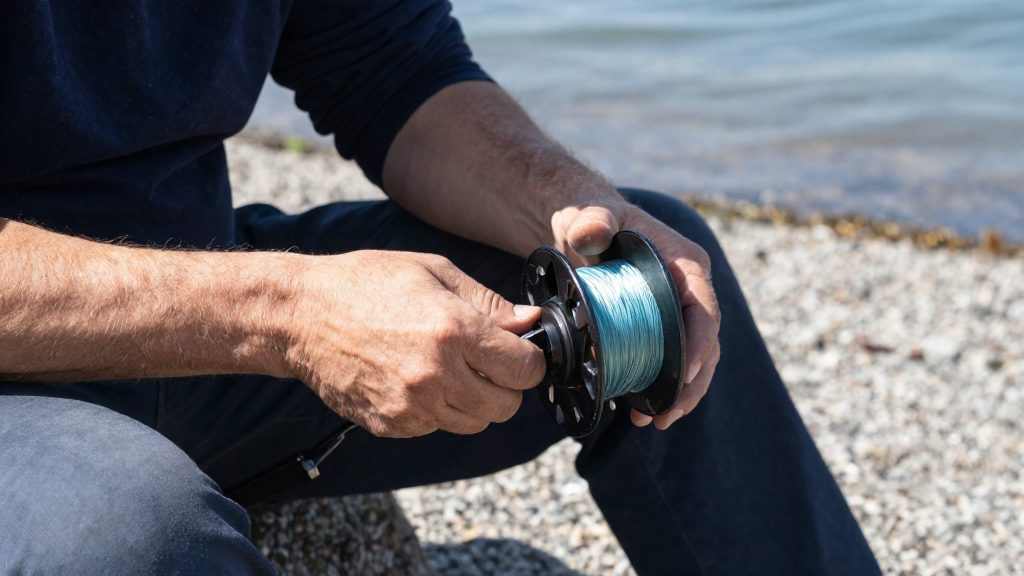
Mono, fluorocarbon or braid: which should you pick?
The three main shore-casting lines differ mainly in how much they stretch, how much feel they transmit, how fast they sink and how they handle. Monofilament is a single strand of nylon, and it is the most forgiving of the three.
Monofilament stretches significantly. One angler cited by Outdoor Life (2023) puts the stretch at up to 25 percent. That cushioning helps when a fish makes a sudden run, but it means you have to set the hook harder to drive it through the fish’s mouth, and you feel less of what the lure is doing. Monofilament is inexpensive, ties easily and suits topwater lures, trout and live-bait rigs. It is mostly chosen for tests under about 10 lb.
Fluorocarbon is usually chosen for its sink rate and abrasion resistance, not for its stretch. It sinks faster than monofilament, which helps a lure reach the bottom or hold deeper in the water column. Its toughness against rocks, weed edges and fish teeth makes it a common choice near structure. Check the manufacturer’s stated sink rate and abrasion rating on the spool label before you buy, as these vary between brands.
Braid is a woven line made from several fibres, and it stretches very little compared with monofilament. That low stretch gives the most direct transmission of bites and lure movement, which suits anglers who want to feel a light take or control a lure precisely. The trade-off is that braid is thinner for its strength, can cut into fingers under load and is less forgiving on sudden runs.
| Line type | Stretch | Feel | Sink rate | Handling |
|---|---|---|---|---|
| Monofilament | Significant, up to 25 percent per Outdoor Life (2023) | Reduced | Slower than fluorocarbon (varies by product) | Ties easily, inexpensive |
| Fluorocarbon | Manufacturer-specific | Sensitive | Sinks faster than monofilament | Abrasion-resistant, harder to handle when cold |
| Braid | Very low | Highly sensitive | Varies by product; check the label | Thin for its strength, can cut fingers |
What pound test is best for shore fishing?
Pound test is the strength rating printed on a line spool, and it is the first number to check when matching line to your target fish and lures. Pound test is the strength rating printed on the spool. The only figure supported here is that monofilament is mostly chosen for tests under about 10 lb (Outdoor Life, 2023). Beyond that, choose the rating from your target species, lure weight and cover, and follow the rod and reel’s rated line range.
Use these steps to narrow down a rating:
- Read the label first. Confirm the pound rating and the line type, since the same number on different materials is not a guarantee of identical performance.
- Match the rating to your target. Lighter ratings suit smaller fish and lighter lures. Heavier ratings suit larger fish and heavier lures, and they tolerate more abrasion.
- Add a margin for snags. If you fish near weed beds, rocks, or submerged structure, choose a rating above the minimum you would use in open water. A line that breaks on a snag costs you the lure and the fish.
- Plan for hard-fighting fish. Species that run hard or dive toward cover put more load on the line. A heavier rating gives more room before breakage.
Why use a leader with braid?
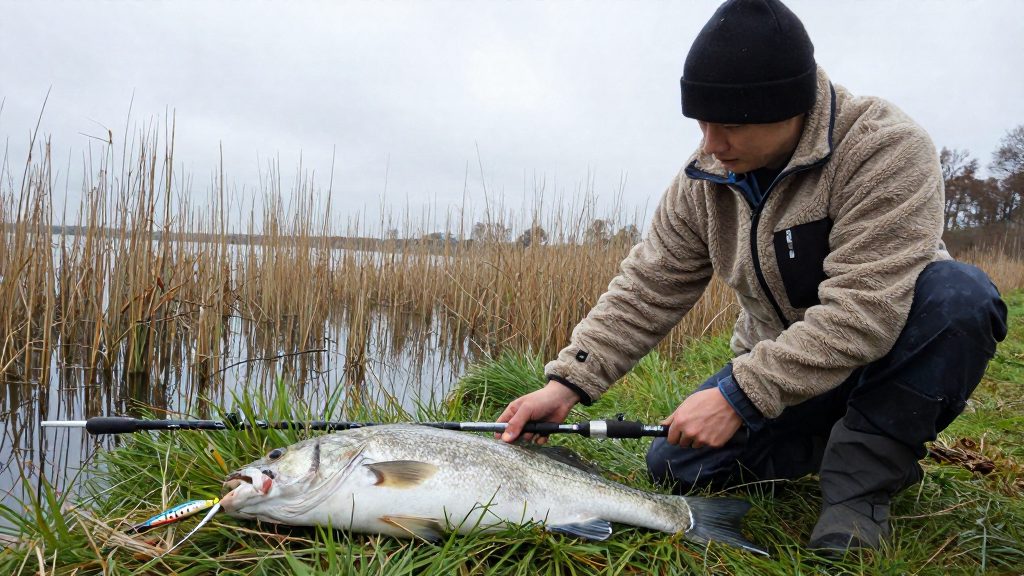
Braid is thin and strong, but it has no tolerance for sharp teeth. Pike and zander can saw through braid when they roll, shake their heads or drag the lure against their jaws. For pike in particular, many anglers use a wire or heavy fluorocarbon leader. A short piece of tougher line at the lure end, called a leader, takes that contact so the braid stays intact. The braid can then stay thin for casting while the leader handles the damage.
Teeth-cut risk by species
| Species | Teeth and mouth | Leader priority |
|---|---|---|
| Pike | Teeth line the jaws and palate, and the fish thrashes hard near the lure | High |
| Zander | Sharp, dense teeth; the fish often takes lures deep in the mouth | High |
| Perch | Small, spiny teeth; less cutting force | Lower |
Leader length for pike, zander and perch
Length matters more than thickness for protection. The leader should be long enough to cover the area where the fish’s teeth can reach the line during a bite or a roll. Pike need the longest leader, zander somewhat less and perch the shortest.
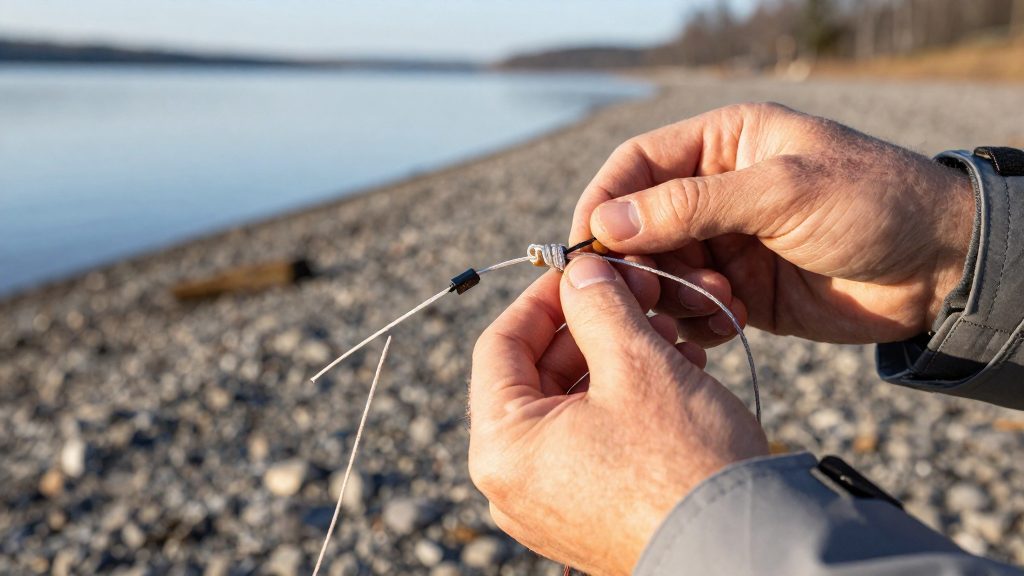
Knot joining leader and braid, step by step
The Albright knot is a common choice for joining braid to a leader:
- Form a loop in the end of the leader.
- Pass the end of the braid through the loop, running it alongside the leader’s standing part.
- Wrap the braid back over itself and both strands of the loop, working toward the loop’s closed end, for about ten turns.
- Pass the braid’s tail back through the loop, exiting on the same side it entered.
- Moisten the knot with water, then pull slowly so the wraps seat evenly.
- Trim the tags close to the knot.
How does line diameter affect casting distance?
Line diameter affects casting distance mainly through resistance. A thinner line presents less surface area to the air during the cast and to the current during the retrieve. Less drag on the line in flight lets a lure travel further for the same effort. The effect is most noticeable with light lures, where line drag makes up a larger share of the total resistance.
The key idea is the diameter-to-strength ratio. Each material delivers a different breaking strength for a given diameter. Braided lines are generally built thinner for a comparable strength than monofilament, and fluorocarbon usually sits closer to monofilament. Two spools labelled with the same strength can therefore have clearly different diameters, so compare the diameter printed on each manufacturer’s label rather than assuming the strength rating tells you the thickness.
Thinner line also raises spool capacity. Less line volume per yard means the same spool holds a longer length, which helps when a hooked fish runs across open shore or when you fish water with long casting distances.
What thinner line trades away:
- Lower abrasion resistance: it wears faster against rock edges, weed beds and gravel.
- Less visible margin when the line is damaged, since fine line can be nicked without obvious signs.
- Harder handling on the fingers during long casts, especially with heavier lures.
- More tangles on reels with poor line lay, which makes careful spooling more important.
Matching line to cover and water clarity
Line visibility matters most in clear water, where fish may be able to see the line. Around weed beds and snags, line strength and the ability to pull fish clear of cover matter more than colour.
Line colour and visibility in clear water
In clear, still water, choose subdued colours such as clear, smoke or green-tinted line. These blend into the background better than bright yellow, white or orange. Bright colours are easier for you to see on the surface, so some anglers use them where the water is clear but they need to track the line, for example when watching for a bite on a long cast. Check the colour in the light you’ll actually fish in, because line that looks faint under shop lighting can stand out at the water’s edge.
Low-visibility options for stained, murky water
In coloured or murky water, fish have less chance to see the line at all, so a subdued colour adds little benefit. Pick a colour that’s easy for you to see, since you’ll rely on the line to detect bites and control the lure. Keep your line tight and watch its movement, especially when fishing lures at a slow pace.
Fishing line around weed beds and snags
When fishing near weed or submerged wood, fish are often holding in cover, so colour matters less than strength. Choose a line strength that allows you to pull a fish out of weed without repeatedly breaking off. Keep your rod held high to lift the fish up and over obstacles, and don’t let the line go slack, because slack line can wrap around snags. Use a line with a suitable breaking strength for the species and cover, and adjust your drag so the fish can take line in short runs without snapping the line.
Line care and when to replace it
Fishing line wears through use, UV exposure and heat, so its condition can change between sessions without any obvious sign. A quick hand check before each outing, a few simple storage habits and a clear replacement rule will keep your line dependable when a fish takes the lure.
Visual and tactile checks
Run the line slowly through your fingers from the reel to the terminal knot and look for three kinds of damage:
- Nicks: small cuts or flat spots, usually from rocks, pier edges or bank debris.
- Fraying: a fuzzy or whitened surface, most often near the knot and where the line rubs the rod guides.
- Kinks: loops that do not straighten when you pull the line taut. They weaken the line at the bend and can cause tangles during the cast.
Focus on the section nearest the lure and the knot, since these take the most stress during a cast and a fight.
Storage away from sunlight and heat
Sunlight and heat degrade fishing line over time. Store spools in a cool, dry, shaded place, such as a tackle box or spool case, and keep them away from car dashboards, radiators and window sills. Do not leave a reel with line on it in a hot car between sessions.
| Storage condition | Effect on line | Practical choice |
|---|---|---|
| Direct sunlight | Accelerates surface ageing | Shade the reel or spool case |
| Hot car or radiator | Heat weakens the line | Carry tackle in a cool bag |
| Damp, sealed box | Trapped moisture can affect the spool and tackle | Dry the spool before boxing it |
When to replace the line
Replacement depends on how often and how hard you fish, so set a rule based on inspection rather than a fixed calendar:
- After visible damage: replace the line if nicks or fraying remain after you cut back and retie.
- After a hard snag or a large fish: replace the length that took the strain if its surface is damaged.
- When kinks persist: if a loop will not come out after stretching the line gently, replace the affected section or the spool.
- Before each season: inspect the line closely and replace it if it shows wear.
Monofilament is inexpensive, according to Outdoor Life (2023), which makes regular replacement a practical habit for beginners.
Frequently asked questions
Is monofilament a good first line for shore fishing?
For lighter setups, yes. Monofilament is inexpensive and easy to tie, which makes it practical while you learn knots. It is mostly used for tests under about 10 lb, and it suits topwater lures, trout and live-bait rigs.
Why does line stretch matter when I fish with lures?
Stretch absorbs part of the movement that travels from the fish to your rod. That cushions the fight but makes subtle bites harder to feel, so you will need a firmer hook set to drive the hook home.
How can I tell when my line needs replacing during a session?
Run the line through your fingers after each snag or heavy fish. Flat spots, fuzzy patches or small nicks mean the line has lost strength at that point. Cut back to sound line and retie, because a damaged section can fail under load.