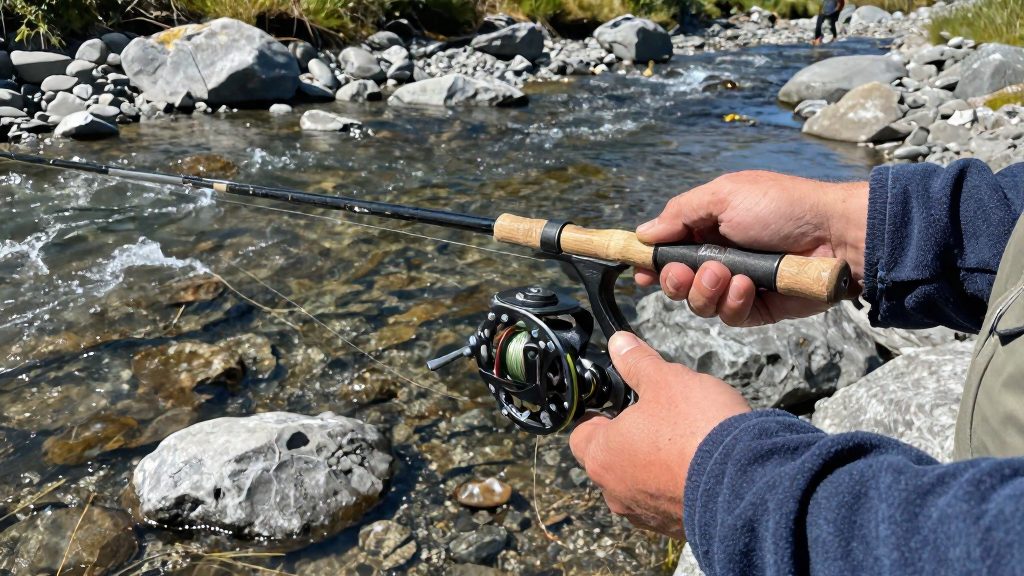
For most trout sessions, monofilament is the simpler choice and fluorocarbon is the stealthier one. Monofilament costs less and is easier to handle, while fluorocarbon is harder for trout to see underwater. Neither line is wrong, so the right pick depends on water clarity and the lure you are throwing.
Mono vs fluoro: the short answer
Overall verdict
Choose monofilament for an easy, low-cost main line that works across most trout waters and lure types. Choose fluorocarbon when the water is clear, the fish are wary, or you are fishing sinking lures. Neither choice is a mistake for a beginner. The real difference is simplicity versus stealth, not whether the line will catch trout.
Core trade-off across visibility, stretch and handling
| Factor | Monofilament | Fluorocarbon |
|---|---|---|
| Underwater visibility | Higher than fluorocarbon | Least visible line underwater (Field & Stream, 2026) |
| Sinking | Sinks more slowly | Sinks faster than mono (Berkley, 2026) |
| Cost | Standard freshwater spool typically under $12 (Field & Stream, 2026) | Costs more |
| Handling | Supple and easy to tie | Stiffer and harder to tie (Field & Stream, 2026) |
Stretch cuts both ways. Monofilament’s stretch can keep hooks from pulling out of a trout’s soft mouth, but it can also mask subtle bites. Fluorocarbon has less low-end stretch, which gives better hooksets at distance.
For a beginner, the handling differences are the practical deciding factor. Monofilament is easier to spool, knot and manage in cold hands on the bank, while fluorocarbon’s stiffness can make knots fiddly. Pound-test is the breaking strength printed on the spool, so check the label of any spool you buy.
Which setup suits typical trout sessions
- Beginners fishing general trout water with bait or spinners: 4-lb monofilament, for its cost, flexibility and simpler knots.
- Clear water or wary fish: fluorocarbon, since it is the least visible option underwater.
- Sinking lure presentations: fluorocarbon is a reasonable choice because it sinks faster than mono.
- Topwater lures and small baits meant to suspend: avoid fluorocarbon, which sinks faster than mono and is a poor fit for these presentations (Berkley, 2026).
- Clear or pressured water: be cautious with braid as a main line, since it is highly visible and can spook trout.
A sensible starting point is 4-lb monofilament. Switch to fluorocarbon when you find fish refusing your presentation in clear water, or when your lure needs to sink.
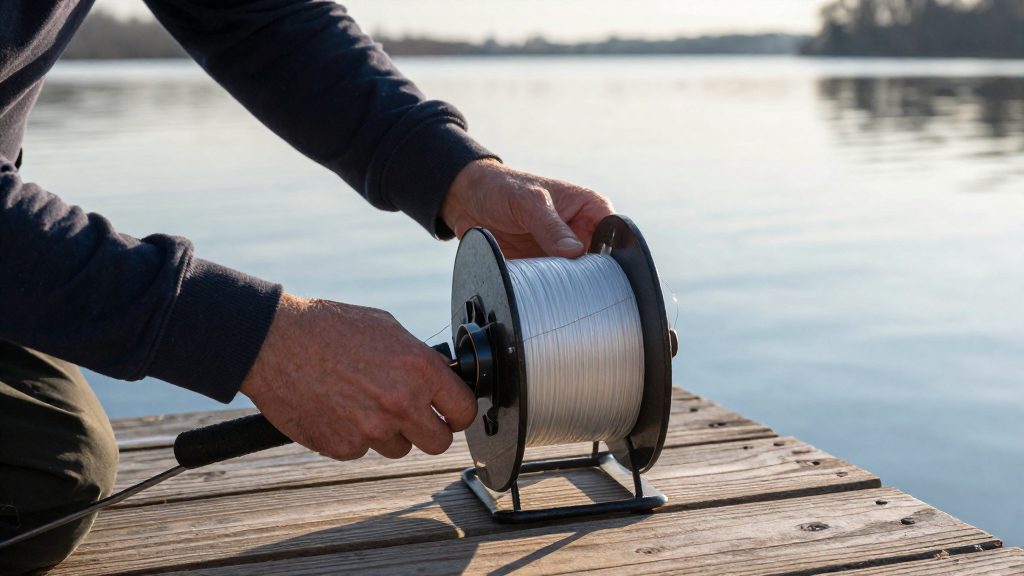
Which line is less visible to trout?
Fluorocarbon is the least visible of the main line types underwater. Field & Stream (2026) rates it as the least visible option, while braid is highly visible and can spook trout. Fluorocarbon’s low visibility comes from how it interacts with light in the water.
| Line | Visibility underwater | Source |
|---|---|---|
| Fluorocarbon | Least visible; refractive index nearly the same as water | Field & Stream (2026); Berkley (2026) |
| Braid | Highly visible; can spook trout | Field & Stream (2026) |
Why fluorocarbon is hard to see
Light bends when it passes between materials, and the amount it bends is the refractive index. Berkley (2026) reports that fluorocarbon has nearly the same refractive index as water. A line that bends light almost like the surrounding water blends into the background, so a trout’s eye has less contrast to pick up.
Why braid can spook trout
Braid is highly visible underwater, according to Field & Stream (2026). A trout that notices the line before the lure may treat the whole presentation with suspicion and refuse the bait. Braid’s strength and thin diameter make it popular for casting, but its visibility is the trade-off to plan for when trout are the target.
Judging visibility in clear and stained water
The sources do not compare visibility in clear and stained water, so the test has to be practical. Cast your line into the water you plan to fish and watch it from the bank. If you can follow it easily with your eyes, a trout at a similar depth is likely to see it as well. Repeat the check in different light, such as bright sun and overcast conditions, because the line’s appearance changes with the light.
Does stretch help or hurt with trout?
Stretch changes how a line behaves after the hook goes in, and it works in both directions. According to Field & Stream (2026), monofilament stretch can keep hooks from pulling out of a trout’s soft mouth. The line absorbs the sudden surges a fish makes when it lunges or thrashes, so the hook holds better under that load. The same give has a cost. Monofilament can also mask subtle bites, so a trout that briefly mouths a worm or a small spinner may not produce a clear pull you can feel through the rod. Because a soft, stretchy line dampens the signal, you may miss the take entirely.
Fluorocarbon sits at the other end of the spectrum. Berkley (2026) reports that fluorocarbon has less low-end stretch than nylon monofilament, and that this gives better hooksets at distance. When you cast a long way and need to drive the hook point home, less give means less of your rod movement is lost before the hook engages. Because it stretches less, it may also give less cushioning against a fish that pulls hard during the fight.
In practice, the two lines suit different situations:
- Monofilament: better for keeping hooks in soft mouths, but bites are harder to read.
- Fluorocarbon: better for a firm hookset at long range, with more direct bite feedback.
Sinking vs floating: matching line to lure
Fluorocarbon sinks faster than monofilament, and that difference decides which line suits a given lure. Choosing between the two depends less on strength than on how the lure needs to behave in the water. The sink rate of the line determines how far the lure sits below the surface, which in turn affects whether it stays on top or hangs at the depth you intend.
How sink rate differs between the two lines
Berkley (2026) states that fluorocarbon sinks faster than monofilament. Monofilament sinks more slowly, so it stays closer to the surface when it is left to settle on the water. The gap is a matter of degree, and the exact figures depend on the brand and diameter, so check the manufacturer’s information on the spool if you need precise values.
| Line | Sink behaviour | Practical effect on the lure |
|---|---|---|
| Fluorocarbon | Sinks faster than monofilament | Pulls the lure down, lowering its working depth |
| Monofilament | Sinks more slowly | Keeps the lure nearer the surface |
Why a sinking line fails with topwater lures
A topwater lure is meant to work on the surface, and it needs the line to stay high in the water. When the line sinks quickly, it drags the front of the lure under, so the bait stops popping or walking as intended. For this reason, Berkley (2026) describes fluorocarbon as a poor choice for topwater lures. Monofilament is the more forgiving option, because its slower sink keeps the line and lure closer to the surface.
Presenting small baits that need to suspend
A suspending presentation keeps a small bait at a steady depth, neither floating up nor dropping to the bottom. Fluorocarbon’s faster sink works against this, since the bait tends to fall past the depth you want. Berkley (2026) also identifies small suspending baits as a poor match for fluorocarbon. Monofilament, which sinks more slowly, gives the bait more time to hold its position. Adjust the weight of the lure or the depth of your retrieve to fine-tune the presentation, rather than changing the line’s sink rate.
Is fluorocarbon worth the extra cost?
For a hobbyist on a limited budget, monofilament is the practical default. Fluorocarbon justifies its higher price only when its specific properties matter for how you fish. According to Field & Stream (2026), monofilament is the cheapest option, with a standard freshwater spool typically costing under $12, while fluorocarbon costs more. If you replace line often, the higher price of fluorocarbon can add up.
Fluorocarbon’s main case rests on how it behaves over time. Berkley (2026) states that UV does not affect fluorocarbon and that it does not absorb water. If you leave line on a reel for long periods between sessions, those two properties are the ones to weigh against the cost. The sources do not say how monofilament compares on UV resistance or water absorption, so check the manufacturer’s information before judging.
Handling is the other trade-off. Field & Stream (2026) describes monofilament as supple and easy to tie, and fluorocarbon as stiffer and harder to tie. The table below summarises these points.
| Property | Monofilament | Fluorocarbon |
|---|---|---|
| Price | Cheapest; standard freshwater spool typically under $12 | Costs more than monofilament |
| Stiffness | Supple | Stiffer |
| Tying | Easy to tie | Harder to tie |
For a beginner, the stiffness difference affects every knot you tie. Practise your knots on monofilament first, since its suppleness makes mistakes easier to correct. Move to fluorocarbon once knot tying feels routine, so the extra stiffness no longer slows you down. If your budget allows, buy one spool of each and compare them at the same reel and rod setup before committing to a full season’s supply.
Best line weight for trout
For most trout fishing, around 4-lb main line is the practical starting point. Field & Stream (2026) suggests about 4-lb line for most situations, whether you use monofilament or fluorocarbon as the main line. Monofilament needs to be very light in pound-test to suit trout, so treat 4 lb as the reference and adjust from there based on your rod’s rating and conditions.
Adjusting pound-test to water and fish size
Pound-test is the breaking strain printed on the spool, and it should move with the conditions rather than stay fixed:
- Clear, pressured water: move toward the lighter end of your range, since trout are more wary and a thinner line is harder to see.
- Snags, weed or rocky cover: move toward the heavier end, so you can pull fish out of cover without the line parting.
- Larger fish: step up when you expect bigger trout, so the line can handle sudden runs.
- Small fish or small lures: stay light, because a heavier line can restrict the action of a small bait or spinner.
Avoid going much lighter than your rod and reel can handle. A line that is too fine for the terrain is more likely to break on the first snag.
Matching breaking strain to lure weight
Your lure has to carry enough weight to cast well, and the line has to be strong enough for the lure and the fish. Check the lure-weight rating printed on the rod blank, then choose a line that suits the lightest lures you plan to throw. Lighter lures generally pair with lighter line, and heavier lures with heavier line.
| Situation | Direction from 4 lb |
|---|---|
| Clear water, small lures, wary fish | Lighter |
| Heavy cover, snags, weed | Heavier |
| Large trout expected | Heavier |
| Small spinners or baits | Lighter |
Mono main line with a fluoro leader
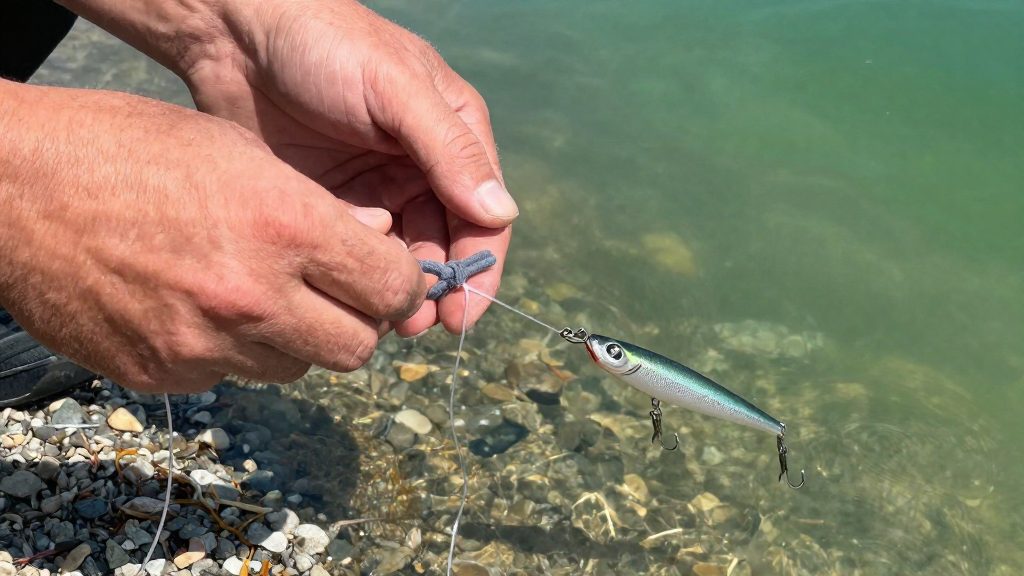
A hybrid setup uses monofilament as the main line on the reel and a short fluorocarbon leader tied to the business end. Each material covers a different job. Monofilament is the cheapest and most supple option. Fluorocarbon sits closest to the lure, where a trout inspects the bait. According to Berkley (2026), it has nearly the same refractive index as water, which makes it hard for fish to see.
Connecting mono to fluoro
The two lines are joined with a knot in the middle of the rig. Use a knot designed for joining lines of different materials and diameters, such as the double uni knot or the Albright knot. Both are widely used in freshwater fishing. Before you tie either, check the knot diagram in the manufacturer’s instructions for your line. Leave a short tag end, about an eighth of an inch, after tightening, and trim it cleanly so the connection does not snag on the rod tip or on weed.
Leader length where visibility matters most
The fluoro section should cover the water where the trout can see the bait. Keep the fluorocarbon leader long enough to cover the last stretch of line near the lure, where trout inspect the bait. Adjust the length by trial, and check that your knot passes smoothly through the rod guides. The exact length depends on water clarity and how closely the trout is feeding, so adjust it by trial rather than fixing a single value.
Frequently asked questions
Can I use fluorocarbon for every trout lure?
No. According to Berkley (2026), fluorocarbon sinks faster than monofilament, which makes it a poor match for topwater lures and small baits meant to hang at a set depth. For those presentations, monofilament keeps the lure higher in the water column.
What pound-test should a beginner start with for trout?
Field & Stream (2026) suggests about 4-lb line for most trout situations, whether you choose mono or fluorocarbon as the main line. Check the breaking strength printed on the spool label before you buy, since line sold under different brand names can vary.
Is braid a good main line for trout?
Usually not. Field & Stream (2026) notes that braid is highly visible to fish and can spook trout in clear water. If you want a line that is hard to see, fluorocarbon is the better option.