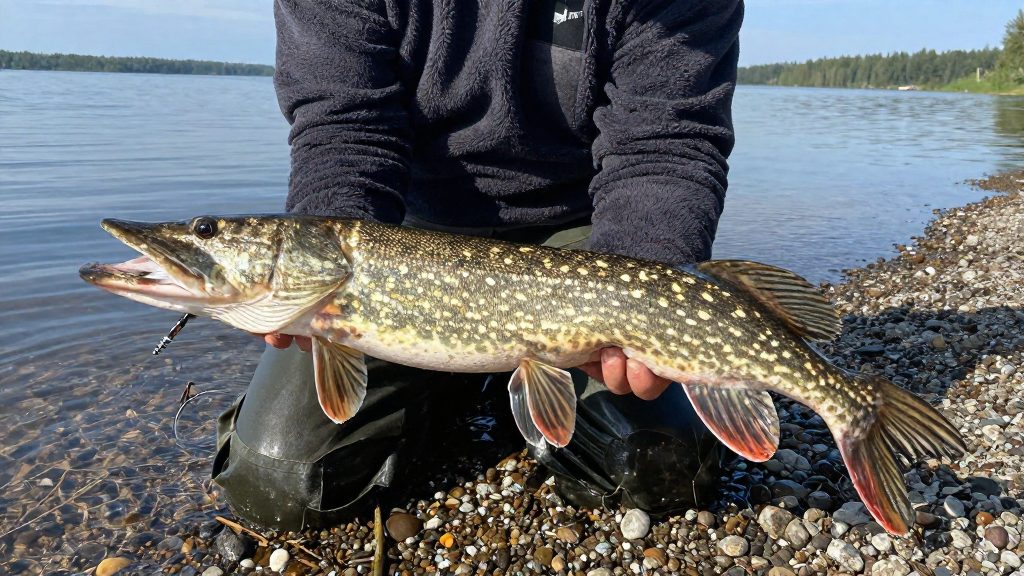
A lip gripper is a clamp-style tool that holds a fish by its lower lip, so you can control the fish while you remove the hook.
What is a lip gripper and when should you use one?
How the jaws work
A lip gripper has two jaws on the end of a pair of handles. You open the jaws, place them around the fish’s lower lip, and squeeze the handles to close them. The grip holds the fish at the end of the tool while you work on the hook with your other hand. Because the tool holds the lip rather than the body, you keep control without lifting the fish clear of the water.
When to use one
Outdoor Guide (2025) recommends a lip gripper for larger, hard-to-handle or toothy fish, and says to secure the fish with it before removing the hook.
| Situation | Recommended approach | Source |
|---|---|---|
| Larger, hard-to-handle or toothy fish | Secure with a lip gripper before removing the hook | Outdoor Guide (2025) |
Testing the jaws before use
Sport Fishing magazine (Sam Hudson, 2017) advises testing a gripper before relying on it. Squeeze the handles firmly, with the tool closed on a firm object, and confirm the jaws stay shut. A gripper that slips under pressure should be replaced or repaired before you use it on a fish.
Which fish should you never lip grip?
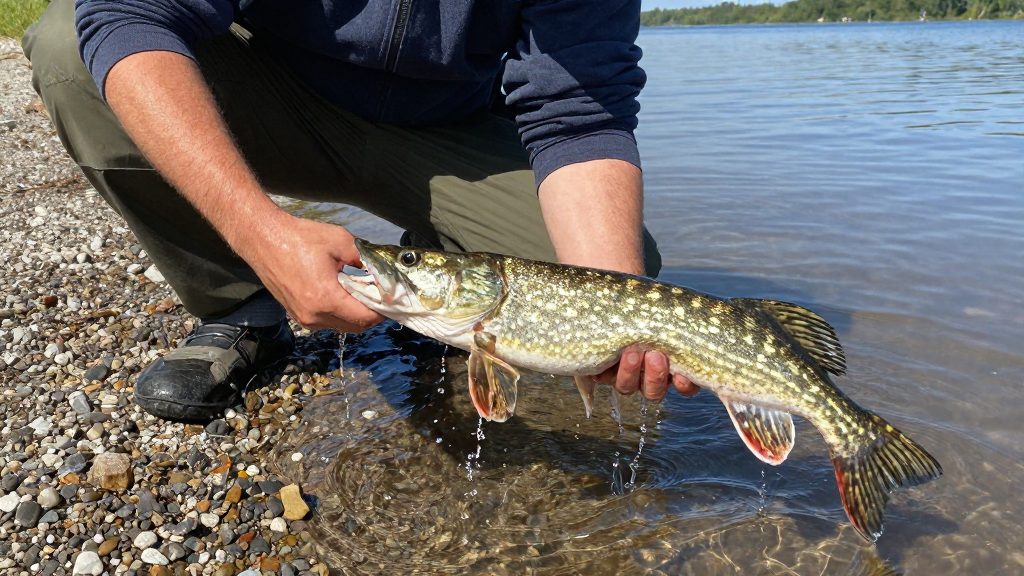
Avoid lip grips on pike and muskies because of their razor-sharp teeth. Sports Illustrated (Joe Shead, 2025-06-24) advises this for both species. Sports Illustrated (Joe Shead, 2025-06-24) advises avoiding lip grips on these two species for this reason. Walleye have sharp dorsal spines, so Sports Illustrated (Joe Shead, 2025-06-24) advises holding them by the belly. Choosing the hold before the fish leaves the water prevents most accidents.
Pike and muskies: hold the back of the head
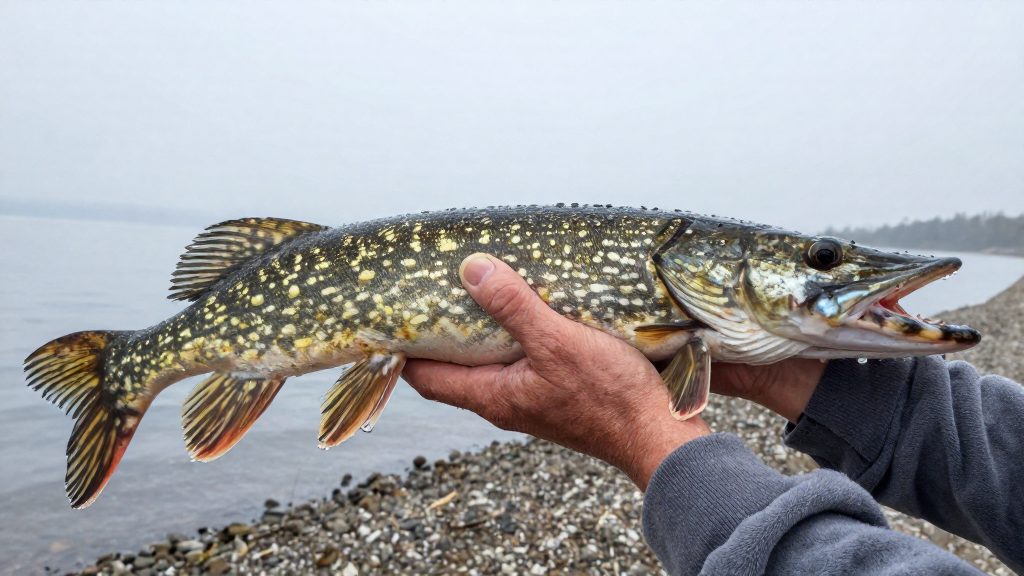
Pike and muskies have razor-sharp teeth, so the safer hold is behind the head, provided the fish is not too large. The same source states that this hold works for both species and for walleye when they are not oversized. Keep your fingers clear of the mouth and hold the fish by the back of the head, as the source describes.
If a pike or musky is too large for a back-of-head hold, do not lip grip it. Keep the fish in the water as much as possible and unhook it with long-nosed pliers or cut the line if needed.
Walleye: hold by the belly
Walleye have sharp dorsal spines running along the back. Holding the fish by the belly keeps your hand away from them. Support the body with the palm under the belly and fingers closed around it, rather than gripping across the back.
| Species | Recommended hold | Reason |
|---|---|---|
| Pike | Back of the head, if not too large | Razor-sharp teeth |
| Muskies | Back of the head, if not too large | Razor-sharp teeth |
| Walleye | By the belly | Sharp dorsal spines |
How do you grip a fish safely?
A lip gripper holds a fish by the lower lip, which keeps your hands away from the mouth while you work. The grip only protects you and the fish if the hand position is right and the tool is in good condition.
Lower lip grip for bass and crappies
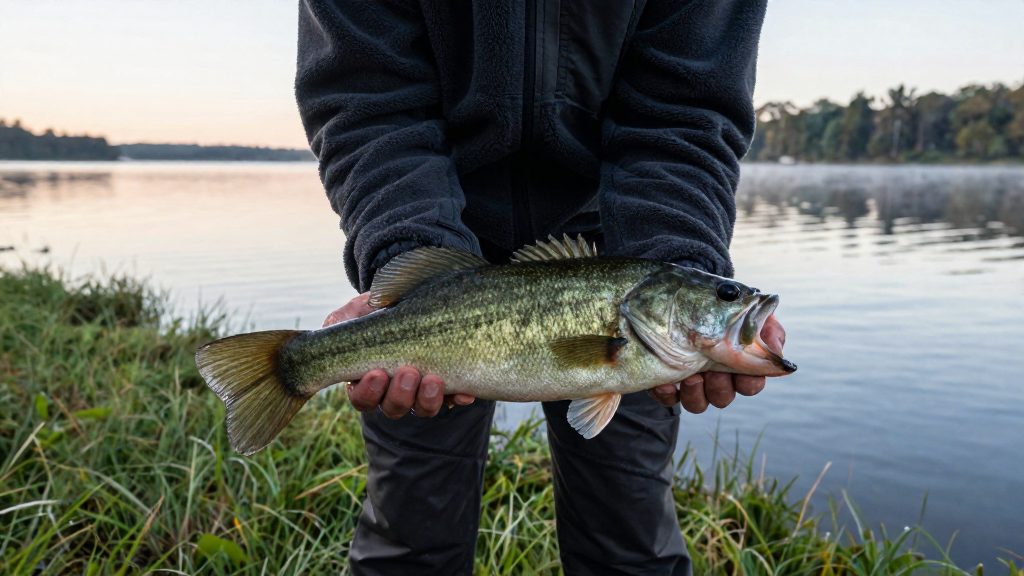
Bass and crappies can be grabbed by the lower lip, according to Sports Illustrated (Joe Shead, 2025-06-24). Close the gripper on the lip only, and do not apply leverage to the jaw. Keep your other hand free to support the fish’s weight horizontally.
Testing the gripper before use
Check the tool before you rely on it. According to Sport Fishing magazine (Sam Hudson, 2017-06-06), you should confirm that the jaws stay closed under firm squeezing. Do this at home, not on the bank, so a slipping gripper does not surprise you with a fish in hand. For the locking mechanism, follow the manufacturer’s instructions.
Keeping fingers clear of teeth and fins
Your fingers should stay out of the mouth area at all times. Keep your fingers out of the mouth and away from the gills.
Why support the body, not just the jaw?
A lip gripper holds a fish at one point, the lower jaw, and that point carries the whole weight of the animal. Supporting the body horizontally with a second hand spreads that load along the fish’s length, which protects the jaw and the internal organs. This matters most for larger fish, where the weight is significant enough to strain the mouth and damage tissue.
Larger fish need their weight supported horizontally with the other hand. The principle is simple: the gripper secures the head, and the free hand carries the body.
Reducing strain on the lower jaw
Lifting a fish by the gripper alone pulls the lower jaw downward and sideways. Hanging the fish from the lip puts the strain on the lower jaw. Keep the fish level, with its belly resting in your open palm, and let the gripper act only as a guide for the head.
Practical handling steps:
- Grip the lower lip with the gripper and close it firmly.
- Slide your free hand under the belly, fingers spread, so the fish rests across your palm.
- Keep the body horizontal and avoid raising the head above the tail.
- Lower the fish gently when you need to free your hands, and set it back in the water when possible.
Supporting the organs of larger fish
Support the fish horizontally with one hand under the belly: this reduces strain on the lower jaw and supports the organs.
| Handling method | Load on lower jaw | Support for body and organs |
|---|---|---|
| Gripper only, fish hanging | More strain on the jaw | Little support for the organs |
| Gripper for the head, free hand under belly | Reduced | Full, body horizontal |
Should you hang a fish from a gripper to weigh it?
No. Sport Fishing magazine (2017) recommends weighing a fish with a knot-free net instead of hanging it from a lip gripper. When a gripper suspends the whole body, all of the weight pulls on the lower jaw.
Comparing the two methods
| Method | Where the weight sits | Guidance |
|---|---|---|
| Hanging from a lip gripper | Entire body weight on the lower jaw | Advised against by Sport Fishing magazine (2017) |
| Knot-free net | Carried by the net, not the jaw | Recommended by Sport Fishing magazine (2017) |
Weighing with a net
- Choose a knot-free net. Use a net with smooth, knot-free mesh so the fish can be lifted without catching on knots.
- Wet your hands before touching the fish. According to Outdoor Guide (2025), dry hands strip the fish’s protective mucus coating, which matters most for fish you plan to release.
- Lift the fish into the net. Place the net under the fish and lift it in, rather than using the gripper as a handle.
- Read the scale with the fish in the net. Note the reading, then remove the fish promptly.
Wet hands, pliers and unhooking
Handling a fish with a lip gripper is only one part of the job. Wet hands, a clear division of tasks between two people, and the right tool for the hook determine how much stress the fish takes and how quickly it can go back into the water. The steps below cover the routine for this stage.
Wetting your hands first
Before you touch the fish, wet your hands. Dry hands strip away the protective mucus coating that covers the skin of the fish, and that coating helps defend against infection. Outdoor Guide (2025) notes that this matters most for fish you plan to release. Wet your hands again whenever you return to the fish after a pause.
Splitting the job between two people
When two anglers are present, use a simple division of roles:
- Person A (controller): keeps the fish secure with the lip gripper, keeps it low and steady, and keeps it low and steady, and keeps it in the water as much as possible.
- Person B (unhooker): locates the hook, works it free, and releases the fish once the hook is out.
Sport Fishing magazine (Sam Hudson, 2017) recommends this two-person approach, with one person controlling the fish while the other removes the hook. Agree on the sequence before you lift the fish, so each person knows when to move. Keep the fight and the handling short, because a long struggle out of the water adds stress.
Using pliers to free the hook
Pliers are the tool for the hook itself. Once the fish is secured in the gripper, the unhooker should:
- Grip the hook shank or bend with the pliers, not the fish.
- Back the hook out along the path it entered, rather than pulling it sideways through the flesh.
- Keep steady pressure so the hook slides free without tearing tissue.
If the hook is deeply lodged, do not force it. If the hook is deeply lodged, do not force it. Cut the line close to the hook rather than causing more damage, and check your state fishing regulations for any rules on releasing fish. Check the rules and the manufacturer’s instructions for your gear.
How do you release a gripped fish properly?
Release begins while the fish is still on the gripper. According to Outdoor Guide (2025), the routine has three parts: keep the fish in the water, keep the fight short, and revive the fish upright, fully submerged, facing into the current. Each part limits the time the fish spends stressed or out of water, which matters because a fish that has been exhausted or handled for too long may struggle to recover after release.
Keep the fish in the water
Once the gripper holds the fish, work on the hook with the fish in the water wherever possible. Lift the fish only as high as needed to free the hook, then lower it back. Keeping the body submerged for most of the process reduces the time the gills are exposed to air.
Keep the fight short
A prolonged fight drains a fish’s energy before it reaches the net or the gripper. Use tackle matched to the species and size you are targeting, so you can bring the fish in promptly. A shorter fight means less stress, and a fish that is landed quickly generally recovers faster after release.
Revive upright, fully submerged, facing current
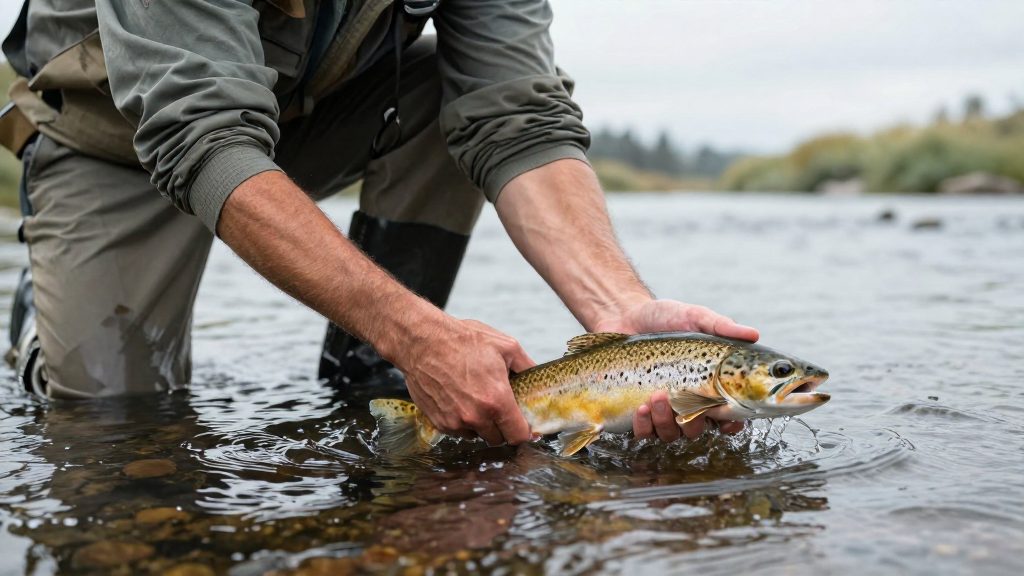
Once the hook is out, hold the fish upright with its whole body under the surface. Turn it so its head faces into any current, because moving water flows over the gills and supplies oxygen. Move the fish gently forward and back, so water passes through the gills, until it kicks free from your hand. Release it only when it holds its position and swims away under its own power.
Frequently asked questions
Can I use a lip gripper on bass or crappie?
Sports Illustrated (Joe Shead, 2025-06-24) notes that bass and crappies can be held by the lower lip, but you should avoid putting leverage on the jaw. Support a larger fish’s weight horizontally with your other hand.
What should I do with pike or walleye instead?
Pike and muskies can be held behind the head if they are not too large, which keeps your fingers away from their teeth. For walleye, hold the fish by the belly and keep your grip away from the dorsal spines (Sports Illustrated, Joe Shead, 2025-06-24).
Can I weigh a fish while it hangs from the gripper?
No. Sport Fishing magazine (Sam Hudson, 2017-06-06) recommends weighing the fish in a knot-free net rather than hanging it from the gripper, which puts strain on the lower jaw.