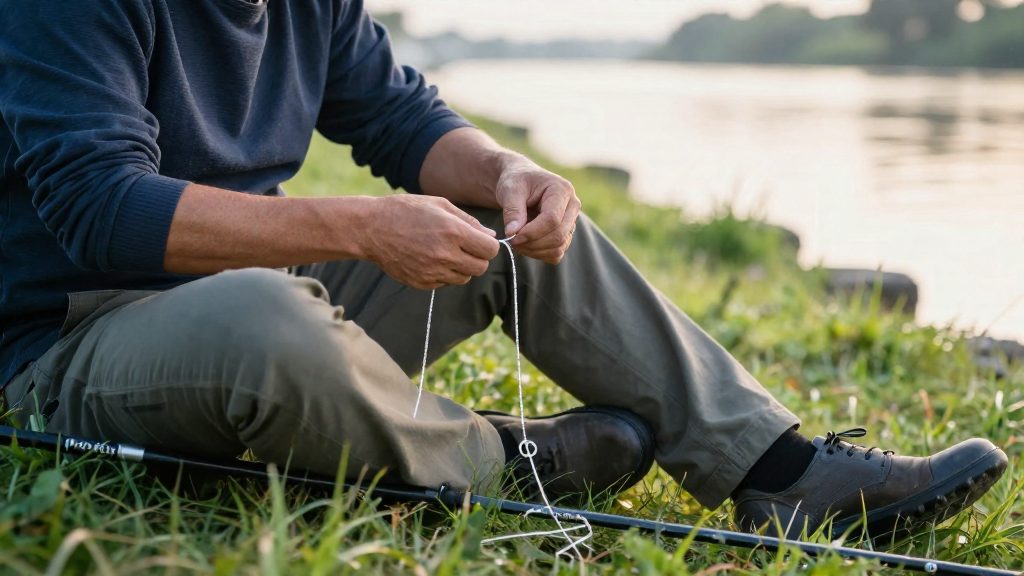
What is the Palomar knot and why use it?
Why braid pairs well with the Palomar
According to Fly Fisher Pro (2026), the Palomar performs especially well with braid. Outdoor Life (2025) notes that uni and clinch knots can slip on braid, which makes the Palomar a useful alternative when you fish with braided line.
Where the Palomar is used
| Attachment point | Why the Palomar fits | Beginner note |
|---|---|---|
| Single hook | The doubled loop passes through the eye, so the knot seats at the eye | Good starting point for practice |
| Lure | The loop passes over the lure’s eyelet | — |
| Swivel | Fly Fisher Pro (2026) lists tying on a swivel as a suitable use | Same tie as for a hook or lure eye |
Why it suits beginners
The Palomar is built around one overhand knot tied in doubled line, so there are fewer structural elements to remember than in multi-wrap knots.
What you need before you start
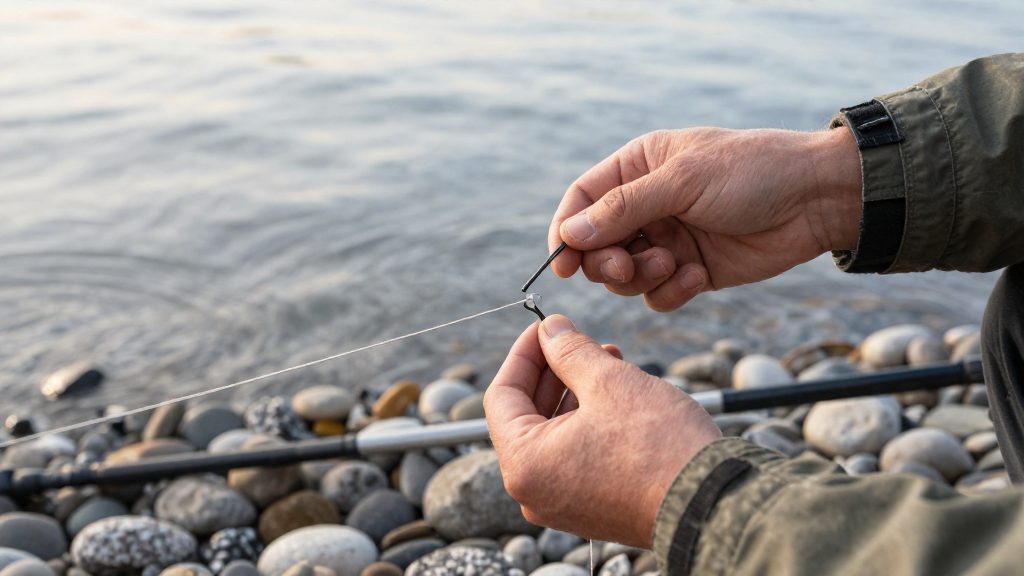
The Palomar knot needs only a few items: a length of line, a pair of scissors, a hook or lure with an eye, and a source of moisture. You can practise with the line already on your reel. The knot is tied by hand, so no special tools are required.
Tools and materials
| Item | Role in the knot |
|---|---|
| Line | Cut a length that lets you double about 6 inches of line (Tackle Warehouse). |
| Scissors | Used to trim the tag end once the knot is finished. A clean cut keeps the end neat. |
| Hook or lure eye | The doubled loop must be large enough to pass over the eye, so check that the line can fit through it before you start. |
| Saliva or water | Lubricates the line so the knot slides closed without binding. |
Lubricant
Saliva or water is the only lubricant needed. Outdoor Life (2025) notes lubrication matters most with mono and fluorocarbon, so keep moisture within reach from the beginning rather than adding it at the end. Wet fingers are enough; there is no need for a dedicated product.
Practice setup
Single hook practice is the best starting point. Use a plain hook with one eye so you can see exactly how the loop passes through and seats. Once the sequence feels repeatable, move on to lures with multiple treble hooks. Those hooks tangle easily, which makes them harder to work with while you are still learning the knot.
How do you tie a Palomar knot step by step?
The Palomar is tied in six steps: double a length of line, tie an overhand knot with the doubled section, pass the hook through the loop, moisten the knot, cinch it down, and trim the tag end. According to Tackle Warehouse, the first step is to double about 6 inches of line and pass the loop through the hook or lure eyelet. Each step sets up the next, so the order matters.
| Step | Action | What to check |
|---|---|---|
| 1 | Double about 6 inches of line and pass the loop through the eyelet | The loop must be large enough to pass over the lure or hook |
| 2 | Tie an overhand knot with the doubled line | Keep the two strands of the loop separate and untwisted |
| 3 | Pass the hook or lure eye through the loop | The eye should sit inside the loop before tightening |
| 4 | Moisten the knot | Wet it just before the final cinch |
| 5 | Cinch the knot down onto the eye | The loop should seat at the eye |
| 6 | Trim the tag end | Leave enough tag end during tying, then trim once the knot is set |
Building the loop
Doubled line provides the loop. Fly Fisher Pro (2026) notes that the loop must be big enough to pass over the lure or hook, so start with more doubled line than you think you need. Keep enough tag end so you can grip the line while you work. Too short a tag end makes the later steps harder to control.
Passing the hook and cinching
Once the overhand knot is formed, pass the hook or lure eye through the loop. Draw the knot down slowly and evenly toward the eye, then trim the tag end close to the knot.
Which line types work best with a Palomar?
The Palomar works with mono, fluorocarbon, braid and super lines (Outdoor Life, 2025-02-25). Fly Fisher Pro (2026) says it performs especially well with braid and is not the best choice for heavy monofilament. The sources do not rank the line families against each other, so the sections below cover what each family means for the tie.
Braid and super lines
Braid and super lines are both within the Palomar’s supported range (Outdoor Life, 2025-02-25). Braid is also the line where uni and clinch knots can slip (Outdoor Life, 2025-02-25), so pull a knot tied on braid firmly and inspect it before the first cast.
Mono and fluorocarbon
Monofilament and fluorocarbon are within the Palomar’s supported range (Outdoor Life, 2025-02-25). Saliva lubrication matters most with these two families (Outdoor Life, 2025-02-25).
Heavy monofilament
Fly Fisher Pro (2026) states that the Palomar is not the best choice for heavy monofilament or for line-to-line joins. If you use heavy mono, check the knot recommendation on your line’s packaging or in the manufacturer’s instructions before tying the Palomar.
Avoid: Using the Palomar as your default knot on heavy monofilament.
Common Palomar mistakes and how to fix them
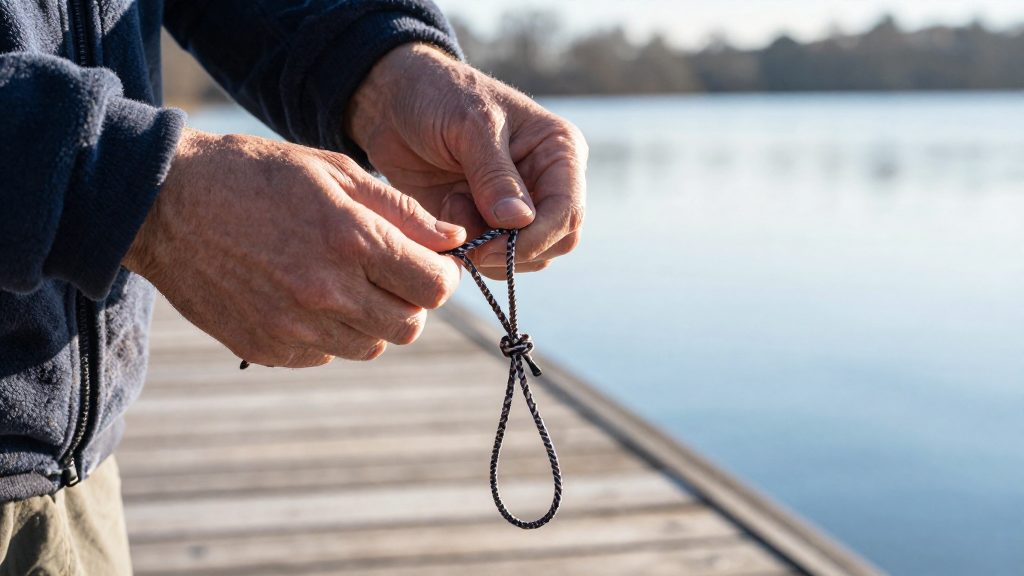
Tackle Warehouse identifies four common Palomar errors: crossing the lines, tightening the overhand knot too early, cinching unevenly, and letting the looped end wrap around the hook eyelet. Each error has its own fix below.
Crossed or twisted lines
According to Fly Fisher Pro (2026), crossing or twisting the lines can significantly weaken the knot. Before you start the overhand knot, lay the doubled line flat so both strands run side by side. If a twist appears, undo that section and lay the line straight again instead of tightening over it.
Overhand knot tightened too early
Tackle Warehouse notes that tightening the overhand knot too early can burn the line. Keep the overhand knot loose until the hook or lure eyelet has passed through the loop. Only pull it snug once the knot sits in position.
Uneven cinch and the loop wrapping the eyelet
An uneven cinch lets the loop wrap around the eyelet instead of seating at the eye. Pull the tag end and the standing line with even pressure so the loop settles neatly against the eye. If the loop catches on the eyelet, loosen the knot slightly, reposition the loop, and cinch again.
How do you make a Palomar knot stronger?
The Double Palomar adds strength to the standard knot. According to Fly Fisher Pro (2026), you wrap the tag end around the loop twice instead of once. The rest of the tie stays the same: double the line, form an overhand knot with the doubled line, pass the hook through the loop, then moisten and cinch.
| Step | Standard Palomar | Double Palomar |
|---|---|---|
| Tag end wrap around the loop | One wrap | Two wraps |
| Strength | Baseline | Adds strength (Fly Fisher Pro, 2026) |
The extra wrap needs more tag end, so leave enough line beyond the loop before you start.
When should you use a different knot?
The Palomar is a strong choice for tying line onto a hook, lure eye or swivel, but it has clear limits. It is not the best option for line-to-line joins, and it performs especially well with braid, where uni and clinch knots can slip. Choosing a knot depends mainly on what you are connecting.
Where uni and clinch knots fail on braid
Outdoor Life (2025-02-25) notes that uni and clinch knots can slip on braid. If you fish braid, remember that uni and clinch knots can slip, so the Palomar is a useful alternative for attaching a hook, lure or swivel.
Line-to-line joins need a different knot
Use a knot designed for joining two lines, and reserve the Palomar for connections to a hook, lure eye or swivel. Check a dedicated knot guide before tying a join, and practise the steps at home until the knot closes evenly.
Quick comparison
| Connection | Palomar suitable? | Notes |
|---|---|---|
| Braid to hook, lure eye or swivel | Yes | — |
| Braid to hook using a uni or clinch | Not recommended | Uni and clinch knots can slip on braid (Outdoor Life, 2025-02-25) |
| Mono or fluorocarbon to hook | Yes (not the best choice for heavy monofilament) | Fly Fisher Pro (2026) |
| Line-to-line join | Not the best choice | Fly Fisher Pro (2026) |
Frequently asked questions
What mistakes should I avoid when tying a Palomar?
The common errors are crossing the two lines, tightening the overhand knot too early (which can burn the line), cinching unevenly, and letting the looped end wrap around the eyelet. According to Tackle Warehouse, crossed or twisted lines are especially damaging, because Fly Fisher Pro (2026) notes they can significantly weaken the knot.
Should a beginner practise the Palomar on a lure with several hooks?
Start on a single hook. Outdoor Life (2025) recommends this because lures with multiple treble hooks tangle easily, so you can learn the sequence on a simpler attachment point first.
What is the Double Palomar?
The Double Palomar is a variant in which you wrap the tag end around the loop twice instead of once. Fly Fisher Pro (2026) says this adds strength to the standard knot.