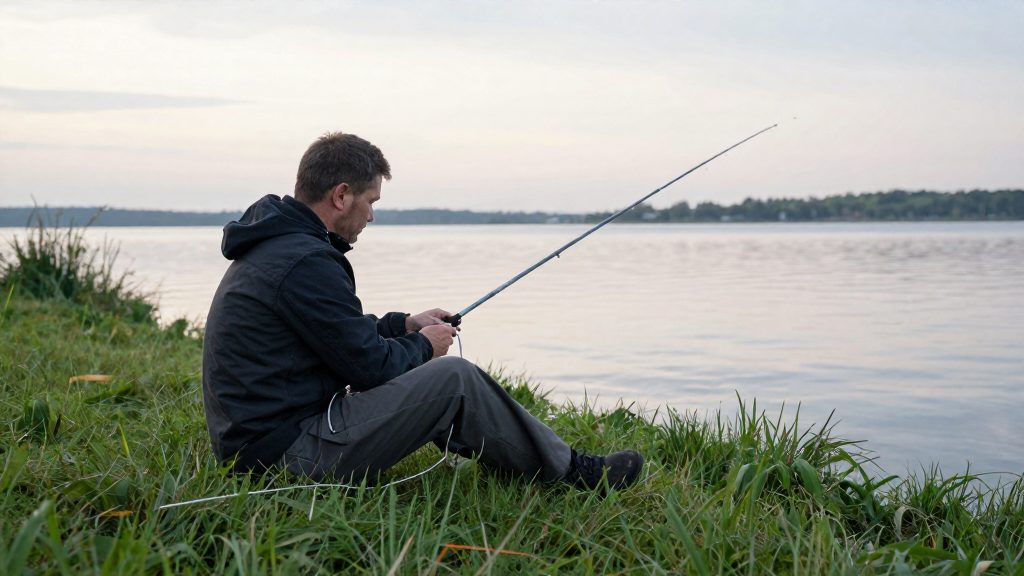
What is a uni knot, and why use it with braid?
The uni knot is a friction knot. The tag end wraps around the doubled standing line and passes back through the loop, so the knot holds through friction between the wraps and the line they grip. When the mainline is pulled, the wraps tighten onto the standing line instead of relying on a fixed stopper. Mississippi Sportsman (2014-05-13) describes the uni as dependable on braid, mono and fluorocarbon.
Why braid’s surface changes the grip
Braid is made of thin, low-stretch fibres with a slick surface. Those traits make the knot’s grip less forgiving than it is on monofilament. A friction knot works only as well as the contact between its wraps and the line, and a slick, thin line offers less to bite into. Check that the wraps have not slid apart before you apply load.
Gear you need before tying
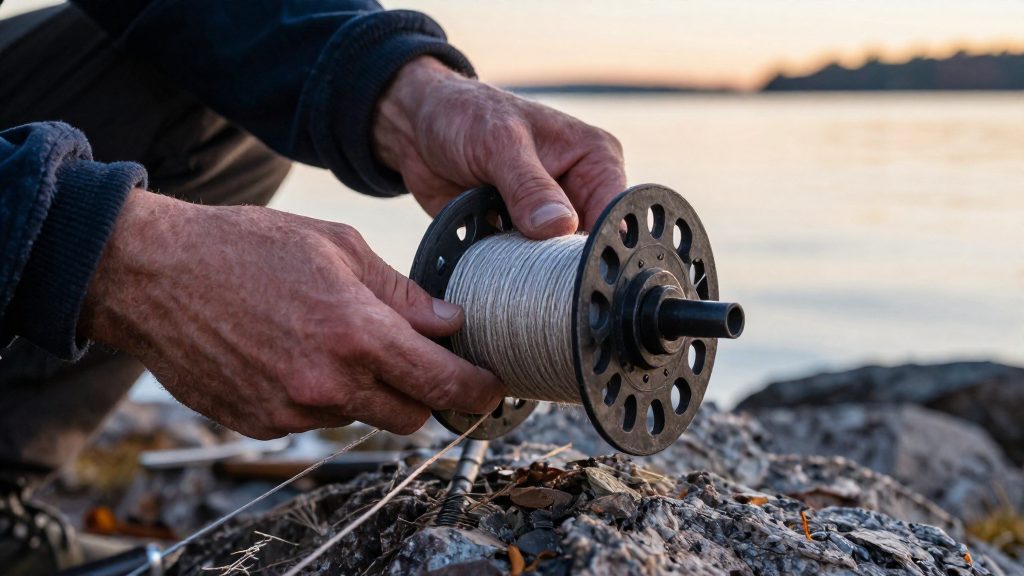
A uni knot on braid needs three things: a leader in a suitable material, sharp cutters, and a light rod and reel whose line rating matches the line you spool. Braid is usually joined to a leader because fish can see it, it has little abrasion resistance, and it can rip hooks free, according to Outdoor Life (2024-10-15). The leader acts as the section that meets the lure or hook, so choosing it deliberately matters as much as the knot itself.
Leader material: fluorocarbon or monofilament
Both materials work with the uni knot.
| Leader material | Documented use in this knot |
|---|---|
| Monofilament | Works with the uni knot (Mississippi Sportsman, 2014-05-13) |
| Fluorocarbon | Works with the uni knot (Mississippi Sportsman, 2014-05-13) |
Choose the leader diameter to suit your target species and the rod’s rating.
Sharp cutters for clean line ends
Keep a pair of line cutters for this job only. Braid fibres are harder to cut cleanly with worn or blunt tools, so check the blades before each session and replace them when they start to crush rather than slice. Store them where the blades cannot dull against other hardware in your tackle box.
Light spinning or baitcasting outfit
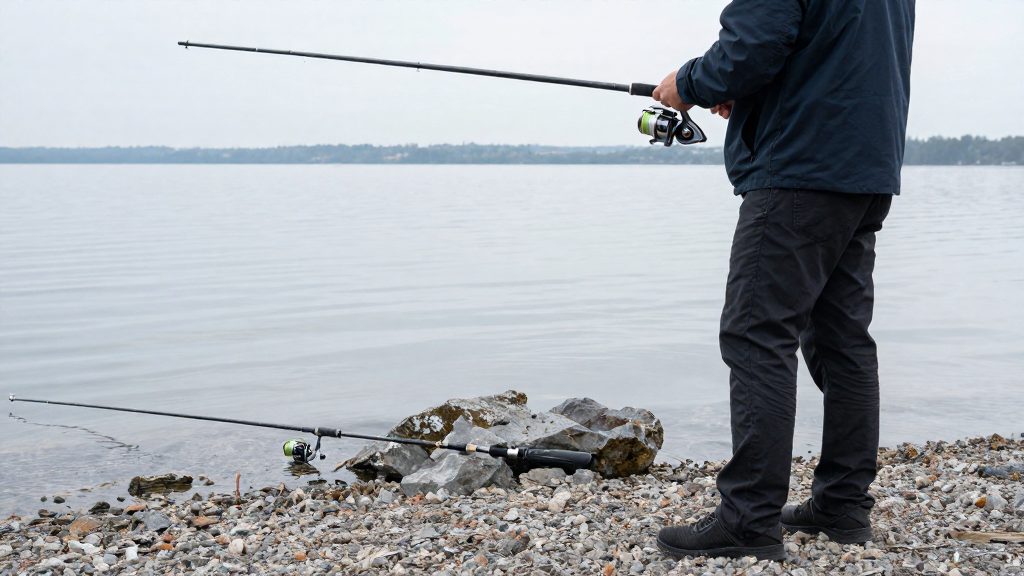
Match the line to the rod and reel before you tie. Check the line-weight or line-rating range printed on the rod blank, and the line capacity printed on the reel spool. Spooling braid heavier than the rod’s rating can overload the blank, while very light braid on a heavy rod gives poor control.
How do you tie a uni knot step by step?
The uni knot is tied in one continuous sequence: thread the line through the eye, wrap the tag end, pass it through the loop, then tighten and seat the knot. Each stage sets up the next, so work slowly and check the shape of the knot before you pull it tight.
| Step | Action | Result |
|---|---|---|
| 1 | Push the tag end through the eye of the hook, lure or swivel. | The line passes through the eye. |
| 2 | Double the tag end back alongside the standing line. | A circle forms, with two parallel strands. |
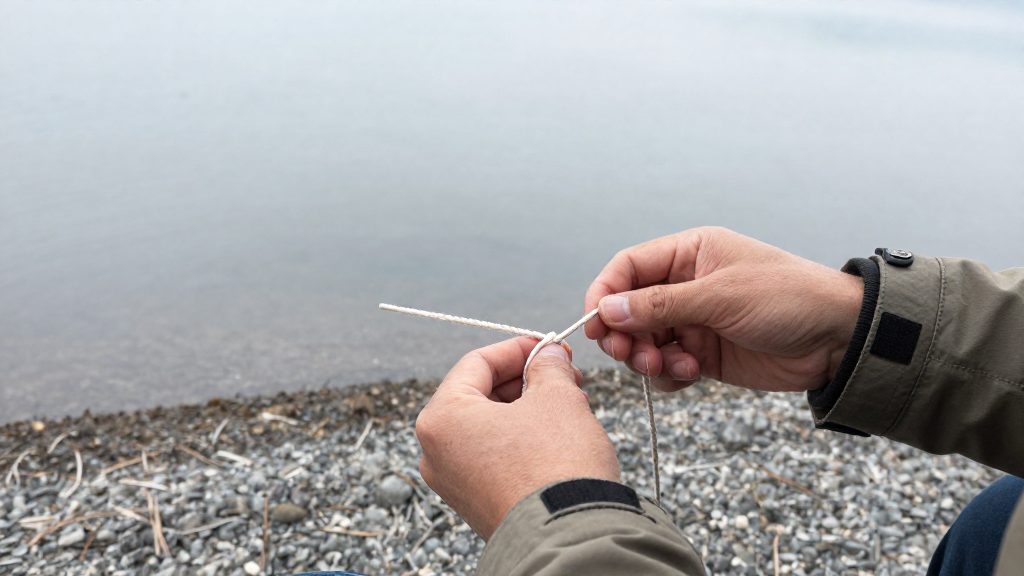
| 3 | Wrap the tag end around both strands of the doubled line, six times for the basic uni (Mississippi Sportsman, 2014-05-13). | A coil of tight turns sits above the eye. |
| 4 | Pass the tag end back through the loop beside the eye. | The wraps are locked in place. |
| 5 | Moisten the line and knot. | Friction drops during tightening. |
| 6 | Pull the standing line slowly to draw the wraps together. | The coil tightens around the doubled line. |
| 7 | Slide the knot down to the eye and pull to seat it. | The knot sits snug against the eye. |
| 8 | Trim the tag end close to the knot. | A short, clean tag remains. |
Keep the wraps neat and touching, with no crossed turns, before you start pulling. Loose or crossed turns make the knot harder to seat. Pull the standing line gently at first, then increase the load so the coil closes evenly.
Outdoor Life (2024-10-15) notes that friction is a problem when tightening uni knots, so the knot should be wet before the final pull. Mississippi Sportsman (2014-05-13) adds that friction heat can damage fluorocarbon, so always moisten the line before tightening.
How many wraps does braided line need?
For the double uni, the Animated Knots by Grog (Netknots) guide (2024) gives about 3 to 4 wraps on monofilament and double that count for braid, which is 6 to 8 turns. The guide’s figures apply to the double uni joint, so check them against the knot you are tying.
Wrap counts by line type
| Line type | Wraps around the standing line |
|---|---|
| Monofilament | 3 to 4 |
| Braided line | 6 to 8 (double the mono count) |
Count the turns of the tag end as they pass around the standing line.
Checking the grip after wrapping
The braid count is the starting point, not a guarantee. Inspect the coil before you pull, and confirm that no turns cross or sit loose. If a braid knot slides under load, the wrap count is only one factor to check, so re-examine the coil layout and the line pairing as well.
Joining braid to a leader with the double uni
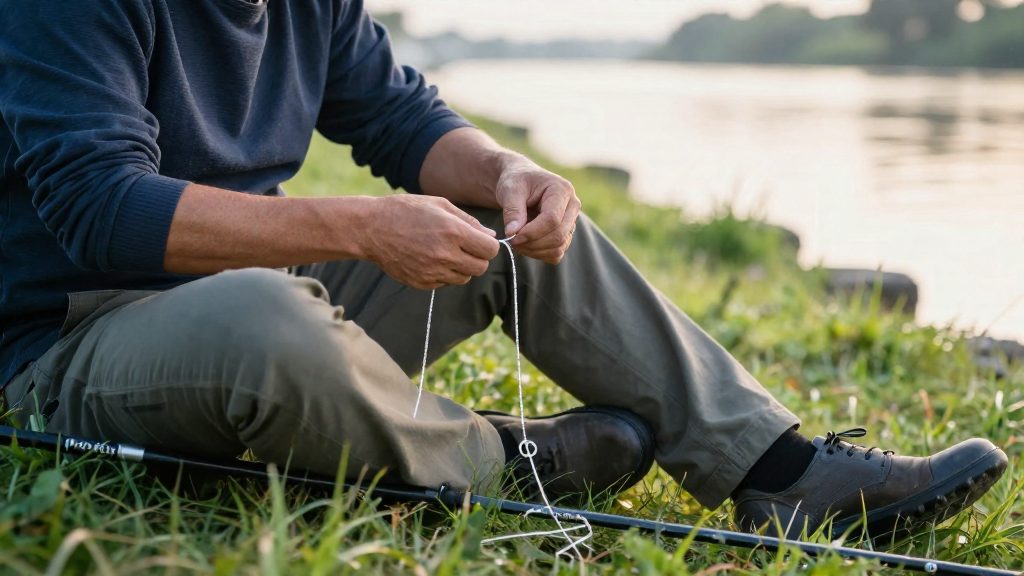
The double uni joins braid to a leader by tying two uni knots, one around each line, and then sliding them together so they grip each other.
Step 1: overlap the two line ends
Lay the braid end and the leader end side by side so they overlap by a short length, with the tags pointing in opposite directions. Both knots will sit in this overlapping section, so keep the lines parallel rather than crossed.
Step 2: tie a uni around the opposite line
Tie a uni knot using the braid end, wrapping its tag around the leader. Then tie a second uni knot using the leader end, wrapping its tag around the braid. Each knot is tied around the other line, so neither knot is tied to its own line.
Step 3: pull the standing lines so the knots slide together
Once both uni knots are formed, pull the two standing lines apart. The knots slide toward each other along the overlap and meet in the middle, which locks the two lines together. Keep pulling until the knots are snug against one another with no gap between them, and check that neither knot has slipped off its own line. Then trim both tag ends close to the knots.
Common mistakes that cause slipping
Most uni knot slips on braid come from setup errors rather than from the tying itself. A knot can be formed correctly and still give way if the line pairing, the coil layout or the pre-fishing check is wrong. Each error below has a specific fix you can apply before the first cast.
Thin, slick braid tied to a much thicker leader
Thin, slick braid has little surface texture, so it grips a heavy leader poorly. Outdoor Life (2024-10-15) warns that braid may slip even when the knot feels secure, which makes this mistake easy to miss. A firm-feeling knot is not proof that the join will hold. Check the diameter printed on each spool before you start, and choose a leader that is reasonably close in diameter to the braid rather than a much heavier one.
Uneven coils that cross and loosen
The coil layout matters as much as the number of turns. When coils cross over each other or sit unevenly, they do not bite onto the standing line as a single, orderly group. Pull the mainline slowly so the coils tighten in sequence, and check that no coil has lifted or crossed before you finish. A loose or crossed coil gives the knot less grip, so it can creep when a fish pulls.
Skipping a test pull before fishing
A neat-looking knot can still be loose, so a test pull is the final check. Pull the braid and leader apart firmly, without jerking. Protect your hands from the thin braid, for example with gloves, and do not wrap it tightly around bare fingers. Then inspect the junction for three signs: the leader sliding out, coils lifting, or the tag end moving. If any of these appear, cut the knot off and tie it again rather than fishing with it. Repeat the test after you have cut the line or changed the lure, because a fresh cut or a new knot needs its own check.
When should you pick another knot?
The double uni is a practical joint for connecting braid to a leader, but it is not the right choice in every situation. Its main advantages are that it is easy to tie and works across a range of line diameters. Those advantages matter most on light tackle in freshwater.
Where the double uni fits best
According to Outdoor Life (2024-10-15), the double uni is recommended mainly for freshwater and light tackle, including panfish, trout and smaller bass. In these situations the loads on the line are modest, so the knot’s simplicity is an advantage.
When strength is the limiting factor
Outdoor Life (2024-10-15) states that the double uni is not as strong as the FG or Alberto knots. If you fish heavier braid, expect hard runs from larger fish, or simply want the strongest possible joint, choose one of these two knots instead. Check the knot against your line class before relying on it for bigger targets.
When the knot has to pass through rod guides
The double uni does not pass through rod guides as cleanly as the FG or Alberto knots, according to Outdoor Life (2024-10-15). Before each session, run the joint slowly through your guides by hand. If it catches or hangs up, the knot is a poor fit for that rod, and you should switch to a knot with a smoother profile.