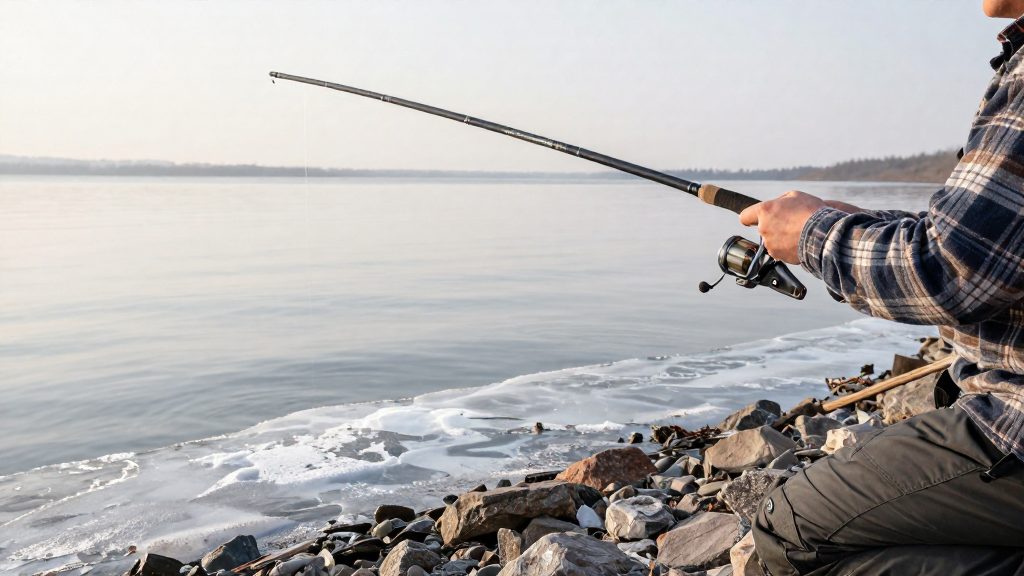
Spring walleye are harder to predict than summer fish because they change position as the water warms. They move from wintering areas toward spawning grounds in stages, and their feeding becomes irregular in cold water. Knowing which phase the fish are in tells you where to start looking and how deep to fish.
Why spring walleye are different
Pre-spawn staging in deeper transition areas
Before they reach the shallows, they often hold in deeper transition areas, where the bottom changes from one type to another or drops toward deeper water. These zones give fish cover and a route to the spawning grounds. For shore anglers, the practical approach is to work the edges of these deeper transitions and keep the lure near the bottom, where staging fish tend to sit.
Reduced feeding during cold, early spring
Early in the season, cold water slows walleye metabolism, so they feed less and less predictably. A fish that does not chase far will only take a bait that passes close to it. This is why spring fishing rewards patience: fewer strikes arrive, but the fish that do bite are often in a specific feeding position, and you need to keep the bait in that zone for longer.
Why spring fish hold in tighter groups
Fish preparing to spawn gather together, so a spot that produces one bite can hold more fish nearby. Work that stretch repeatedly, changing the lure’s depth and retrieve speed between casts, before you move on.
What water temperature should you watch?
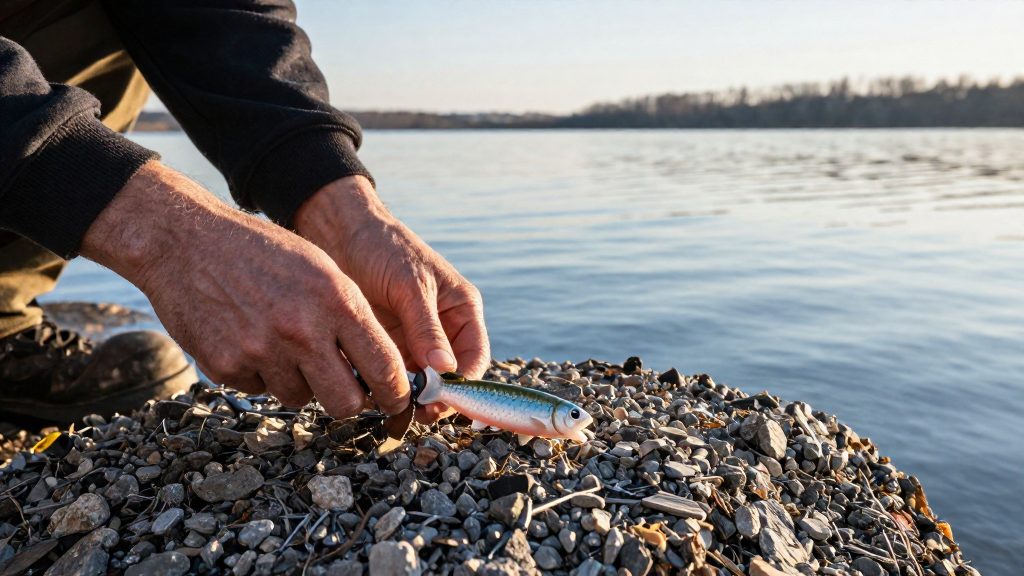
Water temperature is the main spring signal for walleye. Walleye begin moving toward spawning areas once water nears 4°C (40°F), and most spawn between about 6°C and 10°C (42°F to 50°F), according to FishUSA. Knowing these two thresholds tells you when fish are likely to shift from their winter areas and when the spawning window is open on your water.
The movement trigger near 40°F
Movement trigger: walleye start to move once water nears 40°F (about 4°C). This is a point to start checking, not a sharp line. Lakes and rivers warm at different rates, so the first movement can happen at slightly different readings on different waters. Treat 40°F as the cue to begin monitoring, then confirm with the readings that follow.
The spawning window from 42°F to 50°F
Spawning window: most walleye spawn between 42°F and 50°F (about 6–10°C), per FishUSA.
| Water temperature | What it signals |
|---|---|
| Nears 40°F (about 4°C) | Walleye begin moving toward spawning areas |
| 42°F to 50°F (about 6–10°C) | Most walleye spawn |
The spawning band spans only 8°F (about 4°C), so readings can move through it within a few days of warm weather. Check the water more often once it enters this range.
Reading water temperature with a probe thermometer
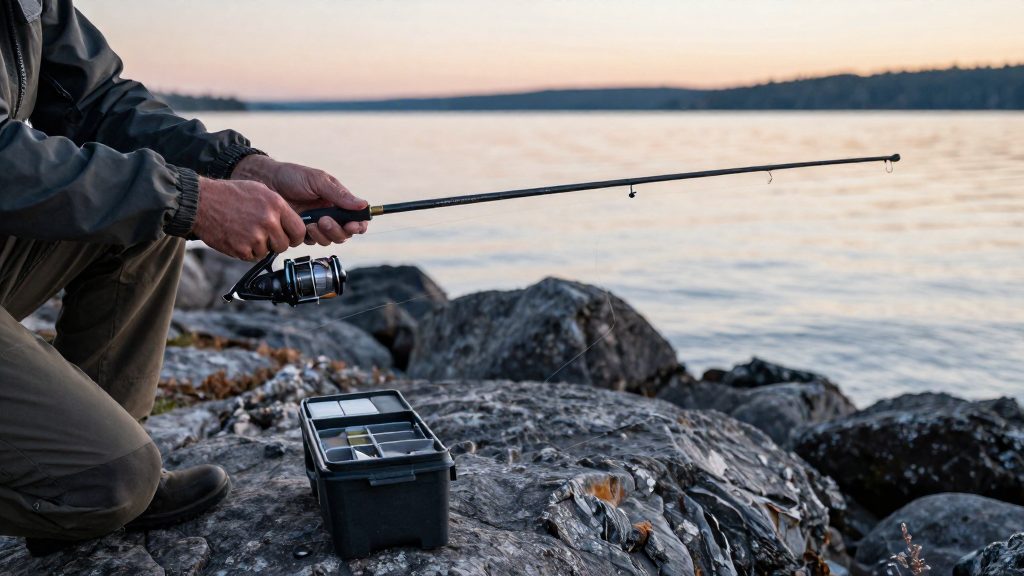
A probe thermometer gives a direct reading at the spot you fish. To get readings you can compare:
- Check the manufacturer’s instructions for the thermometer’s accuracy range and how long it takes to settle on a reading.
- Take a reading just below the surface, then another near the bottom. The two can differ, and walleye often hold deeper.
- Measure at the same time of day, since surface water warms through the afternoon.
- Log readings over several days. A steady rise tells you more than a single value.
- From the bank, lower the probe on its cord to the depth you want to test, leaving it long enough to settle.
Best lures for cold, pre-spawn water
Pre-spawn walleye are slow to commit, so the lure that works best in cold water is a jerkbait worked with a long pause. The Rapala Husky Jerk is the core choice for this phase. Fished with a slow pull-and-pause retrieve, it presents a moving target that reluctant fish can take without chasing hard. Speed the retrieve up only when the fish show they are active.
Why cold water changes the approach
Between the movement trigger and the spawn, fish are staging and feeding lightly, so the lure has to stay in front of them longer and look easy to eat.
Rapala Husky Jerk: the core cold-water jerkbait
Fishing World (2023) recommends the Rapala Husky Jerk for cold water. It is a suspending-style jerkbait fished with rod-tip sweeps rather than fast reeling, which keeps it in the zone where cold-water walleye hold.
The slow pull-and-pause retrieve
Cast beyond the fish, let the lure sink, then make a short pull followed by a pause. Most strikes come during the pause, so keep the lure still for a moment before the next pull.
Increasing retrieve speed when fish show activity
When walleye chase or hit on the pause, shorten the pauses and speed up the pulls. Fishing World (2023) recommends this change when fish are active. If strikes stop, return to the slow pull-and-pause to re-establish the pattern.
Which lures work from shore?
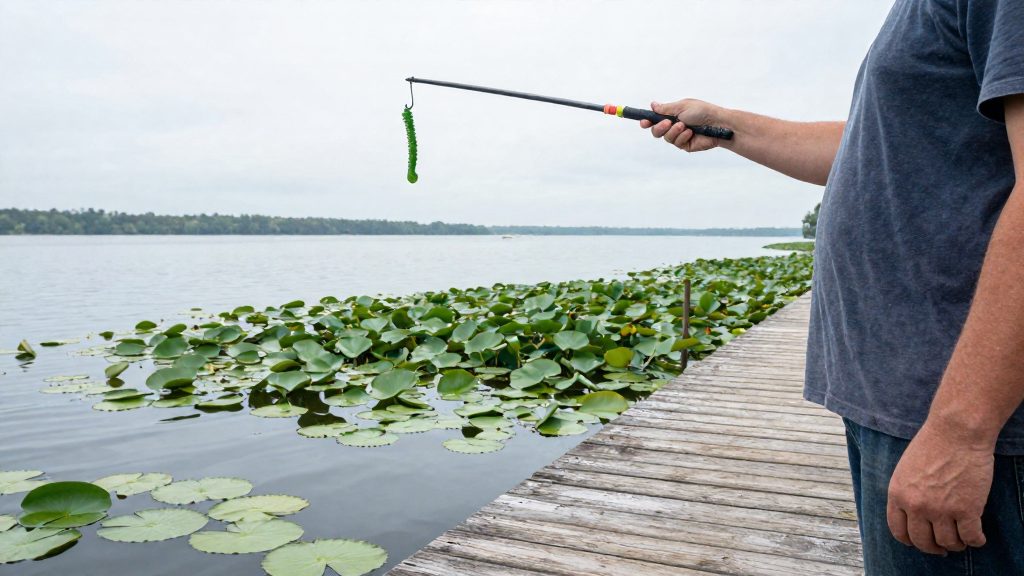
From a bank or pier, you need lures you can cast a good distance and retrieve through the water column. Trolling is a boat technique, so it is not an option from land. Cast-and-retrieve lures do the job from land, and the swimbait is one of the most straightforward. Fishing World’s blog (2023-05-02) gives the 3/8 oz Kalin’s Tickle Tail as an example of a swimbait that works well with a steady retrieve.
Slow, steady retrieve with small rod jerks
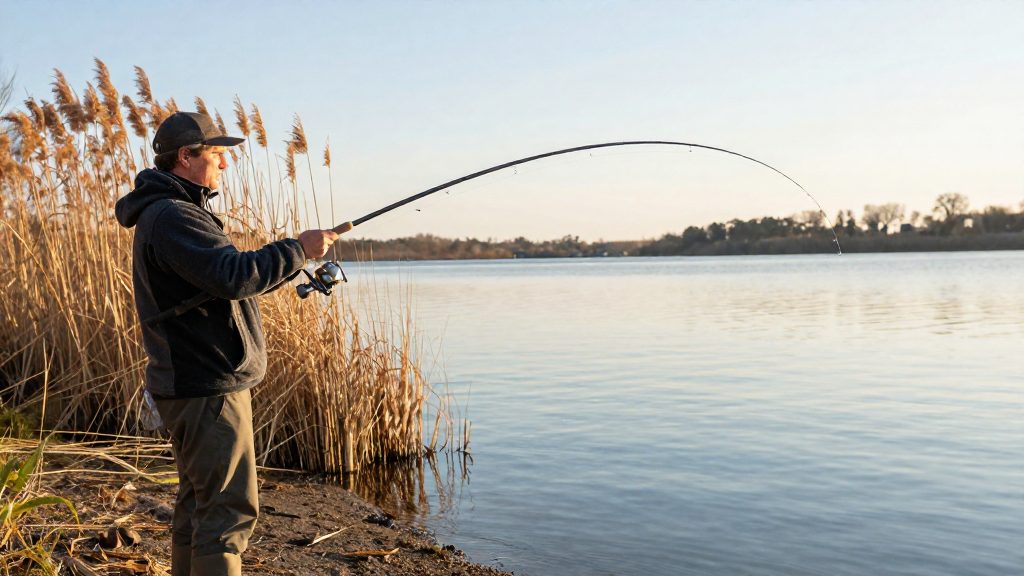
This is the method the same source recommends for the Kalin’s Tickle Tail. Reel at an even pace, and between turns of the handle, lift the rod tip a few centimetres. Keep the jerks small. Large sweeps push the lure out of its line and make it harder to keep the retrieve even.
Faster retrieves to cover more water
When fish are spread out or you want to search a stretch of shoreline quickly, speed up the reel. Faster retrieves cover more water per cast, so you find active fish sooner. Vary your speed until you find what works that day, and move along the bank between casts.
| Retrieve | How to work the lure | Main goal |
|---|---|---|
| Slow and steady | Even reel speed with small rod jerks | Controlled presentation of the swimbait |
| Faster | Quicker reel speed | Covering more water per cast |
How do you fish jigs and lipless cranks?
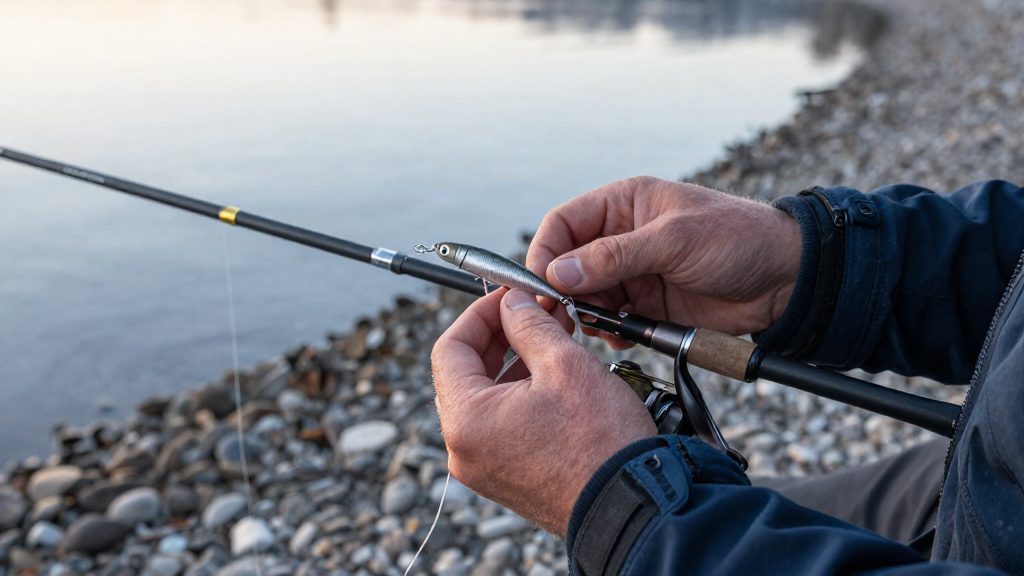
Jigs and lipless crankbaits cover different parts of the water column, but both are fished close to the bottom, where walleye hold. The jig is a current-driven drift presentation. The lipless crankbait is an active sink-and-rip presentation.
Fishing a floater jig with a curly tail grub
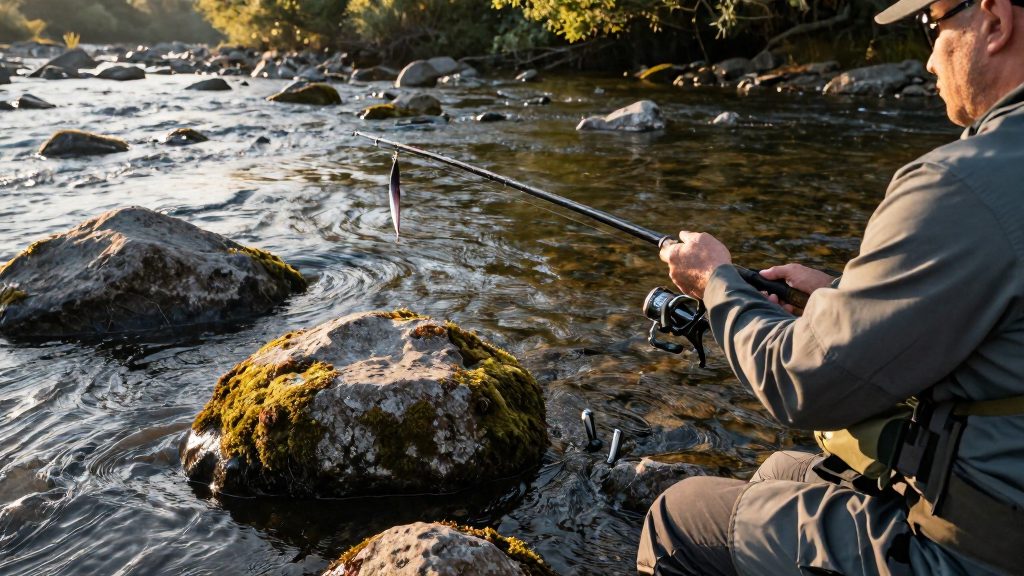
For river fish, cast the floater jig upstream and let the current carry it back toward you along the bottom. Keep the lure in contact with the bottom as it drifts, and keep the line taut enough to feel changes in the bottom and any bite.
Choose the jig weight to match the current. A stronger flow needs a heavier jig to hold bottom, and a gentler flow lets a lighter jig drift naturally. Adjust the weight until the grub tracks along the bottom without repeatedly snagging or lifting off it.
For colour, the reference material recommends white, chartreuse or pink grubs. Start with one colour, fish it through the drift, and switch if you get no response after several casts.
Choosing jig weight and colour
| Variable | What to do |
|---|---|
| Current speed | Match jig weight to the flow so the grub stays near the bottom |
| Grub colour | White, chartreuse or pink |
| Drift direction | Cast upstream, then follow the current back |
Working a lipless crankbait: sink, rip, fall, repeat
A lipless crankbait such as the Rapala Rippin Rap is most effective in late spring, as the water warms. Use this four-step cycle:
- Sink: let the lure fall to the bottom on a loose line.
- Rip: pull sharply upward with the rod tip to make the lure dart.
- Fall: drop the rod tip and let the lure flutter back down.
- Repeat: keep cycling the lure through the same stretch of water.
Walleye often strike as the lure sinks or sits on the bottom, so watch the line closely during each fall.
Post-spawn lure choices
After the spawn, walleye spread out and feed again, so the lure choice shifts from slow, bottom-hugging presentations to lures that cover more water and search for active fish. According to FishUSA, the plugs most often suggested for this phase are the Flicker Minnow, the Bandit and the Bomber, with spoons and slower worm harnesses as additional options. Because post-spawn fish may hold at different depths, the usual approach is to run plugs at several depths until strikes start, rather than repeating one depth all day. The source does not say how to do this from shore, and running plugs at depth is typically a boat method, so shore anglers should treat these plugs as optional and fall back on cast-and-retrieve lures.
Plugs: Flicker Minnow, Bandit and Bomber
| Lure | Post-spawn role (FishUSA) |
|---|---|
| Flicker Minnow | Plug run at various depths to find the feeding zone |
| Bandit | Plug run at various depths to find the feeding zone |
| Bomber | Plug run at various depths to find the feeding zone |
Work each plug at a different depth and log where bites occur. Changing depth is practical with plugs: vary how far the lure runs by changing your line diameter, your retrieve speed or the lure’s diving profile, then return to the depth that produced strikes.
Holding the lure in the strike zone
Keep the lure about a foot off the bottom to stay in the strike zone. A plug that drags along the bottom picks up weeds and debris and spends more time out of the zone, while one that runs too high can pass above fish that are holding deeper.
Spoons and worm harnesses
Spoons and worm harnesses suit a slower presentation. FishUSA suggests them as alternatives when the plugs are not producing, so they are useful once you have tried several plug depths. Slow the retrieve or the drift, keep the lure in contact with the zone you have found, and watch the line for light taps that indicate a fish.
Check local regulations and handle fish with care
Walleye release survival depends on several factors, and two of them are in your control: following the rules for the water you fish, and limiting the stress you put on the fish before it swims away. Size limits, bag limits, closed seasons and gear restrictions vary by water body and can change from year to year, so check them before each trip instead of relying on memory or an older guide. Contact the fisheries agency that manages your water, or check its official website, for current rules.
Confirm current limits before you fish
- Check the size and bag limits for the specific lake, river or section you plan to fish.
- Confirm whether a seasonal closure or spawning-area restriction applies to that water.
- Carry a measuring tool so you can check length on the spot before deciding to keep a fish.
- If the water is designated catch-and-release only, do not keep any fish, whatever its size.
Handle fish with wet hands
Dry hands can remove the slime coat, the protective mucus layer on a fish’s skin. Wet your hands before touching a walleye, and wet them again if you handle it more than once. Keep the fish in the water for as long as the hook removal allows.
Support the fish horizontally
Support the whole body in a horizontal position, with one hand under the belly and the other near the tail. Avoid holding it by the gill covers or the lower jaw alone, and do not squeeze it. Keeping the fish level prevents strain on its internal organs.
Minimize time out of water
Keep the time out of water as short as possible. Before you lift the fish, have your pliers or hook remover, your camera and your net ready. Remove the hook quickly, then return the fish to the water and hold it gently until it can swim away on its own.