Why are plastic worms so effective for largemouth bass?
Soft plastic worms work on largemouth bass because they imitate a common bottom-dwelling food source: a worm or similar invertebrate moving slowly across the bed and through cover. The bait’s supple body moves with very little input, so a slow crawl looks like easy prey that is not trying to escape. That lets a bass approach, inspect and take the worm without the rapid reaction that a fast-moving lure triggers. Bass also hold near the bottom and cover, so a worm worked in those zones stays where the fish are feeding.
Movement that imitates crawling prey
A worm crawled along the bottom drags, flexes and pauses in a way that resembles natural prey moving over the substrate.
Feeding habits on bottom-dwelling prey
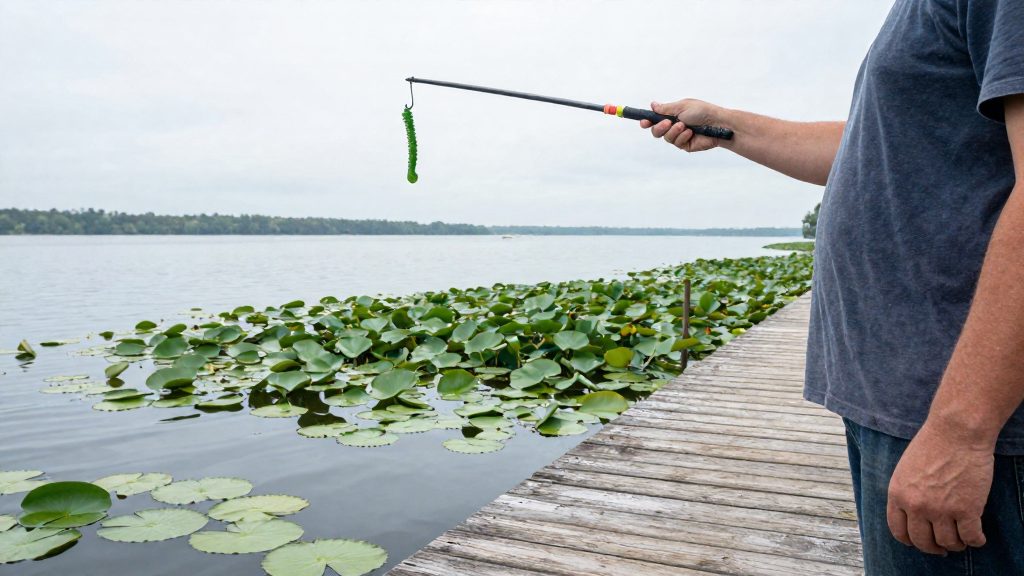
Largemouth bass feed heavily on what sits close to cover and bottom structure, so a bait that works along those surfaces stays within reach of the fish. Weedless worms can be pitched into lily pads, cabbage beds and around tree limbs, places where bass ambush food. Bait choice still depends on conditions, which affects how the worm presents itself in each zone:
| Cover or zone | How the worm moves through it |
|---|---|
| Lily pads and cabbage beds | Pitched in and crawled over the top and down through the stems |
| Around tree limbs | Dropped beside the limb and worked slowly along the bottom |
| Heavy matted weeds | Crawled through gaps, with the bait pausing where bass lie |
Holding time and the feel of the bait
A soft, pliable body feels different in the mouth than a hard lure, and that feel is what the angler reads through the line.
Choosing worm size, colour and hook
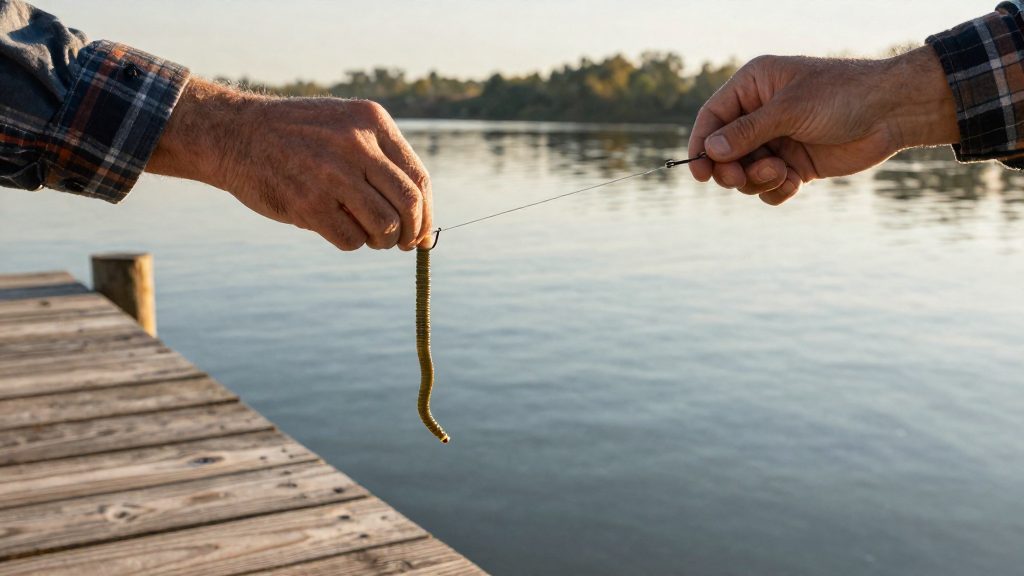
Three decisions shape a plastic worm presentation: length, colour and hook size. For a Texas-rigged worm, Northern Ontario Travel (Gord Pyzer, 2023-04-12) suggests a worm of about 7 to 8 inches on a 2/0 to 4/0 worm hook. Treat the 7 to 8 inch worm as the general starting point, then adjust to conditions: Pyzer suggests a shorter 6-inch dark worm in low light or for sullen fish.
Worm length matched to light and mood
Pyzer’s guidance links worm choice to conditions:
- Low light or sullen fish: a dark, curly-tail worm about 6 inches long.
- Sunny, calm days: a 7-inch straight-tail worm.
Low light includes overcast days and early or late hours. Pyzer’s guidance pairs the dark, curly-tail 6-inch worm with low light, overcast days or sullen fish, and the 7-inch straight-tail worm with sunny, calm days.
Dark versus light colour
In this guidance, dark colour is tied to low light. Pair a dark worm with overcast skies, low light or fish that are not aggressive. To find the colour that works on your water, fish a dark worm and a lighter one on the same stretch of cover. Switch after a set number of casts, and note the sky, water clarity and the time of day. Over a few sessions, the pattern will show which colour the bass prefer under each condition.
Hook size on the Texas rig
The 2/0 to 4/0 range from Pyzer is the baseline. Pro Edwin Evers uses a larger 5/0 hook on a Texas rig for big worms.
| Setup | Hook size | Source |
|---|---|---|
| Texas-rigged worm, general | 2/0 to 4/0 | Northern Ontario Travel (Gord Pyzer, 2023-04-12) |
| Texas rig, big worms | 5/0 | On The Water (Gabe Gries, 2019-01-11) |
| Drop shot, wide-gap hook | 3/0 or 4/0 | On The Water (Gabe Gries, 2019-01-11) |
Choose the hook to suit the worm you are rigging. A larger worm calls for a larger hook, and the table shows where the 5/0 and drop-shot options fit. Plastic worms can also be fished on jig heads or a Carolina rig, but no hook sizes are listed here for those setups, so check the packaging or manufacturer’s instructions for your jig head.
How do you rig a Texas-rigged worm?
A Texas-rigged worm is threaded so the hook point stays buried in the bait, which lets it pass through weeds and cover without snagging. Northern Ontario Travel (Gord Pyzer, 2023-04-12) describes the method: the hook enters the nose, exits the side, and the point is hidden under the plastic. The bullet sinker is then either pegged to the worm or left free, depending on how dense the vegetation is.
Threading the hook weedless
- Insert the hook about 1/8 inch into the nose of the worm.
- Bring the hook out through the side of the body.
- Bury the hook point under the skin of the worm so no bare point is exposed.
- Before casting, run your thumb over the worm to confirm the point is hidden and will not catch on the surface.
The buried point is what makes the rig weedless. A bare point catches on stems, lily pads and branches, so check it after every few casts, especially after a fish has torn the bait.
Pegging the bullet sinker
The sinker setup changes with the cover you are fishing. Pegging holds the sinker against the worm, while an unpegged sinker slides freely on the line.
| Cover | Sinker setup | Where to use it |
|---|---|---|
| Thick, matted weeds | Pin the bullet sinker against the worm with a rubber stop | Dense vegetation where the bait must stay close to the hook |
| Sparse vegetation | Move the stop up the line and fish the sinker unpegged | Sparse vegetation, such as a deep weed line edge |
Rods, reels and line for worm fishing
In heavy cover, the rod has to lift a bass out of vegetation, not just fight it in open water. On The Water (Gabe Gries, 2019-01-11) recommends a rod of at least 7 feet with medium or heavier power and a fast tip for this kind of fishing. The length gives you leverage to pull a fish through weed stems, and the heavier power keeps control once the bass is clear of the cover. The fast tip transmits bites quickly, which helps you feel a take through thick growth.
The same source pairs that rod with a line setup built for strength:
| Component | Recommended spec |
|---|---|
| Rod length | At least 7 feet |
| Rod power | Medium or heavier |
| Rod tip | Fast action |
| Main line | 20-lb braid |
| Leader | 15 to 20-lb fluorocarbon |
The 20-lb braid is the main line. A 15 to 20-lb fluorocarbon leader connects it to the worm. Pro Edwin Evers uses 17 to 20-lb fluorocarbon for casting, according to On The Water (Gabe Gries, 2019-01-11), which falls within the 15 to 20-lb leader range.
When buying a reel, match it to the rod’s power and make sure its spool holds your braid with room to spare. Check the line capacity printed on the reel and follow the manufacturer’s spooling instructions.
Where to cast: weeds, lily pads and cover
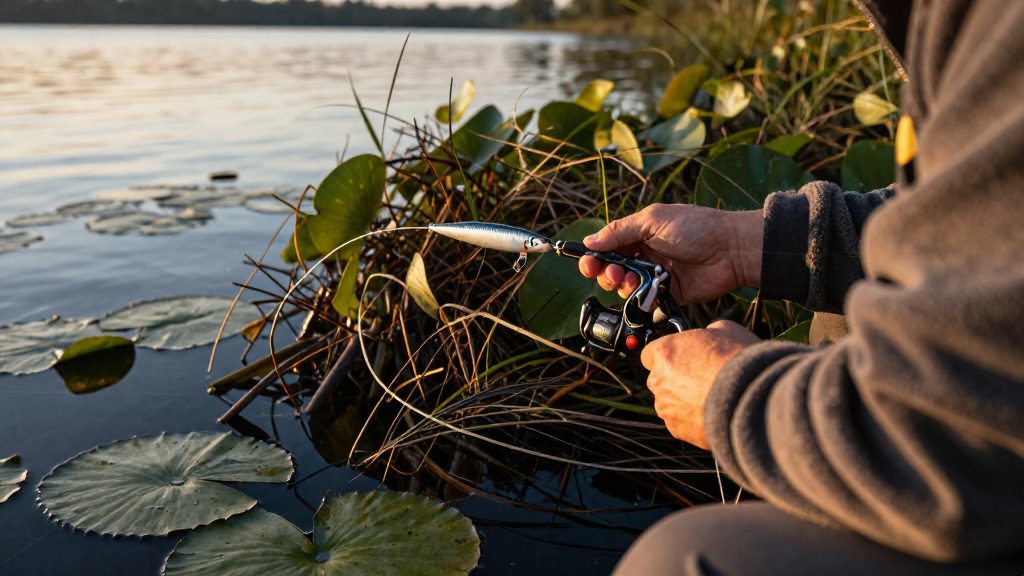
A weedless Texas rig is built to go where most lures snag, which makes cover the core of worm fishing for largemouth bass. According to Northern Ontario Travel (Gord Pyzer, 2023), a weedless Texas-rigged worm can be pitched into lily pads, cabbage beds and around tree limbs. Each cover type calls for a slightly different target.
| Cover | Where to place the worm | Why it works |
|---|---|---|
| Lily pads | Gaps between pads and the open water beneath them | Bass can hold in and around the pads |
| Cabbage beds | Open pockets inside the bed, not the dense centre | Fish use the openings to ambush prey |
| Tree limbs | Under and beside the limbs, on the shaded side | Wood cover blocks light and holds fish |
Pitching into lily pads and cabbage beds
Pitch the worm into the gaps and let it fall through the openings. Fish the edges of the pad field first, then work toward the middle through the gaps.
Working tree limbs and wood
Pitch under and beside the limbs, keeping the worm on the shaded side. Bass can hold close to wood cover, so work the worm slowly beside and under the limbs.
Targeting structure transitions
Look for places where two types of cover meet, such as a weed edge running into open water, or wood sitting at the edge of a weed bed. These boundaries give bass a place to stage and ambush prey, and they often hold more fish than the middle of a single type of cover.
How should you retrieve the worm and set the hook?
Once the Texas-rigged worm reaches the bottom, the retrieve is a slow crawl: you move the worm steadily along the bottom and through the weeds rather than working it quickly. Bites on a worm are often subtle, so the method depends on keeping the line under control and on giving the bass time to take the bait before you strike. According to Northern Ontario Travel (Gord Pyzer, 2023-04-12), the sequence is to crawl the worm slowly, feel for the bite, let the fish start to move off, and then set the hook.
Crawling the worm
- Move the rod tip in small, steady pulls so the worm keeps contact with the bottom and the weeds.
- Keep the worm moving at a slow pace throughout the retrieve, including over open patches between weed clumps.
- Stay in contact with the bottom: if the worm lifts off, it no longer looks like the natural prey it imitates.
Feeling for the bite
Rest the line over one finger while you retrieve. The finger acts as a sensor: a bass that picks up the worm creates a small change in tension or a slight pause in the line, which you feel rather than see. This is why the finger-rested line matters in this method. Any unexpected stop, weight or tap should be treated as a possible bite.
Dropping the rod tip and setting the hook
- When you feel a bite, drop the rod tip so the line goes slack. This lets the bass swim away with the worm and take it deeper into its mouth.
- Wait for the fish to start moving off before doing anything else.
- Set the hook with a firm lift of the rod once the fish has started to swim off.
Other worm rigs: drop shot, Carolina and jig head
When a Texas rig stops producing bites, you can keep the same soft plastic worm and change how it sits and moves in the water. According to On The Water (Gabe Gries, 2019-01-11), worms can be fished on a drop shot, on jig heads or on a Carolina rig. Each setup changes the worm’s position relative to the bottom and the weight, which affects how fish see it.
Drop shot: weight tied at the line end
On a drop shot, the sinker sits at the very end of the line, and the hook is tied a short distance above it. The worm therefore hangs above the bottom instead of lying on it. The source recommends a 3/0 or 4/0 wide-gap hook for this rig. To fish it, let the weight touch the bottom, then lift the rod tip slightly so the worm rises off the substrate. Hold it still between small movements.
Carolina rig: sliding weight above a leader
On a Carolina rig, the sinker slides freely on the main line above a swivel. A leader of several feet runs from the swivel to the hook and worm. Because the weight is not tied to the hook, the worm can drift away from the weight, which makes it easier to present naturally on the bottom. According to On The Water (Gabe Gries, 2019-01-11), a Carolina rig can be fished slowly, and some anglers find this effective in cold water. Drag the weight along the bottom at a steady, slow pace and pause often.
Jig head: weighted hook molded to the worm
A jig head combines the hook and the weight in one molded piece. The worm is threaded onto the hook shank, so the weight is always at the front. This makes the rig simple to tie and easy to hop along the bottom. Because the weight is fixed, changing the head is the only way to change the sink rate. Check the packaging for the weight marked on each head before you buy.
Choosing between them
| Rig | Weight position | Presentation |
|---|---|---|
| Drop shot | Tied at the line end | Worm held above the bottom |
| Carolina | Slides above a leader | Worm trails behind the weight |
| Jig head | Molded into the head | Worm moves with the weight |
Catch and release tips
Landing a largemouth bass on a plastic worm is only half the job. How you handle the fish in the next few seconds determines whether it swims away healthy. Use wet hands, support the body fully, and free the hook quickly, without lifting the fish out of the water longer than you need to.
Wet your hands first. A largemouth bass has a protective slime coating, and a dry grip rubs it off. Wet your hands in the water before you touch the fish, and do the same each time you handle it.
Support the fish horizontally. Hold the bass with one hand under the belly and the other near the tail stock, so its body stays level and its weight is spread along its length. Keep the fish low over the water so that a sudden wriggle does not drop it onto rocks or the bank. Avoid holding a largemouth bass vertically by its head or lower jaw, because the weight of the body can injure its jaw and internal organs.
Never hang the fish by its lip. Lifting a bass by the jaw or lip tears soft tissue and can damage the jaw structure. If you need a photo, lay the fish in a wet landing net or cradle it horizontally on a wet hand and keep the exposure short.
Remove the hook from the worm quickly. Worm hooks are often in the corner of the mouth, but a deeply swallowed hook can cause serious injury:
| Hook position | Best action |
|---|---|
| Visible, in the corner of the jaw | Back the hook out along its curve with pliers or a hook remover |
| Deep in the throat or gullet | Cut the line close to the hook and leave the hook in place rather than pulling it out |
| Hooked in the gills | Cut the line close to the hook; pulling it out risks heavy bleeding |
Keep the fish in the water while you work. Hold it upright, facing into any current, until it swims away under its own power.
Frequently asked questions
Which worm should I pick for low light compared with bright, calm days?
According to Northern Ontario Travel (Gord Pyzer, 2023-04-12), a dark, curly-tail worm about 6 inches long suits overcast days, low light, or bass that seem sluggish. A 7-inch straight-tail worm is the better choice on sunny, calm days.
How do I rig a worm so it stays weedless in cover?
Insert the hook about 1/8 inch into the nose of the worm, bring the point out through the side, and bury it under the skin so the point does not catch on weeds. Northern Ontario Travel (Gord Pyzer, 2023-04-12) also recommends using a bullet sinker pinned by a rubber stop in thick matted weeds, and rubber pegs rather than wooden toothpicks.
What should I do when I feel a bite?
Keep the line resting over a finger so you can feel subtle takes. When a bass grabs the worm, drop the rod tip so the fish can swim off with the bait before you set the hook. Northern Ontario Travel (Gord Pyzer, 2023-04-12) describes this as a slack-line pause that gives the bass time to turn.