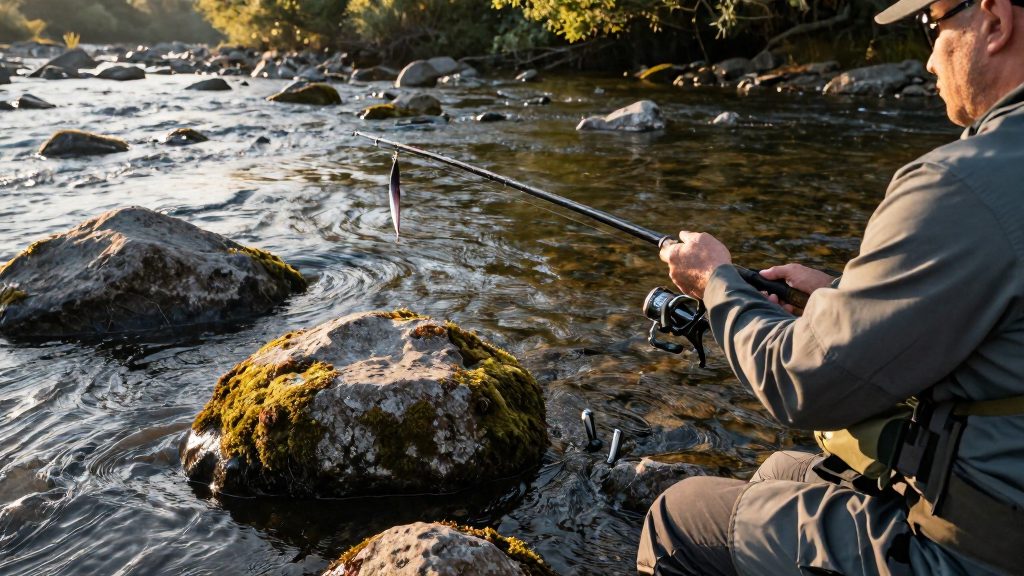
Why do smallmouth bass hold around rocks?
Rock draws the forage
Rock often attracts baitfish and gobies, and smallmouth bass feed on them. Chad Pipkens, quoted by In-Fisherman (2023), puts it directly: “Wherever the forage lives is where you’ll find the smallmouth.” When you scan a rocky bank, look for signs of small fish activity around the boulders. A rock with bait moving near it is a stronger target than a bare rock with nothing around it.
Boulders beside other habitat
Boulders near gravel, sand, grass or an established fish population are more productive than isolated boulders. A hard edge placed next to soft bottom or vegetation gives smallmouth several reasons to stay in one area. Use this as a filter: a single boulder in open featureless bottom usually deserves less time than a boulder group that sits beside a second habitat type.
Rock and gravel patches for spawning
Boulders serve as spawning sites, and small rock and gravel patches are prime spawning habitat, so check them in the spawning season only where regulations permit.
Current and shoal edges
Boulders in moving water serve as current-swept ambush points, where smallmouth hold to intercept food carried by the flow. In rivers such as the St. Lawrence, current flow and washed-out areas matter most. On rock shoals and reefs, active fish often hold on the front face of the reef, facing the flow.
| Rock setting | Why smallmouth use it |
|---|---|
| Boulders with baitfish or gobies | Feeding, following forage |
| Boulders beside gravel, sand or grass | Higher productivity than isolated boulders |
| Rock and gravel patches | Prime spawning habitat |
| Current-swept boulders | Ambush points in moving water |
| Front face of rock shoals and reefs | Active fish holding position |
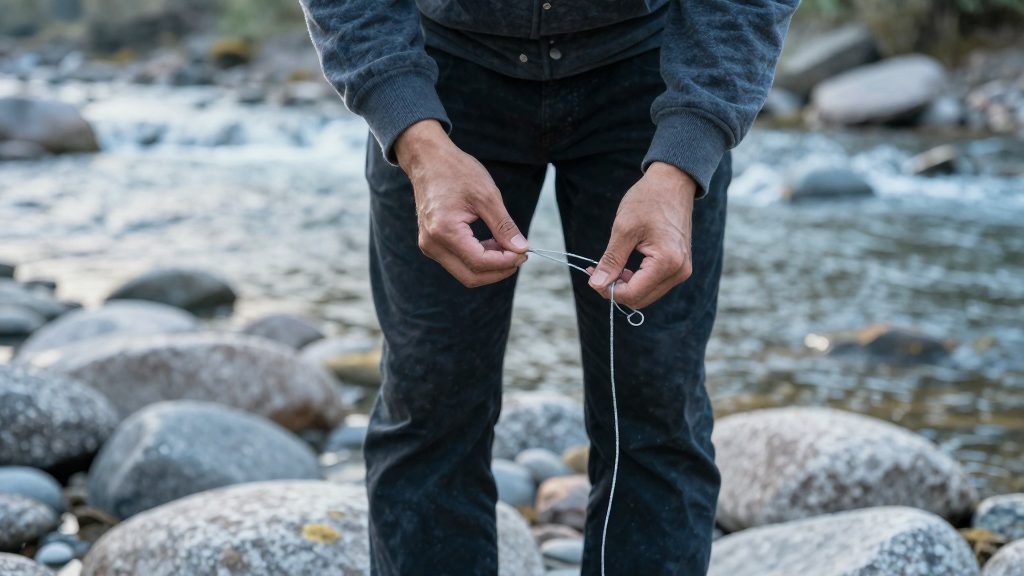
Where to find them on rocky shorelines
Smallmouth bass tend to hold at specific features along rocky shorelines rather than at every rock. Look for places where the shape of the bottom or the flow of the water changes, and fish those spots before covering the rest of the bank. Three features matter most: irregularities in the contour lines of a lake, current and washed-out areas in rivers, and small gravel patches among the rock.
Irregularities in lake contour lines
On a lake, check a map that shows contour lines and look for places where a line departs from the general shape of the shore. According to In-Fisherman (2023), a point jutting out from the shoreline is one such irregularity, and it often signals fish. Start at the tip of the point, then work the sides, since the change in depth where the line bends is where fish tend to stop.
Current flow and washed-out areas in rivers
In rivers, In-Fisherman (2023) identifies current flow and washed-out areas as the features that matter most, citing the St. Lawrence River as an example. Find where the current runs across or along the rock, and where the bottom has been scoured clear of silt. Fish the edge where fast water meets slower water, and make casts that let your lure move through the current rather than standing still in it.
Searching gravel patches
When you find a small rock or gravel patch, search it thoroughly with a series of casts across its surface, then extend the search beyond its edge. In-Fisherman notes that fish may sit a few feet away from the spot where you found the patch, so do not stop fishing once the gravel ends.
Best lures for fishing rocks from shore
Three lure types cover most shallow rock situations for smallmouth bass: a three-hook jerkbait, a hair jig and a dropshot or Ned rig. Each matches a different relationship between the fish and the boulder. In-Fisherman (2023) reports that Chad Pipkens starts with a three-hook jerkbait, a hair jig or a dropshot with a minnow-style plastic when fishing shallow boulders, and switches to a dropshot or Ned rig when fish rise to the bait but don’t take it.
Three-hook jerkbait for shallow boulder fields
The three-hook jerkbait suits shallow boulder fields, where you need to cover water and find the fish first. Cast beyond the target, let the lure settle, then work it back with short rod-tip sweeps so it darts between the stones. Pause at intervals, because a stopped lure can trigger a strike from a fish that ignored the moving one.
Hair jig around boulder edges
Hair jigs work best close to the rock. Bump the jig along the boulder edge and let it fall down the face, keeping the presentation tight to the stone rather than casting far off.
Dropshot or Ned rig when fish rise but don’t take
A rise without a take is a signal to slow down. When smallmouth bass come up toward the bait and turn away, switch from the jerkbait or jig to a dropshot or Ned rig with a minnow-style plastic. Let the bait sit near the bottom beside the boulder, then lift it and let it fall again. The slower fall gives a fish that has already shown interest more time to commit.
| Situation | Lure | Presentation |
|---|---|---|
| Shallow boulder field | Three-hook jerkbait | Cast past the target, pause, sweep back through the rocks |
| Boulder edges | Hair jig | Bump along the edge, let it fall down the face |
| Fish rise but don’t take | Dropshot or Ned rig with minnow-style plastic | Sit near bottom, lift, let fall |
Fishing the front face of rock shoals and reefs
Fishing rocky bottoms without snagging depends on where you place the bait and how close it travels to the rock. According to the source, active smallmouth often hold on the front face of rock shoals and reefs. According to In-Fisherman (2023), active smallmouth often hold on the front face of rock shoals and reefs, and a Carolina rig works well there. Presenting the bait along that edge keeps it in the zone where fish are feeding while the deeper rubble stays out of reach.
Presenting bait on the front face of rock shoals
Find the leading edge of the shoal, the side that faces the current or the approach of baitfish. Cast beyond that edge and bring the bait across the face rather than dropping it into the gaps between stones. A steady, controlled pass along the edge gives fish a clear look at the bait, and it keeps the lure from settling into crevices where it can wedge.
Dragging a Carolina rig along rock edges
Drag the Carolina rig slowly along the rock edge with the rod tip raised. The sinker should tick over the surface of the stones while the bait trails behind it. If the weight drops into a gap, lift the rod and move on. Dragging the rig parallel to the edge rather than pulling it up and over the rocks may help limit snags.
Keeping the lure just above rubble and boulder tops
Work the lure so it rides just above the tops of the rubble and boulders. Fish that hold near rock often sit close to the stone, so a lure at this height stays within their range without touching the surface.
| Position on rock | Where smallmouth may hold | Presentation approach |
|---|---|---|
| Front face of a shoal or reef | Active fish, per In-Fisherman (2023) | Pass the bait across the face |
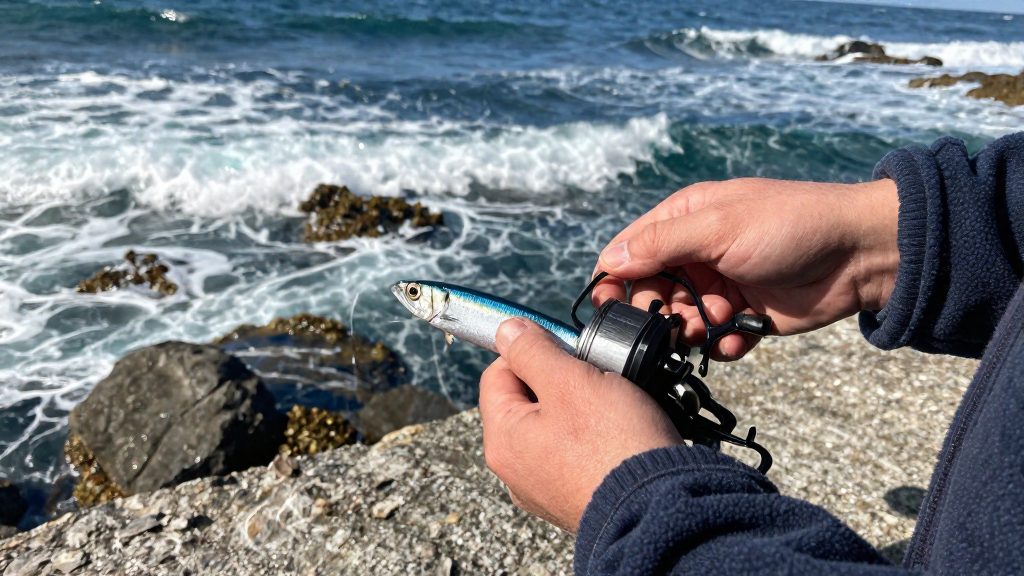
Rods, reels and line for rocky cover
Rock cover tests tackle in two ways. A hooked smallmouth bass can make a fast run toward a boulder, and the line can fray where it rubs the rock edges. Good gear balances sensitivity (feeling a light bite on a jig or dropshot) with enough backbone to turn a fish before it reaches the rock. In-Fisherman (2023-10-05) describes Chad Pipkens fishing shallow boulders with a dropshot or hair jig, and rock shoals and reefs with dropshot, Ned or Carolina rigs. A single rod setup therefore needs to handle both light finesse presentations and heavier rig work.
Rod power and action for jig and dropshot work
- Power is the force the blank needs before it bends. Lighter power suits small jigs and dropshot weights, where the bite is subtle. Heavier power helps when you need to lift a fish away from the rock.
- Action describes where the blank bends. A faster tip transmits bites and helps set the hook at distance. A softer tip absorbs head shakes, which helps keep a hook in the fish’s mouth during a short fight.
- Check the power and action printed on the rod blank, and match them to the lightest weight you plan to fish.
Braided versus fluorocarbon line
Compare the two lines on the points the manufacturer publishes:
| Check on the label or spool | What to look for |
|---|---|
| Line type | Braided or fluorocarbon, so you know which abrasion behaviour to expect |
| Diameter | Braid is usually thinner than fluorocarbon at the same breaking strength, which matters when fishing near rock |
| Abrasion rating | Use the manufacturer’s stated figures where provided, and do not assume one type is safe on every edge |
| Knot strength | Confirm the knot you tie with the line’s recommended knot |
Braid is thin and strong, but its fibres can fray on sharp edges, so inspect the last metre or two of line (a few feet) after each snag. Fluorocarbon sinks readily, which suits jig and dropshot presentations, but it is still vulnerable to sharp rock.
Reel drag setting for sudden strikes
Set the drag before you start fishing, not during a strike. Set it firm enough to turn the fish, but below the line’s rated strength so it slips under a sudden surge toward a boulder. Check the drag rating in the reel’s manual and do not exceed it.
Seasons and time of day to target rocks
Smallmouth bass use boulders differently through the year, so the season should shape where you fish a rock. According to In-Fisherman (2023), boulders serve three roles: spawning sites, current-swept ambush points and post-spawn holding spots. Identifying which role a rock plays at a given time tells you where the fish are likely to sit. Identify the rock’s role at a given time to find where the fish sit.
Spawning period and water temperature
The timing of the spawn depends on water temperature and varies by region and year, so don’t rely on the calendar alone. Measure the water with a simple thermometer and compare your readings with your local fisheries agency’s guidance. Check your province’s fishing regulations for bass seasons, catch-and-release periods and sanctuary closures before you fish gravel beds.
Post-spawn shift to boulders and holding areas
After spawning, smallmouth move to boulders that act as holding areas. Prioritise rock clusters that sit beside gravel, sand, grass or an established population, and look at the rocks closest to the forage that rock attracts.
Cloudy, windy days and low light
On cloudy, windy days, smallmouth may hug the sides of a boulder rather than sitting in open water. Fish the sides of the boulder first, then work the rest of the rock. Light levels and time of day can change this pattern on your own water, so log your sessions at dawn, midday and dusk to see what works locally.
| Condition | Where to look around a rock |
|---|---|
| Post-spawn | Boulders beside gravel, sand, grass or an established population |
| Cloudy, windy days | The sides of the boulder, close to the stone |
How to handle and release smallmouth
Smallmouth bass caught around rock usually fight hard in current, then land on slippery, uneven stone. The aim is to keep the fish out of the air for as little time as possible and to avoid damage to the jaw, the protective slime coat and the gills. Landing, unhooking and recovery are the moments when handling matters most, so each step below focuses on shortening the fish’s time out of water.
Landing with minimal time out of water
Bring the fish to hand steadily rather than letting it tire in the current, since a prolonged fight adds stress before the fish is even handled. Have a landing net ready before the fish arrives, so you do not have to search for it on wet rock. Use a rubber or knotless mesh net where possible, because knotted mesh can snag the fins and scrape the slime coat. Net the fish head first, and lift the net rather than the line.
Removing the hook with wet hands
Wet your hands before touching the fish. Dry hands strip the slime coat that protects the skin. Support the body with one hand and keep the fish low over the water. Back the hook out along the path it entered, and use pliers or a hook extractor if the hook sits deep in the jaw. If the hook is set too deeply to remove without serious damage, cut the line close to the jaw and leave the hook in place.
| Handling step | Better practice | Why it matters |
|---|---|---|
| Landing | Net head first, lift the net | Limits fin and scale damage |
| Unhooking | Wet hands, support the body | Protects the slime coat |
| Jaw removal | Back the hook out, use pliers | Reduces tearing of the jaw |
| Recovery | Face the fish into current | Pushes water over the gills |
Holding the fish upright until it swims away
Once the hook is out, face the fish into the current and hold it gently under the belly, just below the surface. Moving water passing over the gills lets the fish breathe while it recovers. Keep a light grip and move the fish slowly back and forth to push water through the gills. Release it only when it holds its position and swims off under its own power. If it rolls or drifts downstream, reposition it rather than letting it go.
Frequently asked questions
Which lures should a beginner try first on shallow boulders?
According to In-Fisherman (2023), Chad Pipkens recommends a three-hook jerkbait, a hair jig, or a dropshot rigged with a minnow-style plastic for shallow boulders. If smallmouth rise to the bait but don’t commit, he switches to a dropshot or Ned rig.
How should I fish boulders on a cloudy, windy day?
On overcast, breezy days, smallmouth may hug the sides of a boulder, so keep your presentation close to the rock rather than casting well past it. In-Fisherman (2023) notes this behaviour as a reason to work the immediate edge of each boulder thoroughly.
How far should I search around a small rock and gravel patch?
Smallmouth may sit a few feet away from the spot where you found a small rock and gravel patch, so cover the ground around it instead of fishing only the centre. Check spawning areas only where local regulations allow it.