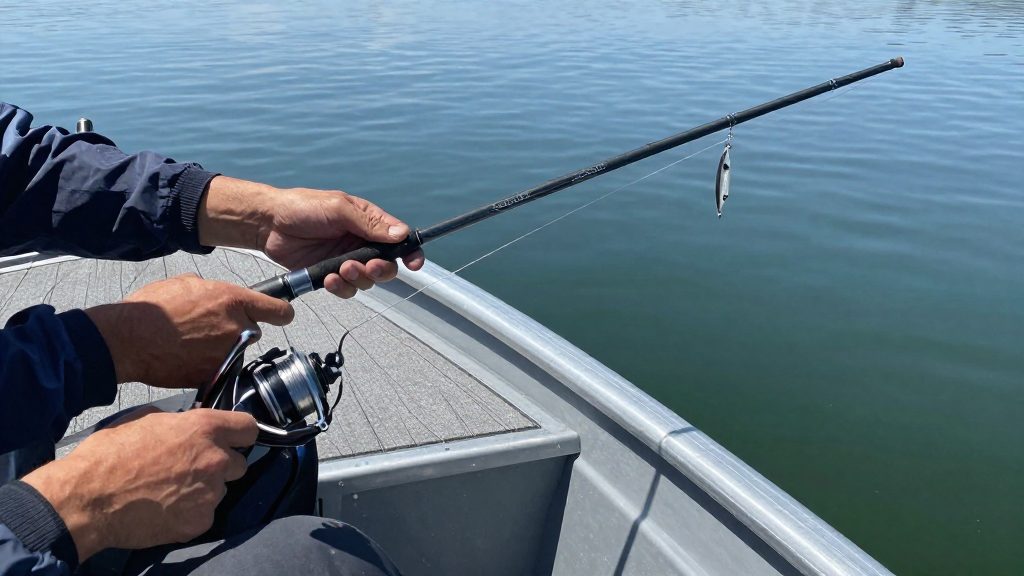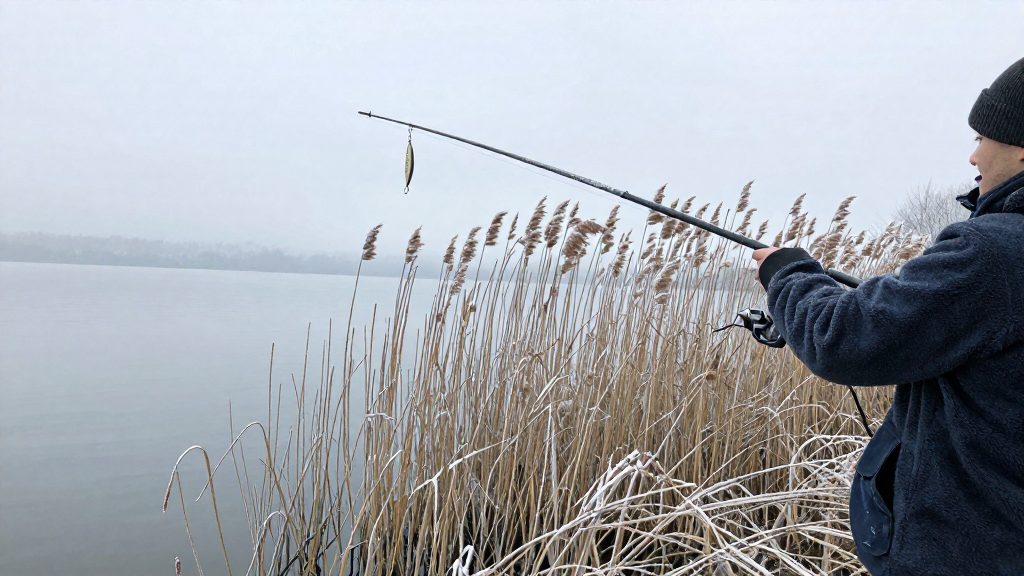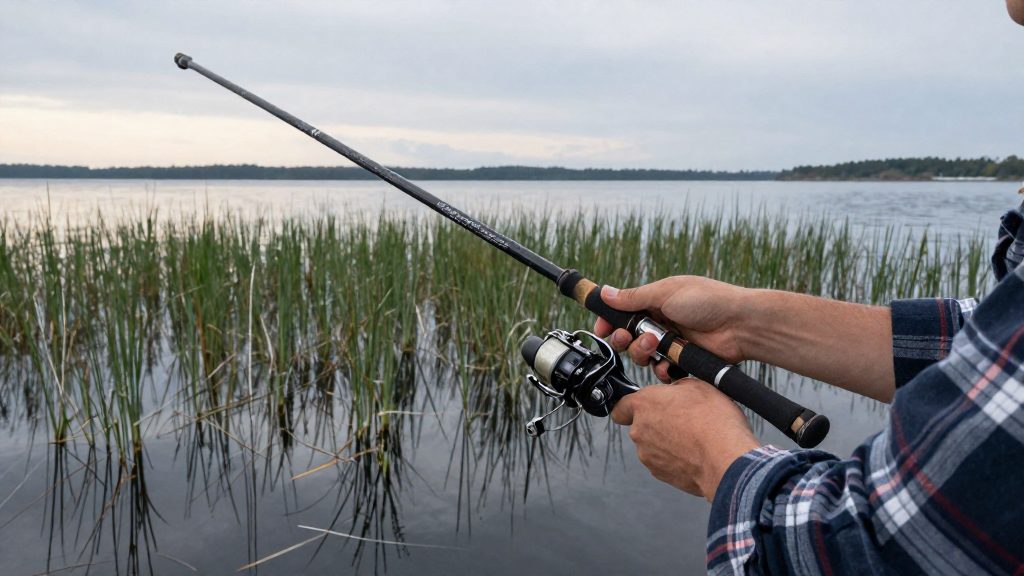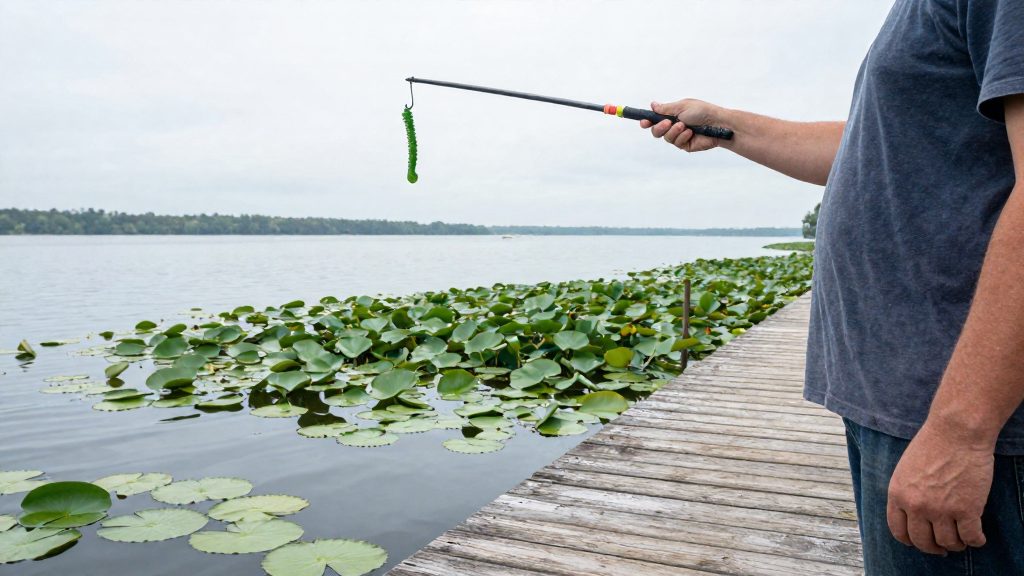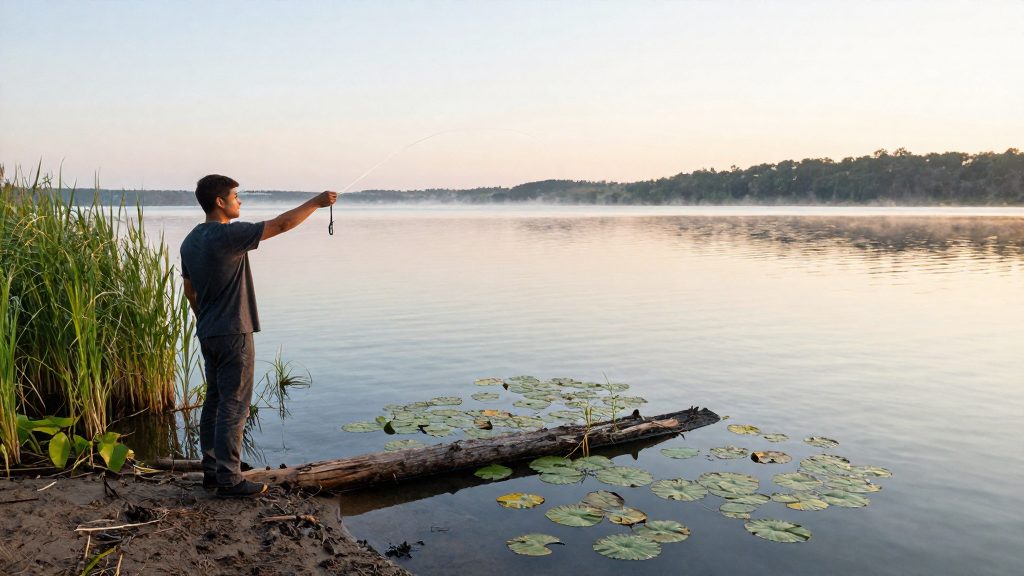
A good first bass lure is one that runs at the depth where bass are holding, stays reasonably free of snags in the cover you fish, and is close in size to the baitfish in your water. Judge any lure on these three points before you compare brands. Largemouth generally stay shallow, from a few feet (about 1 m) down to about 20 ft (about 6 m) (Sports Illustrated, 2026), so depth and cover usually matter more than a brand name.
What makes a good first bass lure?
Check three things before buying: how deep the lure runs, how it behaves around weed, rock and wood, and how its size compares with the local baitfish.
Matching running depth to the water
Running depth is how far a lure swims below the surface during a steady retrieve. A lure that dives to the bottom of a deep channel spends most of its retrieve above the fish if the bass hold in shallow water. Compare the lure’s stated dive range with the depth you can see or measure at your spot. Practical check: in unfamiliar water, count the lure down on a few casts and note the depth where it first touches the bottom or the weeds.
| Lure feature | Depth or cover behaviour | Source |
|---|---|---|
| Square-billed crankbait | Dives 2-6 ft | Sports Illustrated (2026) |
| Crankbait with a larger lip | Dives deeper than a smaller lip | Canadian Tire (2026) |
| Spinnerbait | Typically weedless | Canadian Tire (2026) |
| 3.8-inch jelly shad swimbait on a light jig head | Described as remarkably snag-proof around rocks and cabbage | Outdoor Canada (2024) |
Weedless design and snag resistance in cover
Snag resistance matters most where bass live. Largemouth are found near submerged logs and lily pads, and smallmouth prefer rivers and lakes with rocky shorelines (Canadian Tire, 2026). In these spots, a lure that fouls on every pass costs time and tackle. Look for a weedless design, such as the spinnerbait’s typically weedless build, or a soft body on a light jig head, as described for the jelly shad swimbait (Outdoor Canada, 2024).
Published descriptions of snag resistance come from the publisher or the manufacturer. Test the lure yourself by bringing it back over a patch of the cover you plan to fish.
Sizing the lure to local baitfish
Baitfish size guides the choice of lure length. Diet changes with the water, so identify the prey before choosing a size. Watch the shallow margins for small fish scattering near the bank or weed edge, and pick a lure close in length and profile to what you see. The largest lure in the box is not automatically the best choice. A 3.8-inch swimbait (Outdoor Canada, 2024) is one size reference, and it should be matched to the fish actually present.
Which lure should a beginner buy first?
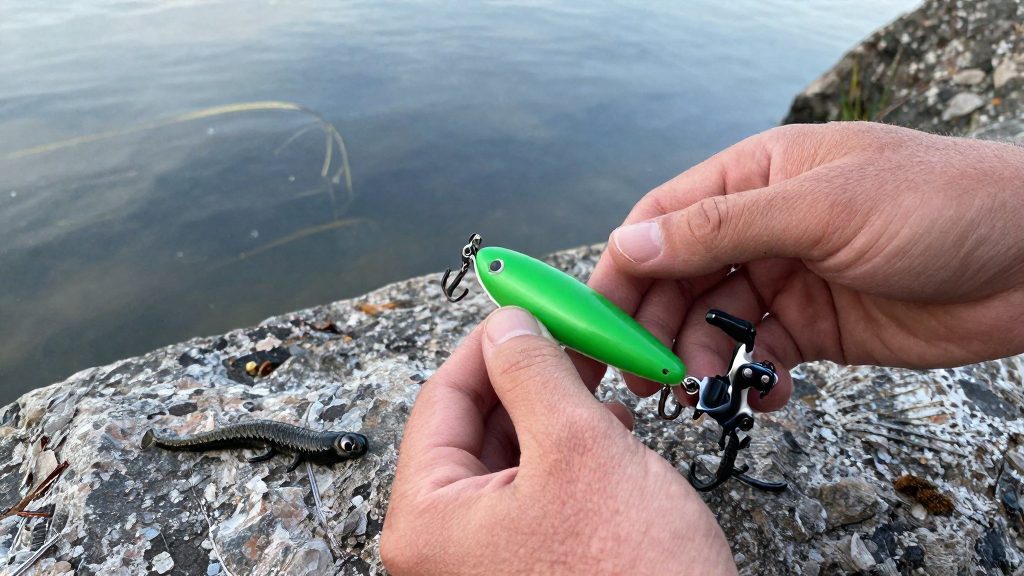
For a first purchase, a square-billed crankbait is a practical choice. Sports Illustrated (2026) lists it among beginner-friendly bass lures, and it imitates a minnow, one of the baitfish that largemouth bass feed on. You can cast it, reel it back at a steady pace and learn how bass respond to different speeds with a single lure.
Why a square-billed crankbait suits a first purchase
- Minnow imitation: Largemouth feed on baitfish, so a minnow-shaped lure matches a common food source.
- Built-in depth: The lip, not the angler, sets how deep the lure runs, so you do not need to master sinking techniques.
Diving depth and lip size
Sports Illustrated (2026) gives a square-billed crankbait a dive range of 2 to 6 ft. Canadian Tire (2026) notes that a larger lip dives deeper.
| Lip size | Expected behaviour |
|---|---|
| Smaller lip | Runs shallower |
| Larger lip | Runs deeper |
Starter box size and purchase order
No fixed box size is established for beginners, so keep the starter box small and buy one lure from each family rather than several of the same type. A logical order is:
- Square-billed crankbait (mid-depth, minnow imitation)
- Spinnerbait (flash and vibration)
- Soft plastic (colour chosen by water clarity)
- Topwater popper (frog, mouse or insect imitation)
Match the crankbait to a spinning setup. Sports Illustrated (2026) suggests a 7 ft medium rod, a 2000 to 2500 reel and 15 lb braid. Braid has no stretch, so Canadian Tire (2026) recommends tying it with a palomar knot and using a fluorocarbon leader.
Soft plastics and spinnerbaits: easy starter picks
Soft plastics and spinnerbaits are two of the main bass lure families for beginners. Canadian Tire (2026) lists both among the main bass lure families for beginners, and Sports Illustrated (2026) includes a spinnerbait and a Texas-rigged soft plastic in its beginner-friendly picks. The soft plastic is a close-contact lure that works around cover, while the spinnerbait is a flash-and-vibration lure that lets you cover water quickly.
| Lure | What it does | Main setup point |
|---|---|---|
| Texas-rigged soft plastic | Imitates baitfish, crayfish or a similar prey, fished near cover | Hook point buried in the body |
| Spinnerbait | Gives flash and vibration (Canadian Tire, 2026) | Steady retrieve so the blades keep turning |
| Light-jig-head swimbait | 3.8-inch Water Wolf Jelly Shad (Outdoor Canada, 2024) | Light jig head with a Texas-style rig |
Choosing soft plastic colour by water clarity
Canadian Tire (2026) states that soft plastic colour should be chosen by water clarity. In general practice, clear water favours natural, subtle tones that look like local prey, while murky or stained water suits brighter or higher-contrast colours that bass can locate more easily. Carry a small range rather than a full box of colours, and note which one produces bites on each outing.
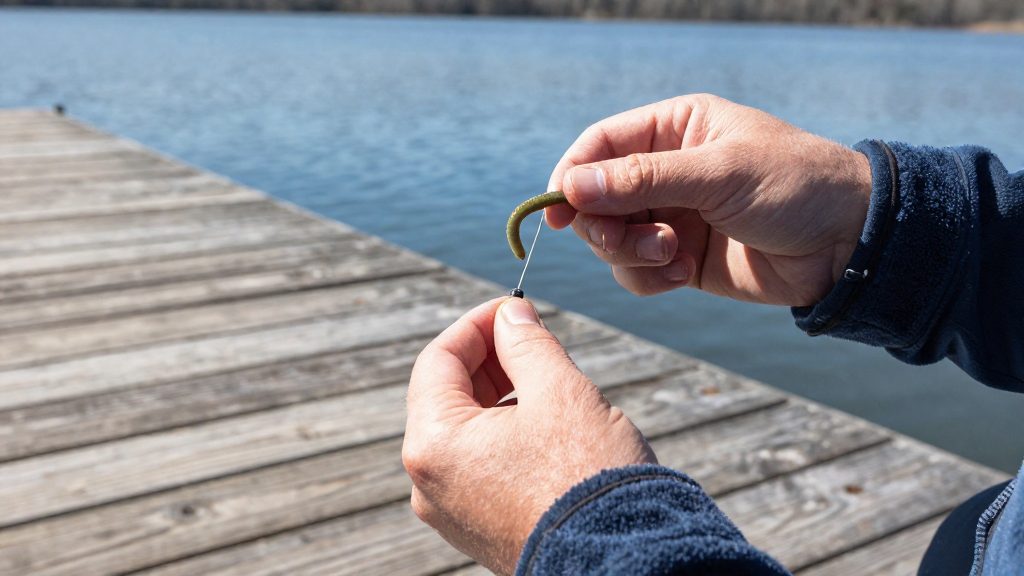
Texas rig setup for a soft plastic
Sports Illustrated (2026) names the Texas-rigged soft plastic as a beginner pick. The basic setup works like this:
- Slide a bullet weight onto the line, then attach the hook.
- Push the hook point into the nose of the soft plastic and out through the side of the body. Then turn the hook and bury the point back into the plastic so it stays weedless.
- Use the lightest weight that keeps the lure in contact with the bottom, since a heavier weight drops faster and is more likely to snag.
Spinnerbait blade flash and steady retrieve
Canadian Tire (2026) describes the spinnerbait as a lure that produces flash and vibration. The blade flash draws bass from a distance, and the vibration helps them find the lure in stained or off-colour water. Sports Illustrated (2026) advises casting the spinnerbait and reeling steadily, so the blades stay turning throughout the retrieve. If the blades stop spinning or the lure rolls over, check the blade and wire for weed or debris before the next cast.
Largemouth vs smallmouth: does the lure change?
Yes, partly. Largemouth and smallmouth bass use different habitat and eat different food, so the places you cast and the lure profiles you choose should shift between the two. Largemouth stay in shallow water around submerged logs and lily pads. Smallmouth favour rivers and lakes with rocky shorelines. Both species eat crayfish and insects, so those overlap, but largemouth also take frogs and baitfish, while smallmouth lean toward minnows.
Habitat: where each species holds
| Species | Typical cover | Depth range | Key structure |
|---|---|---|---|
| Largemouth bass | Shallow water | A few feet to about 20 ft | Submerged logs, lily pads |
| Smallmouth bass | Rivers and lakes | Not specified in source | Rocky shorelines |
Diet: what each species eats
- Largemouth: baitfish, frogs, crayfish and insects
- Smallmouth: crayfish, insects and minnows
Minnow-imitating crankbaits suit both species, since both feed on baitfish.
Matching the lure to the habitat
- Largemouth in lily pads and logs: topwater lures that imitate frogs, mice or insects, and spinnerbaits.
- Smallmouth on rocky shorelines: the Water Wolf Jelly Shad, a 3.8-inch Canadian-made swimbait fished on a light jig head. Outdoor Canada (2024) describes it as very effective on smallmouth.
What rod, reel and line suit a first setup?
A spinning outfit is the simplest starting point for bass. According to Canadian Tire (2026), spinning rods are versatile and suit many situations, while casting rods are more powerful and suit intermediate to experienced anglers, especially when fishing around weeds and stumps. Sports Illustrated (2026) suggests a spinning setup built around a 7-ft medium rod, a 2000 to 2500 size reel and 15 lb braid. That combination handles the main beginner lures without overloading the rod.
Spinning versus casting rods
| Rod type | Suited to | Typical user |
|---|---|---|
| Spinning | Many situations, open water and general casting | Beginners |
| Casting | Heavy cover such as weeds and stumps, more power | Intermediate to experienced anglers |
A medium-power spinning rod keeps lure weight and line strength in a manageable range. A casting rod is better reserved for later, once you are comfortable fishing heavy cover.
Choosing a line
Each line type behaves differently, so match it to your lures and cover:
- Monofilament, 6 to 12 lb: Forgiving and stretches, which helps absorb sudden lunges and makes it easier to avoid pulling hooks free.
- Braid, 15 to 50 lb: Sensitive with no stretch, so you feel bites more clearly. It needs a palomar knot to hold well.
- Fluorocarbon, 8 to 20 lb: Low-visibility and abrasion resistant. It is often used as a leader tied to braid.
To tie a palomar knot, double about 10 cm of line and pass the loop through the eye of the lure or snap. Tie a simple overhand knot with the doubled line, pass the loop fully over the lure, moisten the knot, then pull both tag ends and the main line to tighten. Trim the tag ends close to the knot.
How to fish your first lure from shore
Bass fishing from the bank comes down to placing a lure beside cover and changing how it moves until a fish responds. Your task from shore is to put the lure into the cover with accurate casts and keep it there long enough to draw a strike.
Casting angles along weed edges and docks
Cast so the lure lands just beyond the cover, not on top of it. Then bring it back across the boundary between weeds and open water, or past the posts and shadow of a dock. Changing your angle changes which part of the edge the lure covers, so one position can work the line in two directions, and a second position can reach the same edge from the other side.
A spinning rod is enough to start with. Keep a casting rod for later, once you fish heavy vegetation.
Retrieve speed changes and pauses
If nothing follows, change the pace: speed up across open water and slow down once the lure is in or beside cover. Add short pauses where the lure passes a log, a weed stem or a dock post, and let it sit briefly before resuming. Vary the timing by feel, since no fixed pause length applies to every spot.
Topwater lures are worked with stop-and-go movement near surface cover.
Working a spot systematically
Fish each piece of cover from several angles before moving on. Make several casts to one point, then work along the edge in order, one cast’s width at a time, so you do not skip water. Mark the spot where a fish strikes and repeat the same cast there. Move to the next section only after the cover has been covered from each side.
| Cover | Species linked in the sources | Method from shore |
|---|---|---|
| Submerged logs | Largemouth (Canadian Tire, 2026) | Cast past the log, bring the lure across it, pause beside it |
| Lily pads | Largemouth (Canadian Tire, 2026) | Work the pad edges with a topwater lure in short stops |
| Rocky shorelines | Smallmouth (Canadian Tire, 2026) | Retrieve along the rocks and vary the depth with the lure choice |
Check provincial rules and release bass carefully
Bass fishing rules are set by province and can differ by water body, season and species, so a tip from a forum or an older guide may no longer apply. Before you fish, check the current regulations for the province and the specific lake or river. Look for the licence requirement, the open season, and any size or catch limits for largemouth and smallmouth bass. If a rule is unclear, contact the provincial natural resources or fisheries office rather than guessing. Keep a copy of the current regulations with your gear.
Knowing the size limit before you fish matters because it decides what happens on the bank. A bass below the minimum, or above a maximum where one applies, must be released immediately, and you should handle it with the same care as any fish you intend to keep alive.
Release sequence
Work through these steps in order to shorten the fish’s time out of water:
| Step | Action | Purpose |
|---|---|---|
| 1 | Wet your hands before touching the fish | Protects the slime coat that guards against infection |
| 2 | Keep the bass in the water while unhooking | Limits oxygen loss and stress |
| 3 | Support the body horizontally, one hand under the belly | Prevents strain on the spine and internal organs |
| 4 | If you want a photo, have it ready beforehand and keep the fish out of the water only a few seconds | Limits time out of water |
| 5 | Hold the fish upright in the current until it swims off | Restores oxygen flow over the gills |
Hook removal and revival
Use pliers or a hook remover and back the hook out along its original path. Avoid pulling the hook through the flesh. Keep the fish in the water during this step where you can, because air exposure adds stress.
After a long fight, a bass may be exhausted and unable to hold its position. Face it into the gentle current, move it slowly back and forth so water passes over the gills, and let go only once it holds its balance and swims away on its own.