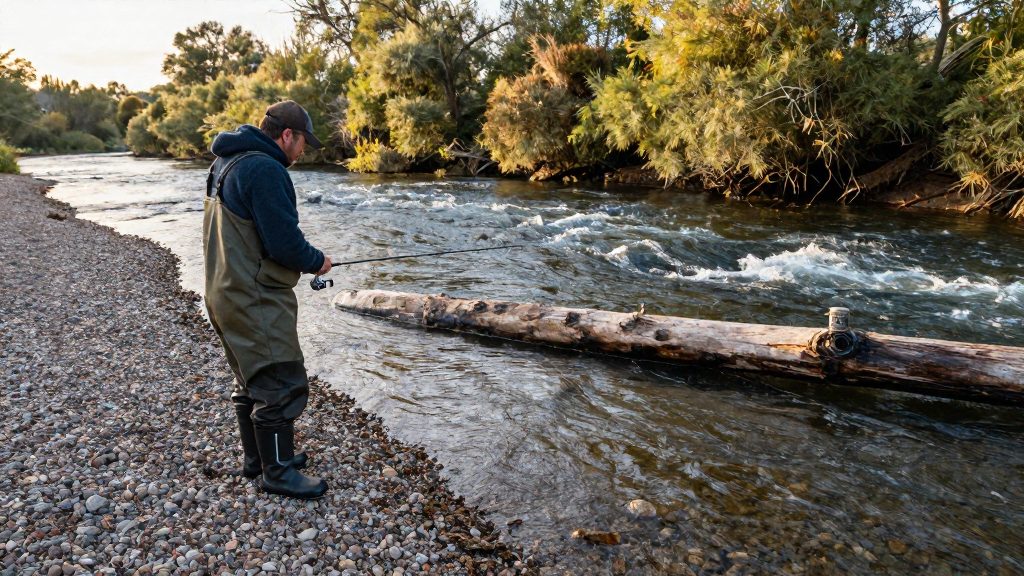
Fish hold where current, food and cover overlap, because a spot that offers all three lets them spend less energy while still intercepting what drifts past. Holding in moving water is costly, so fish usually choose a position where the flow is weaker but food still reaches them.
Why do fish hold where they do?
The energy trade-off
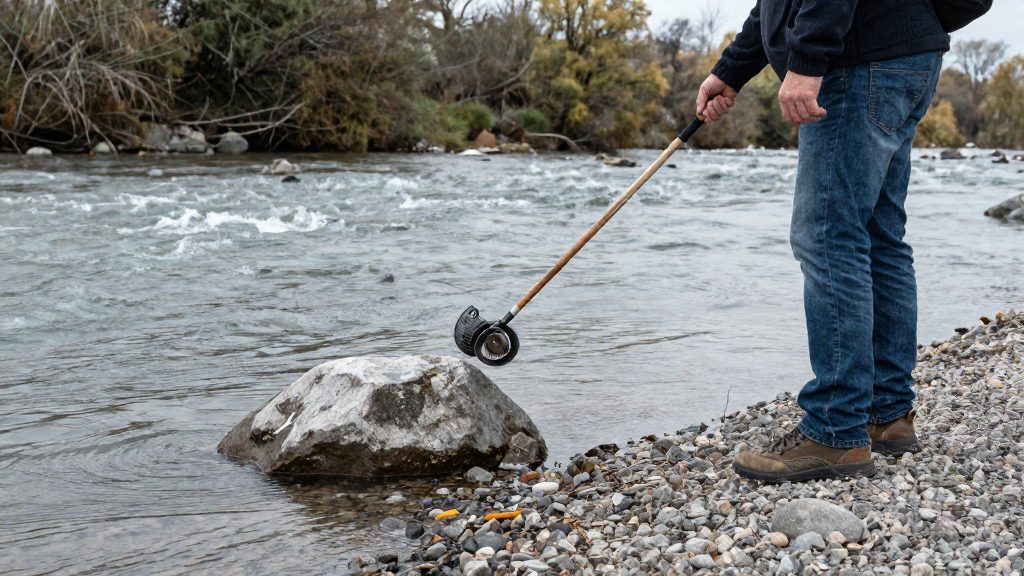
Staying in place against a current takes continuous effort, and that effort only pays off if the position returns enough food. Fish therefore favour spots where the flow slows enough to reduce the work of holding, while faster water beside them still carries prey. Flyloops (2026) notes that behind a boulder, fish sit in the slack water directly downstream of it and in the cushion of slower water on its upstream face. Both positions reduce the force the fish must resist.
Food delivery and ambush positioning
Current moves food along predictable lines, so fish settle where that supply concentrates. Flyloops (2026) states that where currents merge at a confluence, food collects along the seam and fish stack up. In riffles and pocket water, fish hold in the deepest spots, such as behind submerged rocks or in small depressions, where they can intercept drift without fighting the strongest flow. This is ambush positioning: a fish stays in a low-effort lie and strikes what passes within reach. When you read a stretch, look for places where drift lines up in front of a rock, ledge or depression. Those are the likeliest ambush points.
Cover and shelter
Cover gives fish a place to stay out of the main current and out of sight. Flyloops (2026) names undercut banks as providing cover and shade, and says big, wary brown trout and bass favour them. Cover and feeding position often coincide, since a spot beside the main flow can offer shelter and a clear view of passing food at once.
| Holding driver | What the fish gains | Source |
|---|---|---|
| Slack water behind a boulder | Lower energy cost of holding | Flyloops (2026) |
| Deepest spots in riffles and pocket water | Intercepts drift in strong current | Flyloops (2026) |
| Undercut banks | Cover and shade | Flyloops (2026) |
Current seams: the first thing to look for
A current seam is the line where fast water meets slow water. On almost any river, it is the first place to check, because moving water carries food and the slower side gives fish a place to rest while they wait for it. According to Sports Illustrated (2026), trout sit on the slower side of a seam and wait for food drifting in the faster current. Your job is to find that edge, then present your bait or lure where the food will pass.
The fast-to-slow boundary
Start by scanning the surface for the change in speed. Fast water looks broken and textured, while slow water looks smooth and glassy. Cast so the bait or lure lands at the edge of the seam, then let it drift down the seam into the slower water where trout hold. Trout hold on the slow side and take food as it passes, so a presentation that stays just inside the seam tends to be more productive than one that crosses into the main flow.
Foam lines
Foam is a visible marker of a seam. Sports Illustrated (2026) notes that foam lines on the surface mark a seam, and it presents the saying “foam is home” as a reliable guide. Foam tends to collect and drift along the edge where two currents meet, so a line of foam shows you where the boundary runs. Watch the foam for a few minutes before casting. Its direction shows the path food will take.
Confluences
Where two currents merge, food collects along the joining seam. Flyloops (2026) reports that fish stack up in these spots. Walk the confluence from a safe position and note where the two flows meet. Food collects along the seam running out from the junction, and fish stack up there.
| Seam type | What to look for | Where fish sit |
|---|---|---|
| Fast-to-slow boundary | Broken water beside smooth water | Slow side, waiting for drifting food (Sports Illustrated, 2026) |
| Foam line | Surface foam collecting along an edge | Along the seam where foam gathers (Sports Illustrated, 2026) |
| Confluence | Two currents joining | Along the seam where food collects and fish stack up (Flyloops, 2026) |
How do rocks and logs create holding spots?
Boulders, rocks, gravel bars and other hidden structure split the current, and the water around them changes speed and direction. According to Sports Illustrated (2026), these obstacles create seams, and hidden structure can create them too. Where the flow divides, fish get out of the main current while still having food carried past them. Reading these spots means looking for the calmer water each obstacle leaves behind.
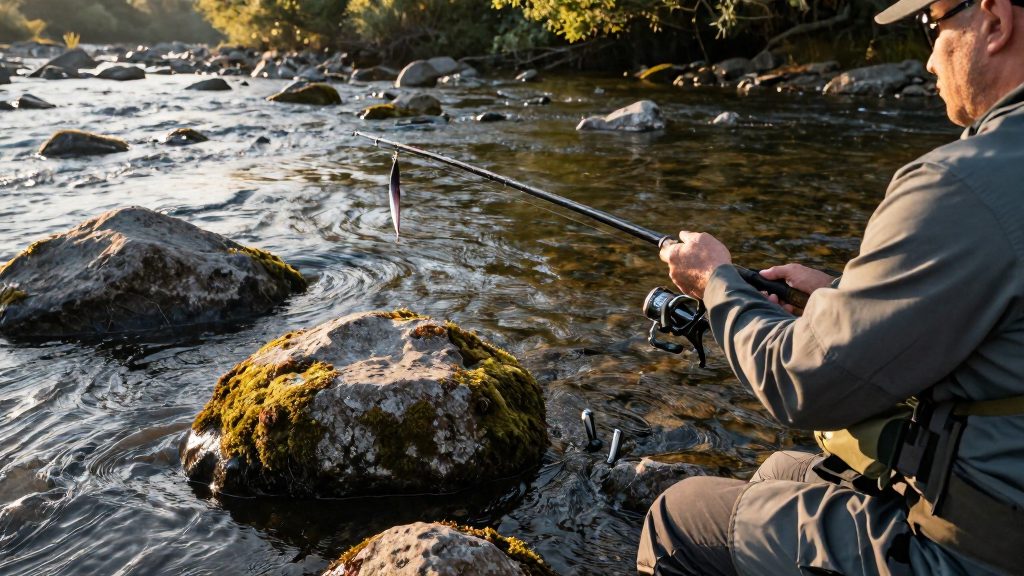
Slack water behind a boulder is a classic holding position. According to Flyloops (2026), fish sit in the slack water directly behind a boulder and in the cushion of slower water on its upstream face. To fish these spots, cast so your lure passes the upstream face first, then drifts into the slack behind the rock, rather than only working the fast water beside it.
Gravel bars and submerged rocks work in a similar way. They split the flow and leave a slower side where fish can rest, so check the water on both edges of the bar or rock before you commit to a cast.
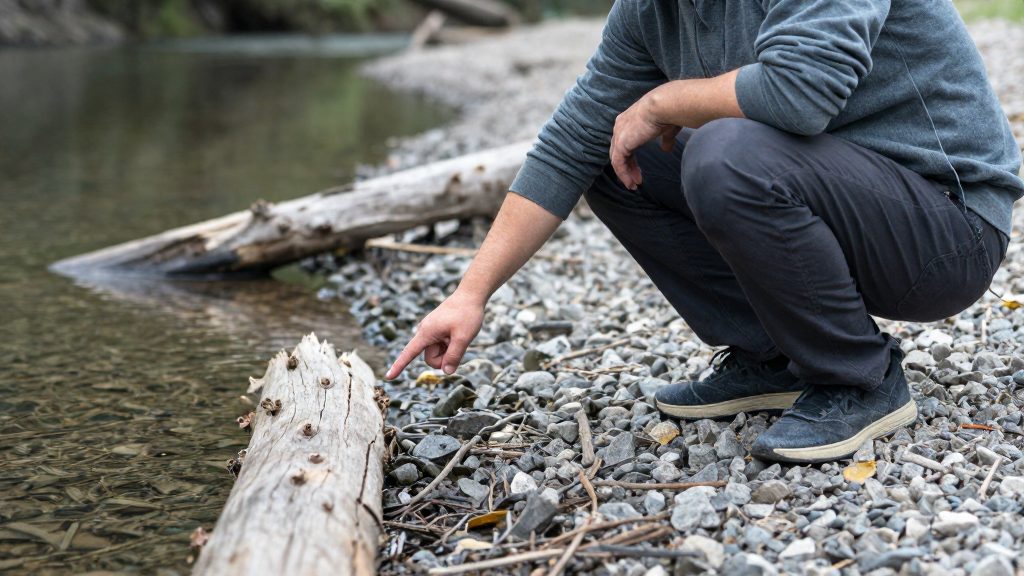
Logs and other submerged wood are a form of hidden structure. Read the water in front of and behind them as you would around a boulder, and look for the spot where the current slows or changes direction.
Pocket water and riffle depressions are a different kind of holding spot. In riffles and pocket water, Flyloops (2026) notes that fish hold in the deepest spots, such as behind submerged rocks or in small depressions. Depressions often look darker than the surrounding water, so they are worth a few casts even when the surface looks uniform.
| Structure | Effect on flow | Where fish hold |
|---|---|---|
| Boulder or rock | Splits the current | Slack water directly behind it, and the slower cushion on its upstream face |
| Gravel bar | Splits the current and creates seams | The slower side of the seam it creates |
| Submerged rock or hidden structure | Splits the current and creates seams | The same positions as a boulder or gravel bar |
| Riffle depression or pocket water | Fast water with deeper pockets | The deepest spots, such as behind submerged rocks or in small depressions |
Pool heads, bodies and tails
A pool is not one uniform hole. Its three zones hold different fish, so each needs its own approach. The pool head, where a riffle drops into the pool, is oxygen-rich and food-heavy, so active fish often gather there. The pool body is deep and slow, and larger fish rest there between feeds. The pool tail is shallow and glassy, and the fish holding there feed selectively.
| Pool zone | Water character | Typical fish behaviour |
|---|---|---|
| Pool head | Oxygen-rich, food-heavy, fed by the riffle above | Active fish gather |
| Pool body | Deep and slow | Larger fish rest between feeds |
| Pool tail | Shallow and glassy | Selective feeding |
The head is also a seam, where fast water meets slow water. The stronger current at the head means your lure or bait has to hold its line and depth as it enters the pool.
The body is harder to read by sight because its depth hides the fish. Use a sink rate that keeps your offering in the lower water column, and let it sit or move slowly so it reaches resting fish that are not chasing.
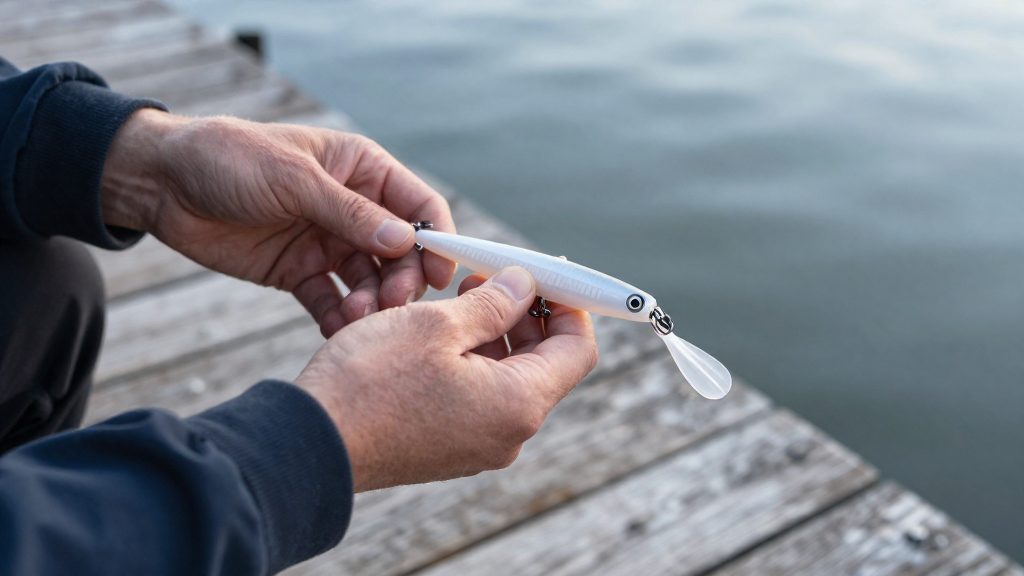
In the tail, the flat, clear surface means fish see your line and presentation clearly. Use lighter line and a subtle presentation, and make fewer casts over the same water before moving on. Watch how fish react to your first few offerings and adjust your choice of lure or bait to match.
Banks, bends and undercut cover
Undercut banks are among the most reliable cover features in a river. Where the current has eroded the soil beneath a bank, an overhang forms, and the water under it is shaded and sheltered from above. According to Flyloops (2026), undercut banks give cover and shade, and big, wary brown trout and bass favour them. A single overhang can therefore hold a large fish for a whole session, while open water a few metres away stays empty.
Overhead cover matters because wary predators prefer ambush positions they can leave without being seen. A fish holding under the lip watches the current slide past and strikes at food that drifts into its reach. For a lure angler, the target is usually the strip of water directly beneath or just beside the overhang, not the open bank.
Outside bends are the second feature to check. On a bend, the current is pushed toward the outer bank, which can scour the bed and leave deeper water along that side. Compare the two sides of each bend:
| Position on bend | Typical water | What to check |
|---|---|---|
| Outside (concave) bank | Deeper, faster flow | Undercut edges, roots and fallen timber |
| Inside (convex) bank | Shallower, slower flow | Gravel or sand where the current slackens |
Scour holes are the deepest pockets created by this action. Fish use them as a place to rest out of strong flow, so a hole directly against an undercut bank is worth working thoroughly.
Practical method for each bend:
- Approach the outside of the bend first, then move to the inside.
- Look for dark, shaded water under overhanging roots, grass or fallen branches.
- Cast so the lure lands just upstream of the overhang, then let the current carry it under the lip.
- Vary the retrieve depth, since the water column along an undercut can differ from the open water nearby.
How do high and low water change fish position?
Water level changes which parts of a river hold fish. When the flow rises, fish leave the fast main current for slower water at the edges. When the flow drops, they gather in the deepest parts of the river. According to Flyloops (2026), high water pushes fish toward slower bank edges, flooded margins and backwaters, while low water concentrates them in the deepest pool bodies and channels. Knowing which of these two situations you are fishing lets you choose where to cast before you reach the bank.
| Water level | Where fish tend to hold | Where to look first |
|---|---|---|
| High | Slower bank edges, flooded margins, backwaters | Quiet water beside the main current |
| Low | Deepest pool bodies and channels | The deepest, most defined water in the reach |
High water: fish move to the margins
Margins are the edges of the river where the current weakens. In high water, these are the first places to check:
- Slower bank edges, where the flow runs more gently than in the centre.
- Flooded margins, the bank areas that the rising river has covered.
- Backwaters, the side pockets that stay calmer while the main river runs high.
When you arrive at a river that is clearly running high, start with these areas and work toward the main flow only if they produce nothing.
Low water: fish gather in the deepest water
As the river drops, the usable water shrinks, and fish concentrate in the deepest pool bodies and channels. Look for the reach’s deepest, best-defined water. A channel that was one part of a wider river at higher levels can become the main holding area when levels fall.
Safe wading and respecting local rules
Reading a river safely starts before your first step into the water. Wading within your limits means judging the footing and the current, knowing where you can stand, and confirming that you are allowed to fish the stretch at all. Check the legal position first, then the physical one, and never skip either because the water looks easy.
Footing and current strength
- Test the riverbed before committing your weight. Firm gravel and compact sand are easier to stand on than silt, weed-covered stones or slick rock.
- Use a wading staff to probe ahead, especially where the bottom is hidden by murky water.
- Watch how the water pushes your legs. If the current makes it hard to keep your footing or pulls at your shins, your limit has been reached. Step back to shallower water.
- Face upstream and move your feet in small steps rather than crossing them, so you keep a stable base.
- Wade alone only in shallow, familiar water. Tell someone where you are fishing when you go out on your own.
Permits and angling regulations
In Canada, fishing rules and licence requirements are set by each province or territory, and some waters carry additional local restrictions, so they vary by region and stretch of river. Always check the current regulations for the specific water before fishing.
- Identify who manages the water, whether a public fisheries authority, a fishing club or a private owner.
- Confirm whether you need a licence or permit, and check what it covers and where it applies.
- Read the season dates, minimum size limits and bag limits for each species you intend to target.
- Check for closed areas, restricted tackle and banned baits, which are often posted on the bank or listed in the permit conditions.
- Look for the official source. Use the regulation booklet, the permit label, the fisheries authority’s website or the club’s notice board. If a rule is unclear, ask the relevant local service before fishing.
Avoiding disturbance to fish and banks
- Move slowly and keep a low profile. Heavy footsteps and sudden movement send vibrations and shadows across the water, which alerts fish.
- Avoid splashing through the same run repeatedly. Repeated disturbance can put fish off feeding in that spot.
- Keep off spawning gravels and any area where fish are visibly nesting.
- Avoid trampling vegetation along the bank, which speeds up erosion and damages habitat.
- Take all litter home, including line offcuts, which can injure birds and fish.
Frequently asked questions
Where should I cast when I find a current seam?
Land the lure or bait on the fast side of the seam, close to the edge, then let the current carry it into the slower water. According to Sports Illustrated (2026), trout sit on the slower side and wait for food drifting in the faster current, so the current seam is where the presentation should finish.
How do I tell a pool head from a pool tail?
A pool head is where a riffle drops into a pool, and it is usually oxygen-rich and full of food, so active fish gather there. The pool tail is shallower and glassier, and fish there tend to feed selectively, so a more precise presentation often works better. Flyloops (2026) describes both features.
Does the water level change where fish hold?
Yes. In high water, fish move to slower bank edges, flooded margins and backwaters, while in low water they concentrate in the deepest pool bodies and channels. Flyloops (2026) describes this pattern, so adjust your search area to match the current flow.