What are current breaks on a river?
Definition: a zone where flow speed changes sharply
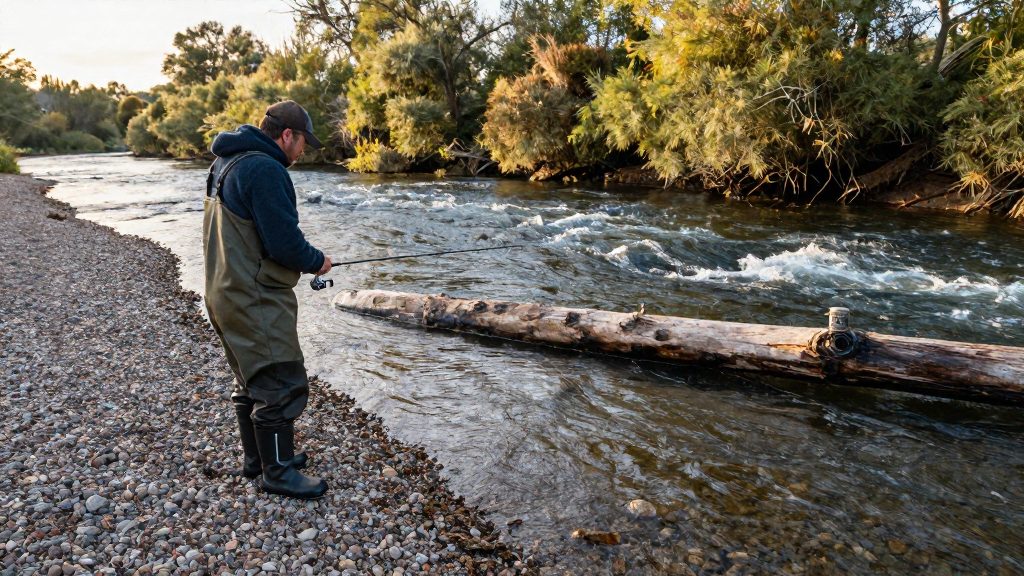
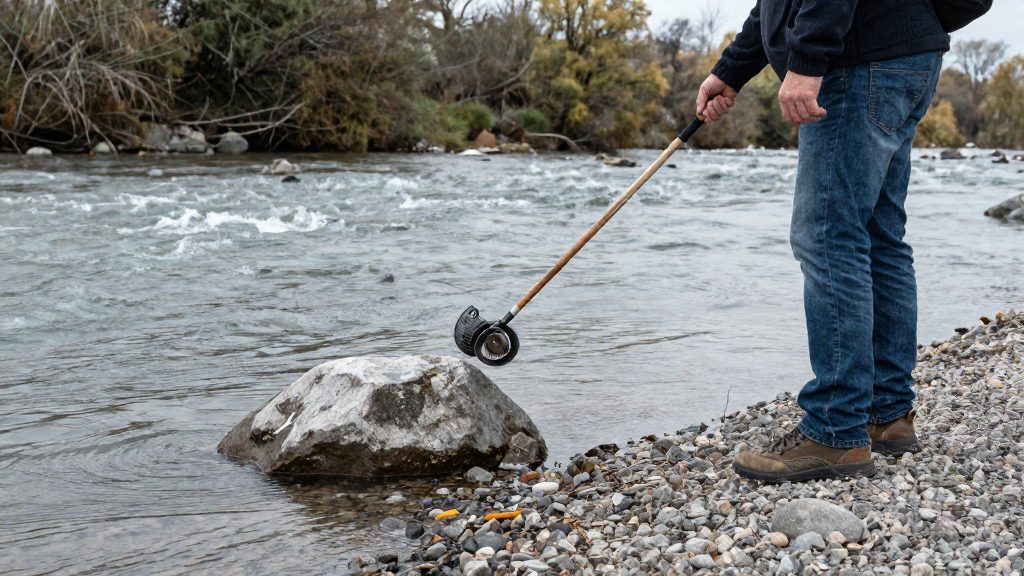
A current break is a zone where fast water and slow water sit side by side. Something in the river, such as a boulder, a log, a bank or a gravel bar, splits the current. The water on the far side of the obstacle slows down, and the fast water running past it creates a boundary.
The features that create breaks fall into three groups:
| Feature | How it changes the flow | Where the slower water forms |
|---|---|---|
| Boulders and solid objects | Split the current | Behind the object, on each side of the split |
| Banks | Slow the water at the edge | Against the bank |
| Submerged rocks and gravel bars | Change flow speed below the surface | Over and beside the bottom feature |
Submerged features matter because they are easy to miss. According to Sports Illustrated (On SI Fishing) (2025-02-26), rocks and gravel bars below the surface also change flow speed, so a break can exist where you see no structure at all.
Current break versus simple slow water pockets
Not every patch of slow water is a current break. A slow pocket that is surrounded by slow water offers little contrast, while a break has fast water next to it. The useful question is whether the slow water sits beside faster flow that carries food past it.
Flow speed as the key variable, not depth
Depth is easy to see, but flow speed is the factor that defines a break. The slow-water side of the break is where fish conserve energy, and the change in speed is what you are looking for. A deep, still pool with no faster water nearby does not meet that definition. A shallow stretch that splits around a rock does. Read the surface for speed differences first, and use depth only to narrow down where the slower water sits.
Why do fish hold behind current breaks?
Fish hold behind a current break because slack water lets them rest while staying close to passing food. Holding against strong flow costs energy continuously. According to Outdoor Canada (2026), a fish holding in strong current would tire out within hours. Resting in slower water is therefore an energy-saving choice, and the fish moves into faster current mainly when it needs to feed.
The energy trade-off
A fish must keep its position against the flow, and every minute spent in strong current is paid for in muscle effort. Behind an obstacle, against a bank or along the bottom, the water slows down and the same fish can hold with far less exertion. This is why the slack side of a current break becomes a preferred holding lie.
Feeding in faster current
Fish prefer to feed in current that is ideally faster than the current at their holding spot. The fish keeps its low-effort resting position and takes food carried by the faster water, then drops back into calm water. The table below summarises how the two activities differ.
| Activity | Current speed | Fish behaviour |
|---|---|---|
| Resting | Slower, at the holding spot | Holds station with little effort |
| Feeding | Faster than the holding spot | Takes food carried by the flow, then returns |
Leaving safe spots when food is plentiful
Holding position is not fixed. When food is plentiful, fish may leave their safe spots for more exposed ones. An abundant drift can pull a fish out of its resting lie into faster, more exposed water, trading comfort for feeding opportunity. Anglers should expect fish to shift as food supply changes, rather than assuming a fish will stay in the same slack water all day.
How to spot seams, eddies and foam lines
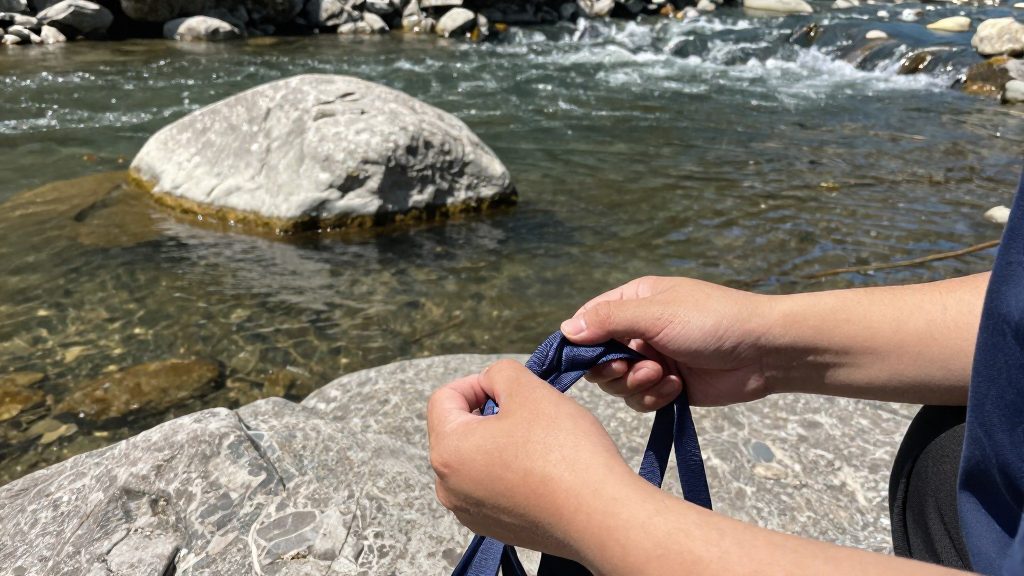
The surface of a river shows where fast and slow water meet if you know what to look for. A seam is the boundary between fast and slow water. Trout hold in the slower water and feed on food drifting past in the faster water, according to Sports Illustrated (On SI Fishing, February 2025), so the seam is where a fish can rest and feed without much effort.
Start by scanning the whole run for changes in surface texture. A smooth, slower patch beside a band of faster, rippled water usually marks a seam.
The table below summarises the three surface signs and how to check each one.
| Surface sign | What it indicates | How to check it |
|---|---|---|
| Speed change | Fast and slow water meeting, the seam itself | Compare the surface texture on both sides of the line |
| Slack patch behind an obstacle | An eddy, where the water slows and can turn back | Drop a leaf or small piece of debris upstream and watch whether it circles or drifts slowly while the main current passes |
| Line of foam | Two currents converging, a likely seam | Look for foam collecting in a continuous line where the flows join |
Reading eddies
An eddy is the slack water that forms behind an obstacle, where the main current splits and slows. Fish often sit in this calmer water. The debris test in the table is a simple extra check on whether the water is turning or only drifting slowly.
Reading foam lines
A foam line shows where two currents meet. Sports Illustrated (On SI Fishing, February 2025) describes foam as a marker that points to a likely seam, summed up as “foam is home.” Foam lines can show where food is being carried.
Where to look: boulders, bars, bends and tributary mouths
Current breaks form where the flow is interrupted, slowed or redirected, so the features to check first are boulders, submerged gravel bars, the inside and outside of bends, and the points where tributaries join the main channel. Working through these features in turn turns a stretch of river into a short list of spots to test.
Boulders and the slack behind them
Boulders and other solid objects split the current and create seams on each side, with slack water directly behind them (Sports Illustrated (On SI Fishing), 2025-02-26). Walk the bank and watch how the surface breaks around each rock. The smooth water just downstream of a stone is the first place to test. Where a run has several boulders, treat each one as a separate pocket rather than fishing the whole run as a single spot.
Submerged gravel bars
Because a submerged gravel bar cannot be seen from the bank, read the pace of the water instead. A patch that moves noticeably differently from the water beside it may sit over a shallow shelf. Note its position against a bank landmark, such as a tree or a bank step, so you can find it again on the next visit.
Outside and inside bends
Current pushes against the outside of a bend, and the inside edge usually carries slower water. Stand on the inside of the curve and compare the pace of the water with the opposite bank. The slower water along the inside edge, where the flow is weaker, is the first area to check, because fish hold in slow water against the bank.
Tributary mouths
Where a side stream enters the main river, the incoming water alters the main flow and can create slower pockets along the nearby bank. Before choosing a position, observe whether the main current is pushed sideways by the inflow, and check both banks near the join.
| Feature | Where slack usually forms | Reader check |
|---|---|---|
| Boulder | Directly downstream of the rock | Compare surface pace on each side |
| Submerged gravel bar | Over the shallow shelf | Mark it against a bank landmark |
| Outside bend | Under the bank being pushed | Watch which bank takes the main flow |
| Inside bend | Along the slower inner edge | Compare pace with the opposite bank |
| Tributary mouth | Near the bank beside the join | Check both banks at the confluence |
How do you fish a current break with lures?
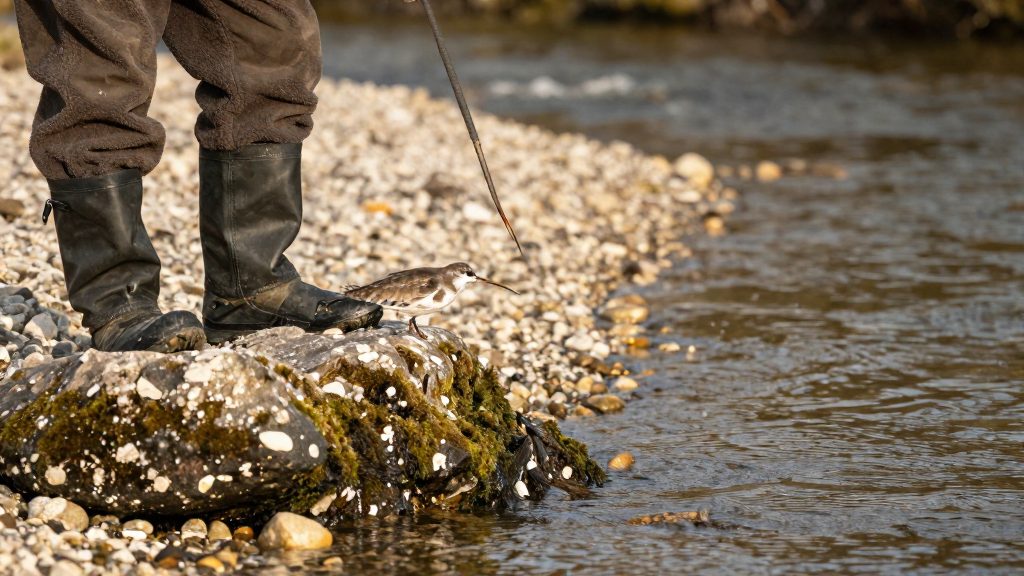
To fish a current break with lures, place the cast so the lure reaches the seam drifting naturally, then control its speed as it crosses into slower water.
Casting above the seam
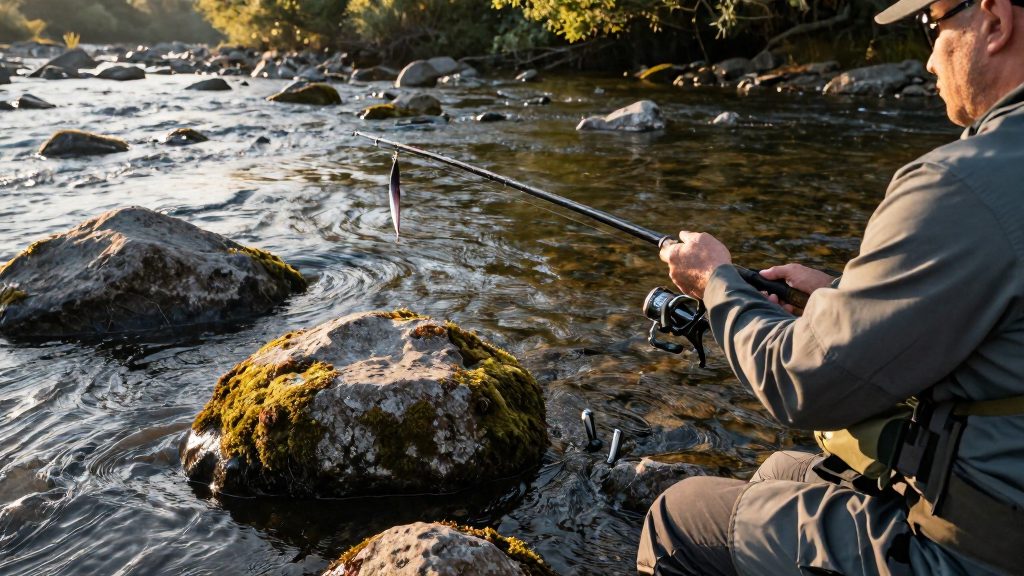
Cast upstream of the seam, on the fast-water side, so the current carries the lure into the break. A cast that lands on the slow side and is then pulled across the seam moves unnaturally, because the line drags the lure against the flow.
- Cast upstream of obstacles. Cast above the rock and let the lure swing past its edge.
- Target seams you cannot see. Probe these areas with several casts before moving on.
Matching retrieve speed to the drift
Keep the retrieve close to the speed of the current. Once the lure is in the seam, keep the line just tight enough to feel it and let the flow move the lure, rather than reeling against it. When the lure drifts into slack water behind an obstacle, slow the retrieve. Change speed in small steps until you get a response, and note which speed works for future trips.
Lure weight and profile for seam fishing
Choose a weight that lets the lure reach the feeding line without being swept through it too fast. A heavier lure sinks faster in fast water and stays near the bottom of the seam. A lighter lure drifts higher and looks more natural. Check the weight printed on the lure or its packaging, and change weight when the current changes. A slimmer profile produces less drag in fast water.
Which species use current breaks: trout, bass, pike, walleye?
Trout are the clearest example of a fish that uses current breaks. Bass, pike and walleye can use similar slack water, but the positions below describe where to look on the water, not fixed rules for each species.
Trout and bass: holding positions compared
A fish’s holding spot is usually where the current slows. Trout sit in one of three places, and other species such as bass often use similar slack water:
| Holding spot | Why the current slows | Where the fish feeds |
|---|---|---|
| Behind an obstacle | Boulders and solid objects split the flow, leaving slack water on their downstream side | Faster water beside the slack |
| Against the bank | Friction along the bank reduces speed | The edge where the bank current meets the main flow |
| Along the bottom | Friction at the riverbed reduces speed | Food carried in the faster water above |
Pike: ambush positions behind boulders and bars
Pike suit the same structure, but their position is about cover and ambush. Look for slack water behind boulders and submerged gravel bars. Test the slack side of these spots, then cast or present a bait into the faster water beside it.
Walleye: slower edges
Walleye use the edge between fast and slow water, as pike do. Fish the slow side of a seam, especially where the bottom is gravel or a bar slows the flow. Work the boundary rather than the middle of the slack, since the faster current carries food to the edge.
Safety and water-level checks before you wade or fish from shore
Before you wade or stand on a bank near a current break, check the water level, the flow speed and the ground under your feet. A seam can sit right beside deep, moving water that you cannot see from the bank. Trout and other predators hold in the slower side of that line, so the best spots are often close to strong current. Treat fast water as a hazard until you have judged it.
Water level and flow before wading
Rivers rise and fall, and a current that looked gentle earlier can be stronger later. Check these signs before you enter:
| Check | What to look for |
|---|---|
| Water mark | Compare the current level with the usual level on the bank, a bridge pier or a post |
| Debris line | Leaves, sticks or fresh silt high on the bank, which show where the water recently reached |
| Surface pattern | A foam line marks where two currents meet, so expect a change in flow speed there |
| Bottom visibility | Whether you can see the riverbed clearly; if not, the depth and flow are unknown |
Footing on boulders and gravel
Solid objects split the current and create slack water behind them, and the rocks and gravel bars that cause this can be below the surface, so you may step onto them without warning. Wet stones can be slippery, and loose gravel can shift under your weight. Move slowly, test each step before you commit your weight, keep your feet apart for balance, and use a wading staff if you have one. Avoid stepping onto large rocks in fast water, where a fall is most likely to carry you downstream.
Shore positioning away from fast, deep channels
Choose a spot on the bank where you can reach the seam without entering the main channel. Keep a clear, dry route back to firm ground before you start, and do not stand on an undercut bank or on a slope of wet mud or loose stones. If the water is higher or faster than usual, move to a shallower or safer stretch rather than wading further out. Check the manufacturer’s guidance on your wading boots and staff, and follow the local rules on access and safety where you fish.
Frequently asked questions
How can I tell a true current break from an ordinary slow spot?
Look for a seam, the line where fast water and slow water meet side by side. If the slow water has no faster current running alongside it, it is more likely a slow pocket and offers little contrast for fish.
Why do fish stay in slow water instead of the fastest current?
Holding in strong flow would tire a fish quickly, so trout and other predators rest in the slack water behind or beside an obstacle. According to Outdoor Canada (2026), fish still prefer to feed in current that is faster than their holding spot, so they often feed on the edge of the flow.
Can a current break form where I see no rock or log?
Yes. According to Sports Illustrated (On SI Fishing) (2025), submerged rocks and gravel bars change flow speed below the surface, so a seam can exist with no visible structure. A foam line drifting on the surface often shows where two currents meet and where that seam is running.