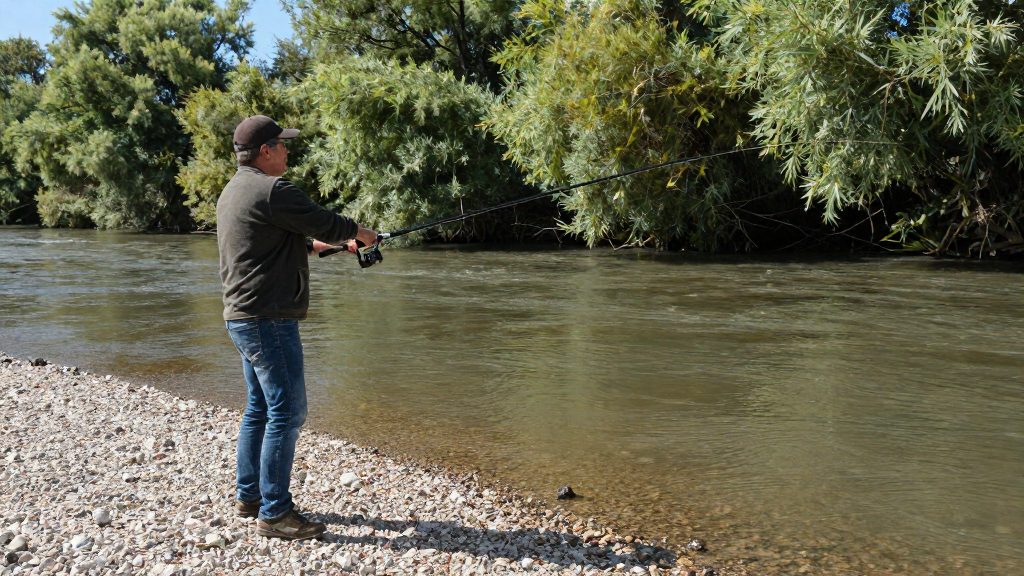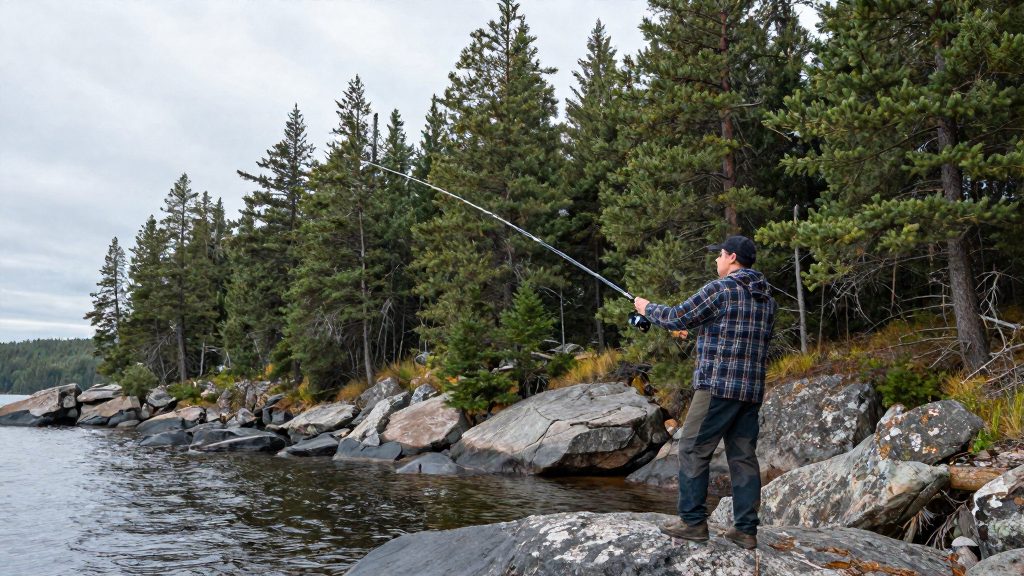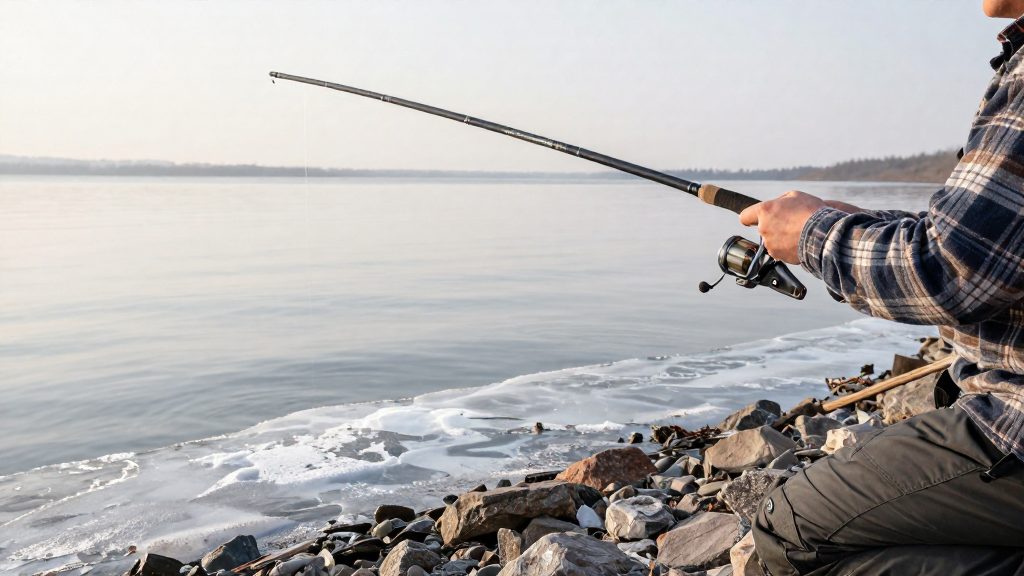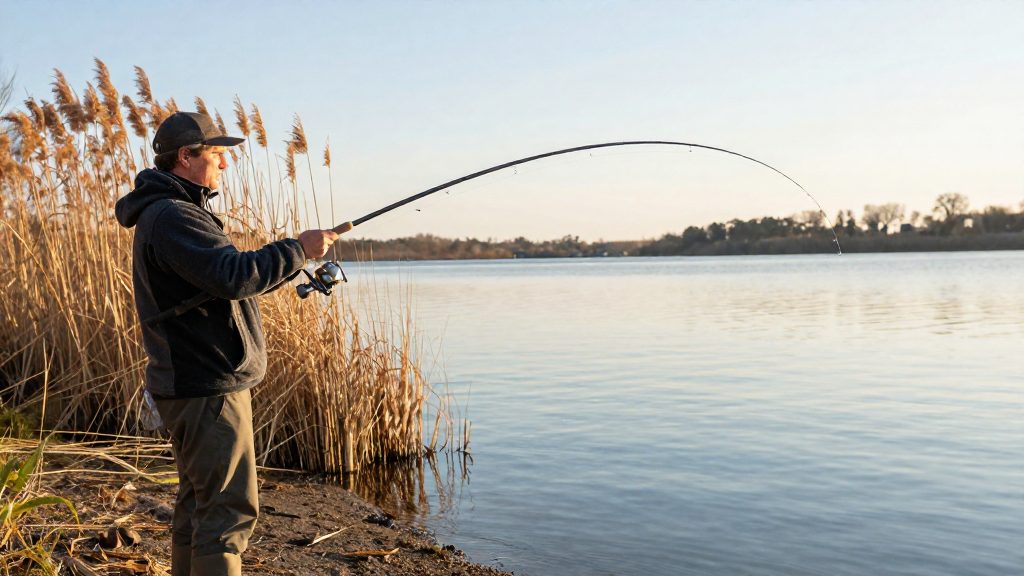
Rod action and rod power are separate properties, and beginners often confuse them. Action describes where a rod blank bends and how much it flexes under load. Power is the force needed to bend it. Because the two measure different things, a rod can share one action label with another rod and still have a different power rating.
Rod action vs rod power: what’s the difference?
Action answers the question “where does the blank bend, and how far?” According to Mud Hole (2025), action describes where and how much a rod blank flexes under load. The same rod can bend mostly near the tip or along most of its length, which changes how it responds to a fish and how it handles hook-setting.
Power answers a different question: “how much force does it take to bend the blank?” Mud Hole (2025) states that power depends on four factors:
- Taper: how the blank’s diameter changes from butt to tip
- Material: the composition of the blank
- Diameter: the thickness of the blank at a given point
- Wall thickness: how thick the hollow wall is
Since power comes from how the blank is built, it is set during manufacturing rather than by the angler. Action is shaped by the same build, but it is judged by the bend pattern rather than by the force required.
Action and power are independent. A rod can be labelled with one action and one power, and the two do not replace each other. Mud Hole (2025) gives the example of “fast action, medium power” as a combined label.
There is also no industry standard for these labels. Mud Hole (2025) notes that a term such as “fast action” or “medium power” can mean different things at different manufacturers. Treat the words on a label as the maker’s own description.
What is a fast action rod?
A fast action rod is a rod whose blank bends mainly in its upper third while the lower section stays firm. Action describes where and how much a blank flexes under load. According to Angling Times (2025), this tip-focused profile, often called “tippy”, suits light floats, short accurate lure casts and fast, aggressive bites.
Where the bend happens
A fast action blank loads near the tip rather than along its whole length. This is different from power, which is the force needed to bend the blank. Power depends on taper, material, diameter and wall thickness, so a fast action rod can be light or heavy in power.
What it gives the angler
According to Mud Hole, a Canadian fishing site (2025), the upper third bend gives sensitivity and enough backbone to pull fish out of cover. The source suggests this profile for the following setups:
| Setup | Fit described by the source |
|---|---|
| Jigs | Sensitivity and backbone for pulling fish out of cover |
| Texas rigs | Same cover-pulling role |
| Carolina rigs | Same cover-pulling role |
| Single-hook rigs in grass | Same cover-pulling role |
| Light floats | Tip-focused bend suited to light floats |
| Short, accurate lure casts | Tip-focused bend suited to short, precise casts |
What is a slow action rod?
A slow action rod is a rod whose blank bends along most of its length instead of concentrating the curve near the tip. According to Angling Times (2025), a slow, or progressive, action starts bending at the tip, and the curve moves down the blank as pressure increases. The whole rod therefore takes part in absorbing load. This is the main difference from a fast action rod, which flexes mainly in its upper third.
Bend spread across the blank
Mud Hole (2025) describes slow rods as flexing through most of the blank, so the rod curves in a broad arc rather than a tight bend near the top. Because the bending is distributed, the rod carries pressure over a longer section, and the movement you feel in the handle is less localised than with a fast rod.
Progressive curve toward the butt
In a slow rod, the bend develops in stages. At light load the tip does most of the flexing. As the fish pulls harder, the progressive curve travels toward the butt, bringing more of the blank into the bend. Angling Times (2025) links this behaviour to cushioning the fight with bigger fish, since more of the blank is available to absorb sudden runs.
Slow recovery and a gradual response
Once the load eases, a slow rod returns to its straight shape gradually. Mud Hole (2025) notes that slow rods recover slowly, which produces a smoother, more gradual response to the angler’s movements. In practice, expect the rod to react more slowly when you set the hook or change the speed of a lure than a fast rod would.
Where does moderate action fit in?
Moderate action sits between fast and slow on the action scale. Its blank flexes deeper than a fast rod, whose bend is concentrated in the upper third, and it keeps steady tension during a fight. There is no industry standard for action and power labels, so a “moderate” rod from one manufacturer can bend differently from one made by another. Compare the bend description in the listing, not the word alone, as noted by Mud Hole (2025-06-26).
Steady tension during the fight
Moderate and moderate-fast rods flex deeper and maintain steady tension. Mud Hole (2025-06-26) states that this helps protect hooks during a fight. Because the blank bends further down, the rod keeps a more even pull on the fish than a fast rod does, which concentrates the bend near the tip.
Through action for lighter lines
A through action (also called parabolic) bends from tip to butt. Angling Times (2025-08-05) states that it absorbs a fish’s movements and suits lighter lines and smaller hooks. It also cushions the hook hold, so this profile fits setups where the line and hook are fine rather than heavy.
| Action profile | Where the blank bends | Behaviour during a fight |
|---|---|---|
| Fast | Mainly the upper third | Sensitivity and enough backbone to pull fish out of cover |
| Moderate and moderate-fast | Deeper than fast | Steady tension that helps protect hooks |
| Through (parabolic) | Tip to butt | Absorbs fish movements; suits lighter lines and smaller hooks |
Which action suits which lure?
Matching rod action to lure comes down to two things: how the lure is worked, and how many hooks it carries. Mud Hole (Canadian site, 2025) groups the common cases into three families: fast action for jigs and Texas and Carolina rigs, extra fast tip-only rods for jerkbaits, and moderate-fast rods for crankbaits with treble hooks. The table below sums up the mapping.
| Lure or rig | Suggested action | Reason given |
|---|---|---|
| Jig | Fast | Keeps enough backbone to pull fish out of cover |
| Texas rig | Fast | Same backbone for working soft plastics through cover |
| Carolina rig | Fast | Same backbone for bottom presentations |
| Single-hook rig in grass | Fast | Pulls fish out of dense vegetation |
| Jerkbait | Extra fast (tip-only) | Flexes only at the tip |
| Treble-hook crankbait | Moderate-fast | Steady tension helps protect hooks during the fight |
Fast action for jigs and rigs
Jigs, Texas rigs and Carolina rigs all use a single hook or a small hook set that must drive into a fish that is often holding in cover. A fast action blank gives enough stiffness to lift the fish away from snags once the hook is set. This is also the suggested choice for single-hook rigs fished through grass, where the same pulling power matters most.
Extra fast, tip-only rods for jerkbaits
Extra fast rods flex only at the tip, and they are the suggested choice for jerkbaits. Because the rest of the blank stays firm, the rod stays responsive to the lure’s action at the end of the line.
Moderate-fast rods for treble-hook crankbaits
Moderate and moderate-fast rods flex deeper into the blank and keep steady tension during a fight. That steadiness is why they are suggested for crankbaits with treble hooks. Treble hooks carry three points, so a more even pull on the fish helps limit the stress on the hook set.
Fast or slow action: which is better for beginners?
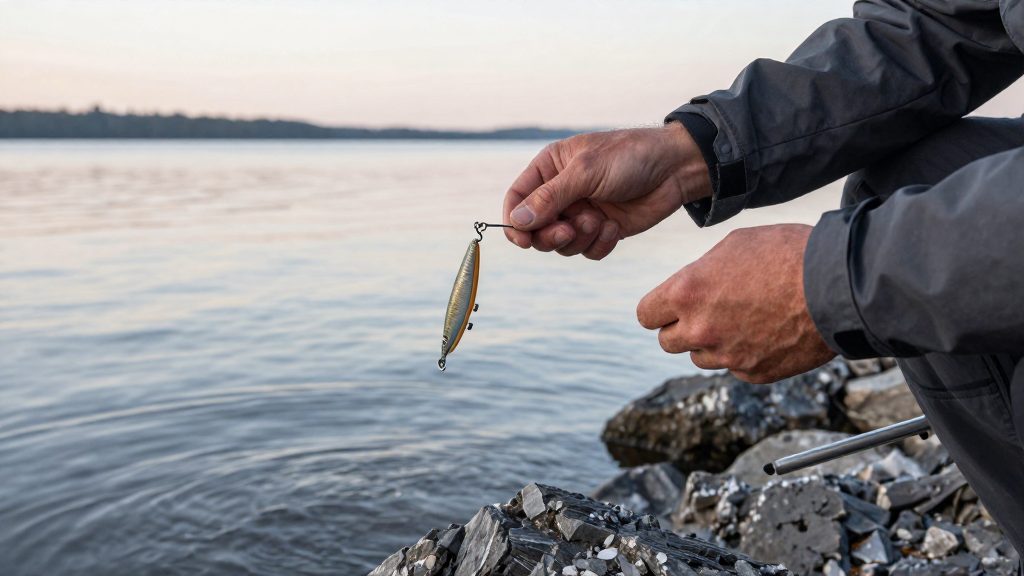
For a first rod, a fast action blank is usually the more practical choice, provided its bend suits the lures you plan to use. According to Angling Times (2025), a fast (“tippy”) rod bends mainly in the top third while the rest of the blank stays firm, which suits short, accurate casts and fast, aggressive bites. Mud Hole (2025) also recommends fast rods for jigs, Texas rigs and Carolina rigs, and for single-hook rigs in grass. A fast rod suits jigs, Texas rigs, Carolina rigs and single-hook rigs in grass, but treble-hook crankbaits call for a moderate or moderate-fast rod, so one rod will not cover every lure.
One rod for several lure types
A first rod rarely does one job. The sources point to different actions for different setups:
| Beginner setup | Action suggested by the source |
|---|---|
| Jigs, Texas rigs, Carolina rigs, single hook in grass | Fast (Mud Hole, 2025) |
| Treble-hook crankbaits | Moderate or moderate-fast (Mud Hole, 2025) |
| Light floats and short, accurate casts | Fast (Angling Times, 2025) |
| Lighter lines and smaller hooks | Through (parabolic) (Angling Times, 2025) |
Moderate rods flex deeper and keep steady tension, which helps protect hooks during a fight, so they suit treble hooks better than a fast rod does. A fast rod’s backbone is what pulls fish out of cover. Because these needs conflict, the simplest decision method is to list the three lure types you expect to use most in your first months, then choose the action that matches the majority of them.
Budget and length trade-offs
Price is a weak guide to action. Power, the force needed to bend the blank, depends on taper, material, diameter and wall thickness (Mud Hole, 2025). Two rods with the same stated action can therefore feel different, and a cheaper rod is not automatically the wrong one. Before buying, hold the rod, bend the tip gently by hand and check that the flex matches your top three lure types. Then check the manufacturer’s stated specifications on the product label or in its instructions, and confirm the length and power that fit your fishing spots with the retailer.
Does action matter for pike, bass, perch and trout?
Partly. The sources do not give advice by species. They tie action to where the blank bends, to the lure or rig, and to the size and bite style of the fish, so use that to choose a rod for pike, bass, perch or trout. The label on the box matters less than what the rod actually does, because action labels are not standardised. According to Mud Hole (2025), there is no industry standard for rod action and power labels, so a “fast action, medium power” rod can differ between manufacturers.
Fight styles compared by bend zone
Action describes where and how much a blank flexes, while power is the force needed to bend it. Power depends on taper, material, diameter and wall thickness, so two rods with the same action can feel different in the hand.
| Action | Where it bends | Behaviour during the fight | Suited to |
|---|---|---|---|
| Fast | Upper third | Sensitivity and backbone to pull fish out of cover | Lifting fish from cover (Mud Hole, 2025) |
| Moderate / moderate-fast | Deeper into the blank | Keeps steady tension to help protect hooks | Fights where hook protection matters (Mud Hole, 2025) |
| Slow (progressive) | Starts at the tip, curve moves down the blank | Cushions the fight with larger fish | Bigger fish (Angling Times, 2025) |
| Through (parabolic) | Tip to butt | Absorbs the fish’s movements | Smaller hooks and cushioned hook hold (Angling Times, 2025) |
Matching action to fish size
The guidance above ties action to fish size and bite style, and species names serve as a practical shortcut. For bigger fish in general, Angling Times describes a slow (progressive) action as cushioning the fight. For jigs, Texas and Carolina rigs and fishing in cover, Mud Hole suggests a fast action, so the lure and the cover matter as much as the species. Where you fish with lighter lines and smaller hooks, Angling Times suggests a through (parabolic) action. Where you fish light floats or expect fast, aggressive bites, it suggests a fast (“tippy”) action. These are guides to the setup, not species rules.
Trout versus predator rod stiffness
Stiffness is the practical result of action and power together. A trout rod built for light floats and accurate casts usually sits at the sensitive end of the scale, while a predator rod needs enough backbone to move a larger fish. Compare the power rating and taper description on each product listing rather than relying on the action word alone.
How to test a rod’s action in the shop
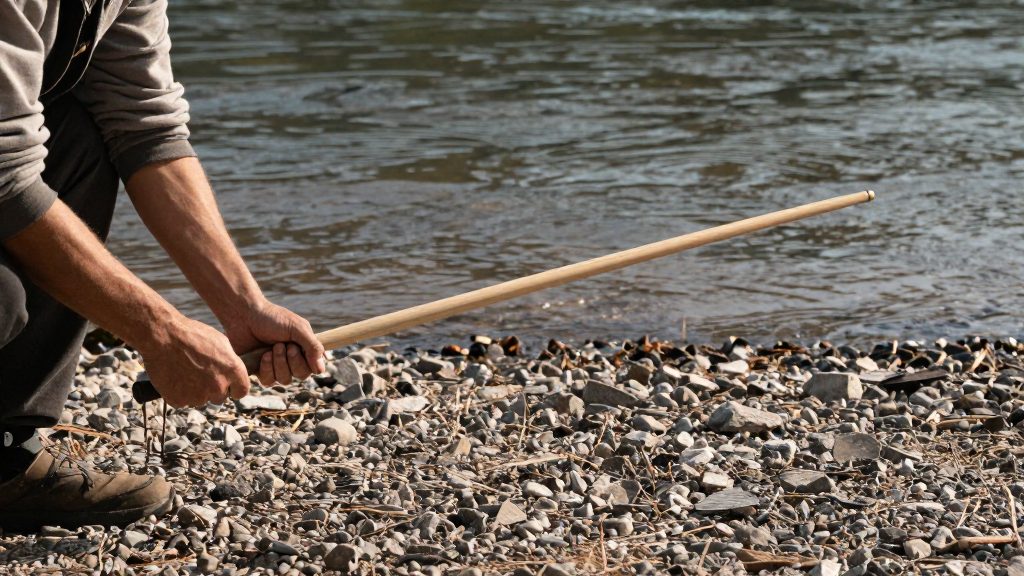
Testing a rod’s action in a shop takes a few minutes and needs no equipment beyond the rod itself. Action describes where and how much the blank flexes, so the test is about watching the bend travel along the rod rather than judging stiffness alone. Hold the rod by its handle, keep the reel seat free of pressure, and check each part of the blank before comparing rods.
Flexing the blank by hand
Hold the lower section of the handle in one hand and place the other hand a short distance up the blank. Apply gentle, even pressure to the tip, then watch where the curve begins. According to Mud Hole (2025), a fast action rod bends mainly in the upper third, so you should see the bend close to the tip while the lower part stays nearly straight. Stop as soon as the shape is clear. The goal is to observe the bend, not to load the rod to its limit.
Checking tip, middle and butt response
Move your hand down the blank and repeat the gentle flex at each point. Note whether the bend stays near the top, spreads into the middle or reaches the butt.
| Where the bend appears | Action it suggests |
|---|---|
| Tip only | Extra fast (Mud Hole, 2025) |
| Upper third, lower section stays straight | Fast (Mud Hole, 2025) |
| Deeper into the blank, middle bending earlier | Moderate or moderate-fast (Mud Hole, 2025) |
| Even curve from tip to butt | Through, or parabolic (Angling Times, 2025) |
| Curve starting at the tip and moving down as pressure increases | Slow, or progressive (Angling Times, 2025) |
If the butt section bends only slightly, the rod is likely a faster design. A visible curve reaching the handle suggests a through or slow action.
Comparing two rods of the same label
Labels cannot be relied on alone. Mud Hole (2025) notes that there is no industry standard for action and power labels, so a label such as “fast action, medium power” can mean different things from different manufacturers. Hold two rods side by side, flex each with the same gentle pressure, and compare where the bend starts and how far down the blank it travels. The rod whose bend starts lower down the blank and travels further toward the butt has the slower action, whatever its label says. A rod that simply bends more at the same pressure may only have lower power, so judge the position of the bend, not the amount.
Frequently asked questions
What is the practical difference between a fast and a slow action rod?
A fast action rod bends mainly in the upper third and stays firm lower down, which gives sensitivity and enough backbone to pull fish out of cover. A slow rod flexes through most of its length and recovers slowly, so the response feels smoother and more gradual, according to Mud Hole (2025).
Can I use one fast action rod for every lure?
No. According to Mud Hole (2025), a fast action rod suits jigs, Texas rigs and Carolina rigs, while moderate and moderate-fast rods are better for treble-hook crankbaits because they keep steady tension and help protect hooks during a fight. Extra fast rods are the suggested choice for jerkbaits.
Which action suits light lines and which suits bigger fish?
A through (parabolic) action bends from tip to butt, which suits lighter lines and smaller hooks. A slow (progressive) action starts bending at the tip and the curve moves down the blank as pressure increases, which helps cushion the fight with bigger fish, according to Angling Times (2025).