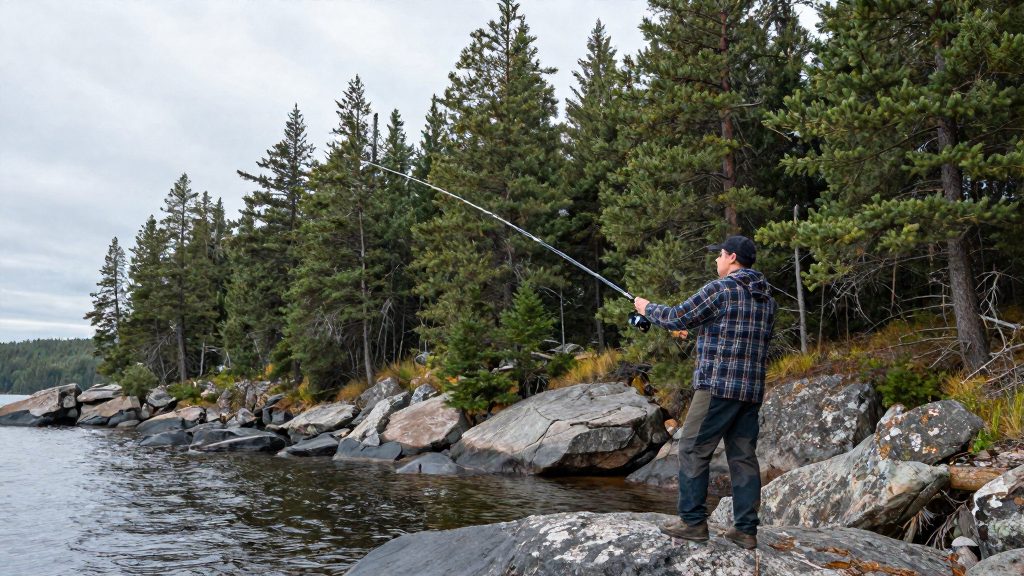
What makes a good beginner spinning rod?
A good beginner spinning rod is one whose construction absorbs casting errors and light mistakes instead of passing them straight to your hands. Three construction traits matter most: the blank material, which determines how the rod bends and recovers; the quality of the guides and reel seat, which keeps line and reel secure under load; and the overall weight and balance, which decide how long you can cast without fatigue.
Blank material: graphite versus fiberglass
The blank is the tubular shaft of the rod. Most spinning rods for beginners use graphite (a carbon composite), fiberglass, or a blend of the two.
| Trait | Graphite blank | Fiberglass blank |
|---|---|---|
| Weight | Lighter at the same size | Heavier |
| Sensitivity | Transmits bites and lure contact more directly | Dampens vibration, so light bites are harder to feel |
| Recovery | Stiffer, returns to shape quickly | More bend, slower recovery |
| Forgiveness | Less forgiving of hard, fast casts | More forgiving of sudden loads and rushed hook sets |
For a beginner, the trade-off is between feel and tolerance. Fiberglass hides mistakes better, while graphite makes bites and bottom contact easier to read. Many entry-level rods use graphite with a moderate taper, so the blank bends smoothly under load without feeling dead.
Guides and reel seat construction
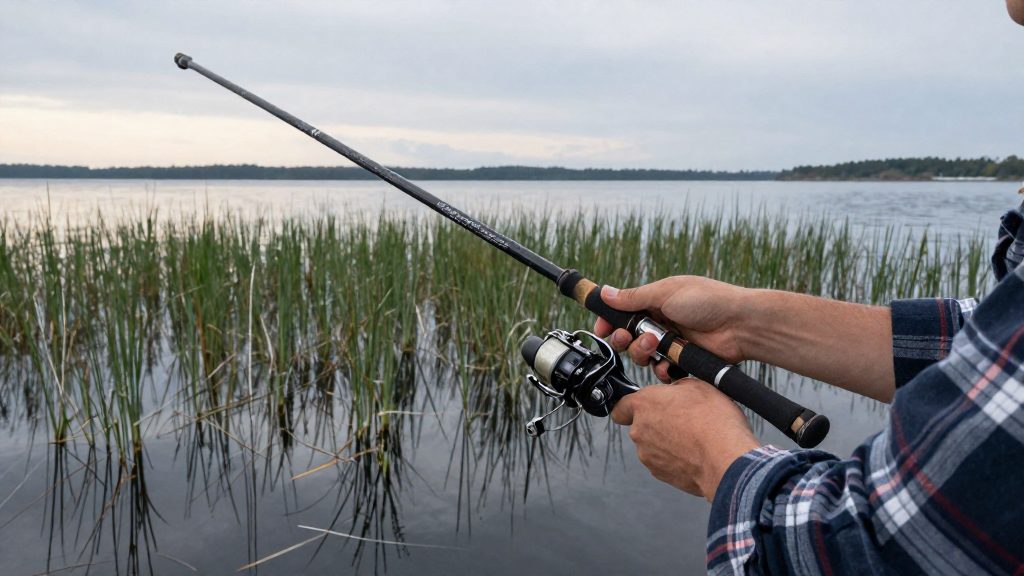
Guides are the rings that carry the line along the blank. Check them before buying:
- Guide alignment: all guides should line up in a straight line from the tip to the reel seat, with no gaps or sharp angles.
- Guide feet: the feet should be wrapped tightly and sealed, with no loose thread or glue showing.
- Insert material: the ring at the centre of each guide that the line rubs against. Zirconia inserts, used on the TACT X with stainless-steel frames, resist grooving better than basic ceramic or plain metal.
- Tip-top: the guide at the very end should be smooth, with no chips or flat spots that can fray the line.
The reel seat holds the reel to the rod. Look for a seat that locks the reel foot firmly, a hood that tightens without slipping, and no movement when you tap the reel gently. Any play in the reel seat transfers to the line and reduces control on every cast.
Overall weight and balance
Weight is felt over a session, not in the first minute. Hold the rod with the reel mounted and simulate a cast motion for a few minutes. If your wrist tires quickly, the setup is too heavy for you, regardless of how good the blank is.
Balance is the second test. Rest the rod across one finger placed under the reel seat. A balanced rod sits level, while a tip-heavy rod pulls the front down and tires the forearm during repeated casts.
Best rod length for beginners
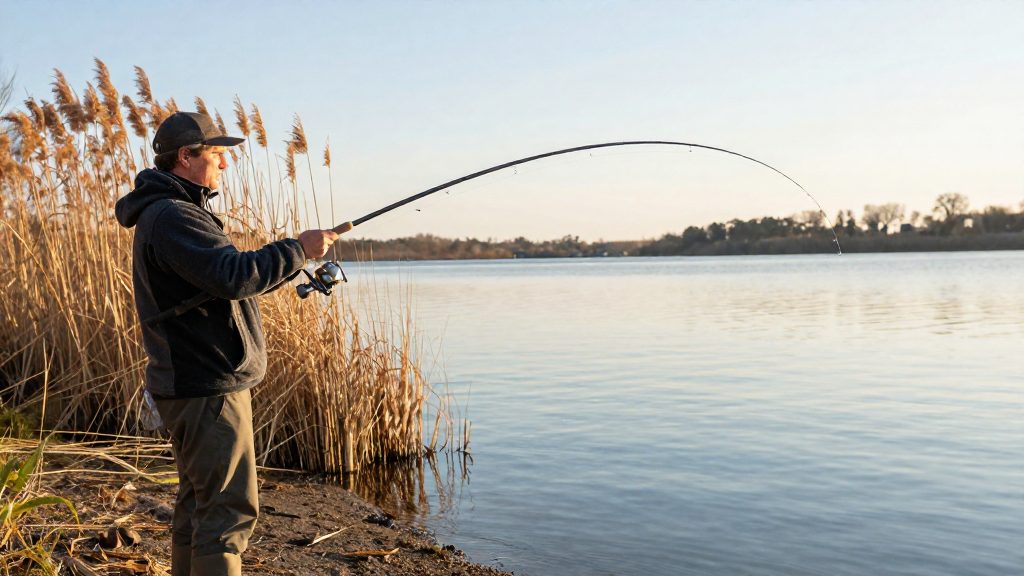
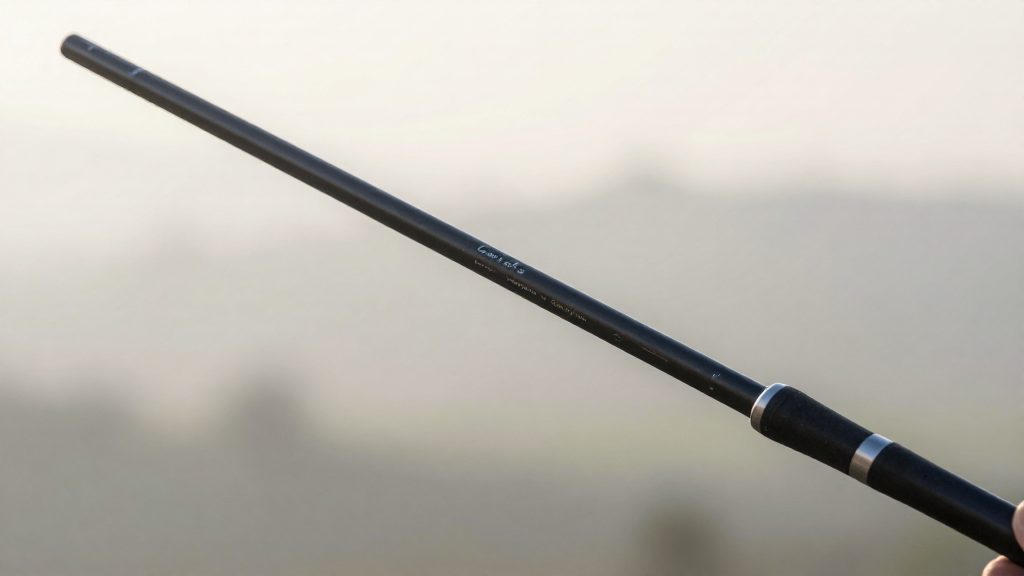
A spinning rod length changes how much leverage you have, how far you can cast and how easily you control the rod. Outdoor Life (2025) notes that a longer rod usually gives more leverage and casting distance, but it also stresses that length is partly a matter of feel. For most adults starting out, the practical question is which length they can cast accurately without tiring, not which length gives the longest cast.
How length changes casting
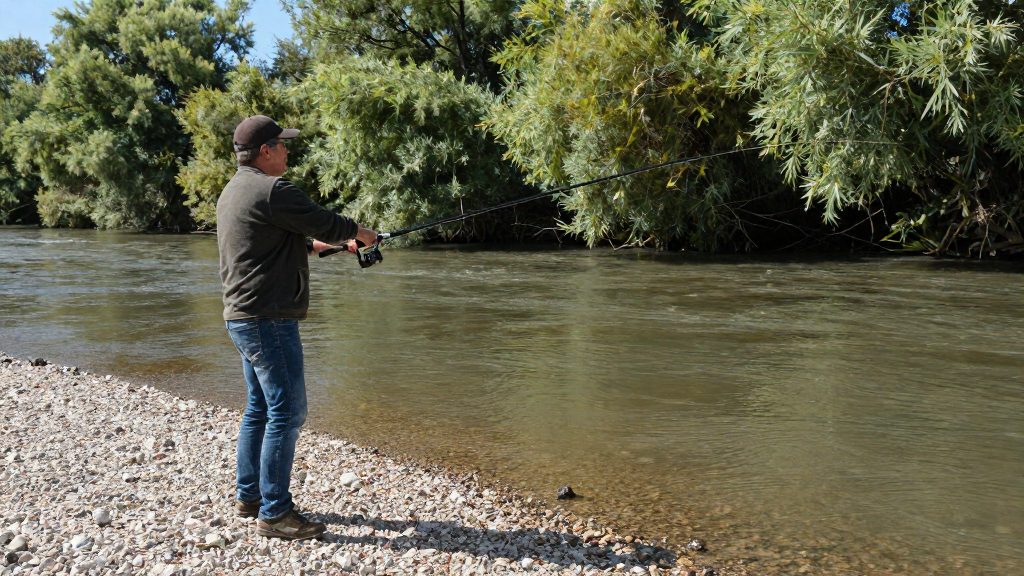
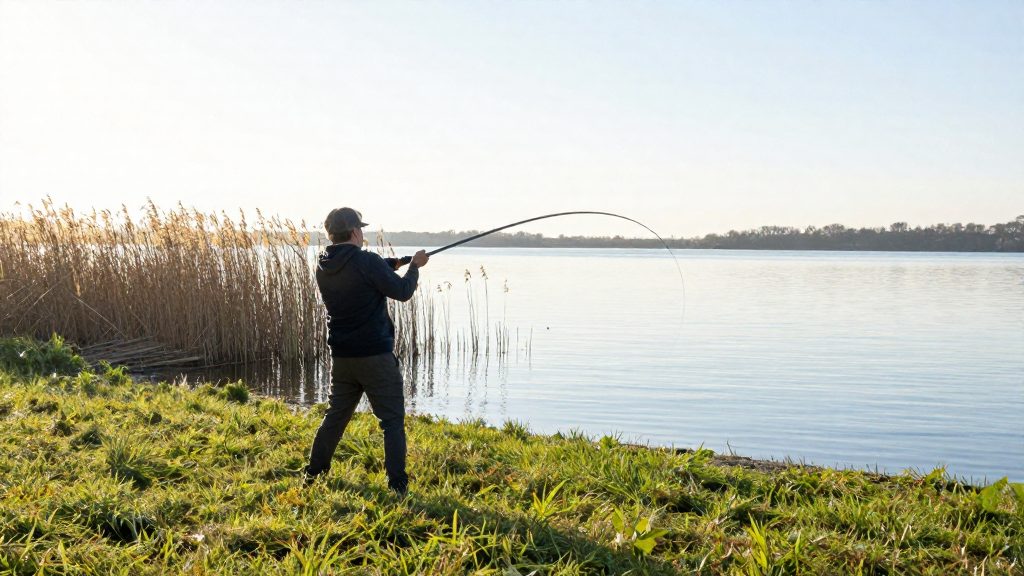
A longer spinning rod acts as a longer lever. The angler can accelerate a lure over a wider arc, which helps with casts to the far side of a river or a weedbed edge. The trade-off is weight and swing: a longer rod is harder to control in tight spots, such as near overhanging trees or along a narrow bank.
A shorter rod gives more direct control. Strikes are easier to set, the lure is easier to place precisely, and the rod is lighter to hold for long sessions.
Matching length to the angler
Outdoor Life (2025) suggests that shorter or younger anglers may do better with a rod below the standard length. In practice, this means a child or a smaller adult can cast more comfortably with a shorter rod, and a longer rod can feel awkward and tiring over an afternoon.
| Rod length | Main advantage | Main limitation | Typical user |
|---|---|---|---|
| Shorter (below standard) | Easier control and handling | Shorter casts | Children, smaller anglers |
| Standard (commonly 6 ft 6 in to 7 ft among the rods reviewed) | Balance of distance and control | Less specialised | Most first-time adults |
| Longer (above 7 ft) | More leverage and casting distance | Heavier to swing, harder in tight spots | Anglers working large open water |
Common lengths for a first rod
The spinning rods named in recent buying guides cluster around the standard range. These examples show that a 6 ft 6 in to 7 ft rod is a common starting point for an adult beginner.
Which rod power and action should you choose?
Two labels describe how a spinning rod behaves: power and action. Power sets how much force the blank needs before it bends, which determines the lure weights and line strengths it handles. Action describes where along the blank the bend happens. Reading both labels, along with the printed lure weight range, tells you whether a rod suits the lures you plan to use.
Power ratings from ultralight to heavy
Manufacturers use a common ladder of power labels. Each step up is stiffer and designed for heavier lures and stronger line.
| Power label | Relative stiffness | Typical use |
|---|---|---|
| Ultralight | Most flexible | Very light lures and fine line |
| Light | Flexible | Small lures |
| Medium | Moderate | General-purpose lures |
| Medium-heavy | Firm | Heavier lures |
| Heavy | Stiffest | Heavy lures and strong fish |
Power names are not standardised across brands. Two rods both labelled “medium” can differ, so compare the printed lure weight range rather than relying on the word alone.
Fast versus slow action and tip flex
Action describes the bending pattern under load:
- Fast action: the blank bends mainly in its upper section, giving a stiffer feel and quicker hook sets.
- Slow action: the blank bends through most of its length, giving a softer, more cushioned feel.
- Tip flex: the tip is the most flexible part of a fast-action rod. A softer tip helps cast light lures, while a stiffer tip gives more control with heavier ones.
Outdoor Life (2025) advises beginners to choose a spinning rod from the middle of the lineup, in a common length and action. Choosing a rod from the middle of the lineup, in a common length and action, is a sensible starting point for most lure fishing.
Reading the lure weight range on labels
Every rod is rated for a lure weight range, printed on the blank or in the manufacturer’s specifications. Use this range as your main guide:
- Lures below the minimum may not load the blank enough to cast well.
- Lures above the maximum can overload the rod and risk damage.
Spinning combo or separate rod and reel?
A spinning combo is a rod and reel sold as a matched set. Buying separately means choosing each component yourself. For a first outfit, the combo is usually the simpler route, because the manufacturer has already paired the parts.
Factory balance and matching
A combo is built so the reel and blank work together.
Cost savings versus upgrade flexibility
A bundled combo typically costs less than buying a comparable rod and reel separately, and it avoids mismatched purchases. Separate purchases give you more control. You can upgrade the reel without replacing the rod, or change rod length as your fishing develops.
| Option | Matching | Price | Later changes |
|---|---|---|---|
| Combo | Paired by the manufacturer | Bundled price | Rod and reel are typically replaced together |
| Separate | You match reel size and rod | Each part priced individually | Each part can be swapped independently |
Reel size and line capacity matching
Whichever route you take, confirm that the reel size suits the rod and the type of fishing you plan. Reels in a smaller size are generally paired with lighter lines and lures, while larger sizes handle heavier line. Fill the spool only up to the capacity marked on it. Overfilling can cause line to come off unevenly during casting.
Recommended spinning rods and combos from recent buying guides
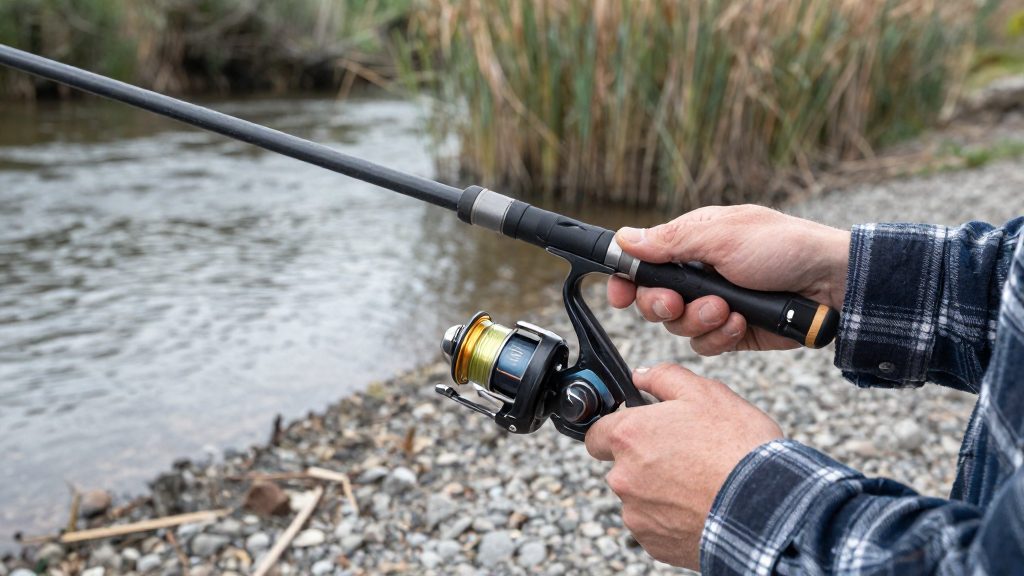
Outdoor Life (2025-02-18) and Outdoor Canada (2026-04-15) name a few models that fit different needs, from a general-purpose rod to a budget combo.
| Model | Type | Best for | Verified specifications |
|---|---|---|---|
| Rapala TACT X Spinning Combo | Combo | Best value under $150 (Outdoor Canada, 2026-04-15) | 6 ft 6 in; Japanese graphite blank; stainless-steel guides with zirconia inserts; 2500-size reel with six-disc drag |
| Falcon BuCoo SR | Rod | All-around use (Outdoor Life, 2025-02-18) | 7-foot, medium power |
| Ugly Stik Elite | Rod | Panfish (Outdoor Life, 2025-02-18) | 7-foot, medium-light |
| Lew’s Mach Crush spinning combo | Combo | Trout, panfish, pike and light saltwater species (Outdoor Life, 2025-02-18) | Check the label for length and action |
The Rapala TACT X Spinning Combo is the choice for a buyer with a fixed budget. Outdoor Canada named it its “Best Value Spinning Combo” for under $150 in its 2026 Tackle Week roundup. Because the rod and reel come matched, a beginner gets a complete setup in one purchase rather than assembling parts separately.
The Falcon BuCoo SR is the all-around pick. A 7-foot medium rod covers a wide range of lure weights and target species, which makes it a practical first rod if you plan to fish several kinds of water.
The Ugly Stik Elite and the Lew’s Mach Crush serve more specific purposes. The Ugly Stik Elite, at 7 feet medium-light, is suited to panfish, which call for lighter lures and gentler strikes. The Lew’s Mach Crush combo covers a broader group of species, including pike, which makes it a useful choice if your target list is mixed.
Which rod suits pike, bass, walleye and trout?
Matching rod weight and flex to the target species mostly depends on lure size and how hard the fish fights.
Pike: medium-heavy rods for big, bulky lures
Pike take large, bulky lures, so the rod needs backbone to set the hook on them and to turn a strong fish away from weed beds and other cover. A medium-heavy rod provides that. It also handles the heavier line that pike fishing usually calls for. Use it for big lures, not for small spinners, because the rod will feel clumsy with light lures.
Walleye and bass: medium rods for jigs and plastics
Walleye and bass take jigs and soft plastics, which are lighter than pike lures but still need to be fished with control. A medium rod is sensitive enough to feel light bites on a jig head and has enough power to drive the hook home at a distance. It is the most versatile choice in this group, and it covers most of the lures a beginner will use for both species.
Trout: light rods for small spinners and baits
Trout are usually caught on small spinners, small spoons and natural baits. A light rod casts these small lures well and transmits the light vibration of a spinner, so you can feel the bite. A heavier rod throws small lures poorly and makes subtle takes hard to detect. Light rods suit small fish and gentle fights, so they are a poor match for pike and their heavy lures, even though some multi-species combos are rated for both.
| Target species | Rod weight | Typical lures | Main reason |
|---|---|---|---|
| Pike | Medium-heavy | Big, bulky lures | Backbone for large lures and strong runs |
| Walleye | Medium | Jigs and soft plastics | Sensitivity for bites with enough power to set the hook |
| Bass | Medium | Jigs and soft plastics | Balance of feel and hook-setting power |
| Trout | Light | Small spinners and baits | Casts small lures and reveals light bites |
How do you care for your first rod?
Routine care is mostly about removing what the water leaves behind and catching small damage before it spreads. Grit, moisture and loose parts wear down a spinning setup far more than normal casting does, so a few minutes after each session will do more for your gear than any repair kit. The steps below cover three routine checks.
Rinse and dry after each freshwater trip
Sand, silt and weed caught in the reel and guides act like sandpaper on every moving part. After each trip:
- Rinse the rod, reel and line with clean tap water, and avoid spraying water directly into the reel’s drag area.
- Wipe the blank and handle with a soft, dry cloth to remove film and debris.
- Let the reel and rod air-dry in a shaded spot before packing them away. Trapped moisture is what starts corrosion on metal parts.
Inspect guides and the reel seat
Run a quick check before the next outing. Catching a problem early is much cheaper than finding it mid-session.
| Part | What to check | Sign of damage |
|---|---|---|
| Guide rings | Run a fingertip along the inside edge | Nicks, grooves or rough spots that can fray line |
| Guide inserts | Look for cracks or missing material | Chipped or loose inserts |
| Guide wrapping | Look for lifting or cracked thread | Loose wraps that can slide |
| Reel seat | Tighten the reel and try to wobble it | Loose seat, cracked hood or worn locking nut |
| Blank | Look along the length and flex it gently | Hairline cracks or flaking finish, especially near joints |
A rough guide will abrade line, so replace or repair damaged guides before fishing again. Check the manufacturer’s instructions or ask a tackle shop before attempting a repair yourself.
Store the rod away from heat and sun
Heat and direct sunlight degrade finishes, grips and adhesives over time. Store your setup in a cool, dry, shaded place such as a closet. Keep the rod in a rack or lay it flat rather than leaning it against a wall, and keep the tip protected so it does not get knocked.
Before storing the reel, back off the drag fully. This keeps the drag washers from staying compressed, which is a simple habit that helps the drag work smoothly on your next trip.