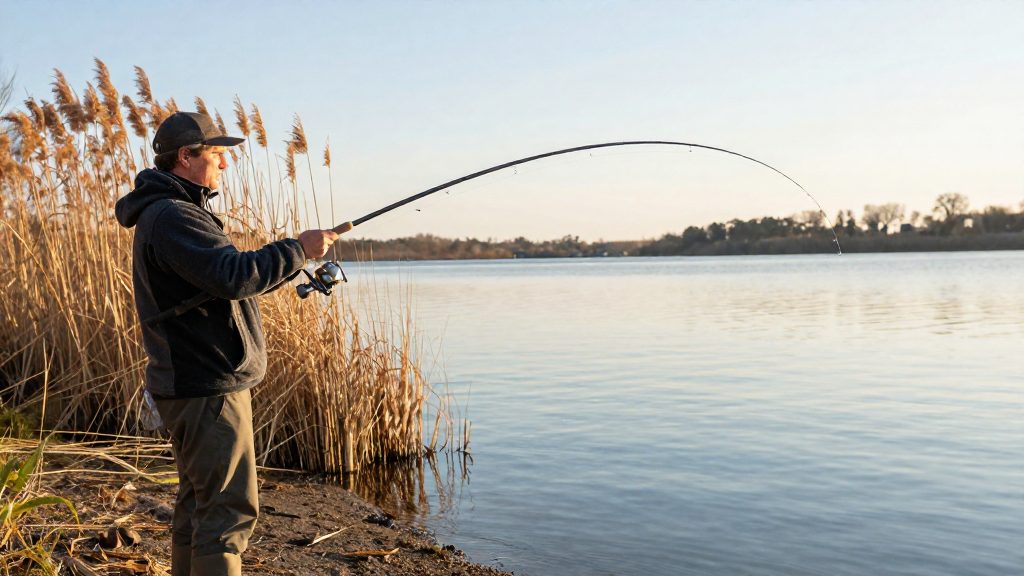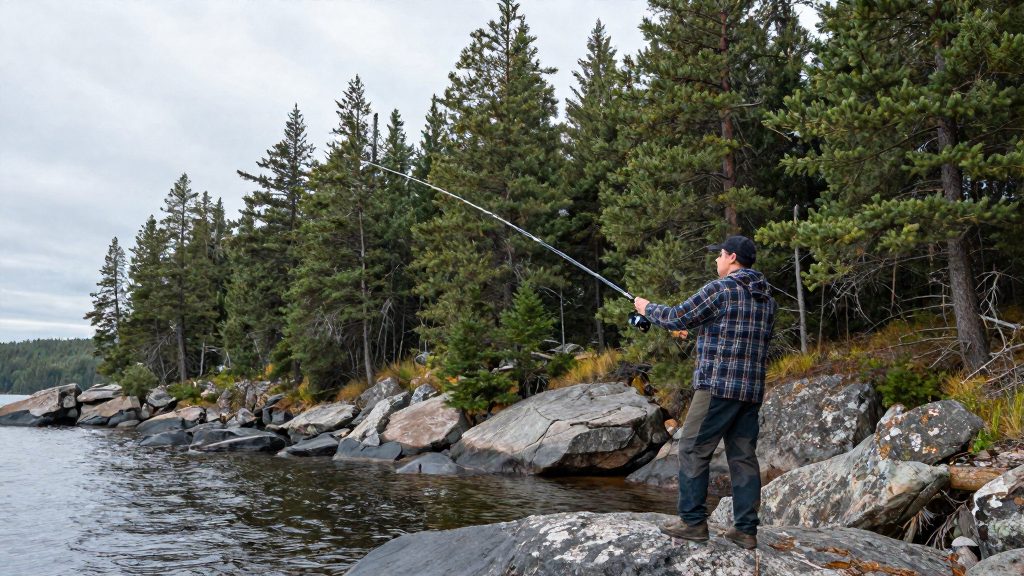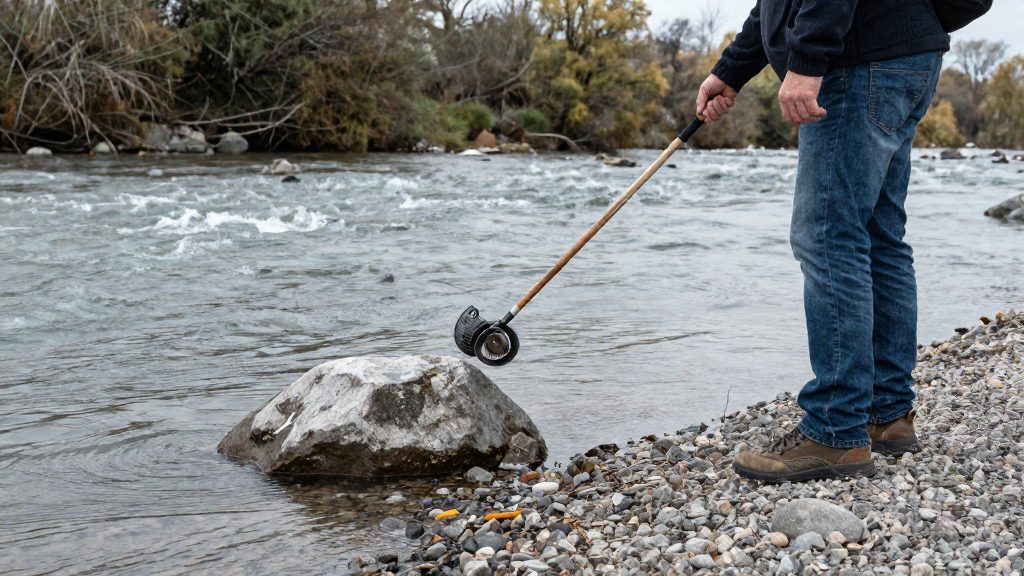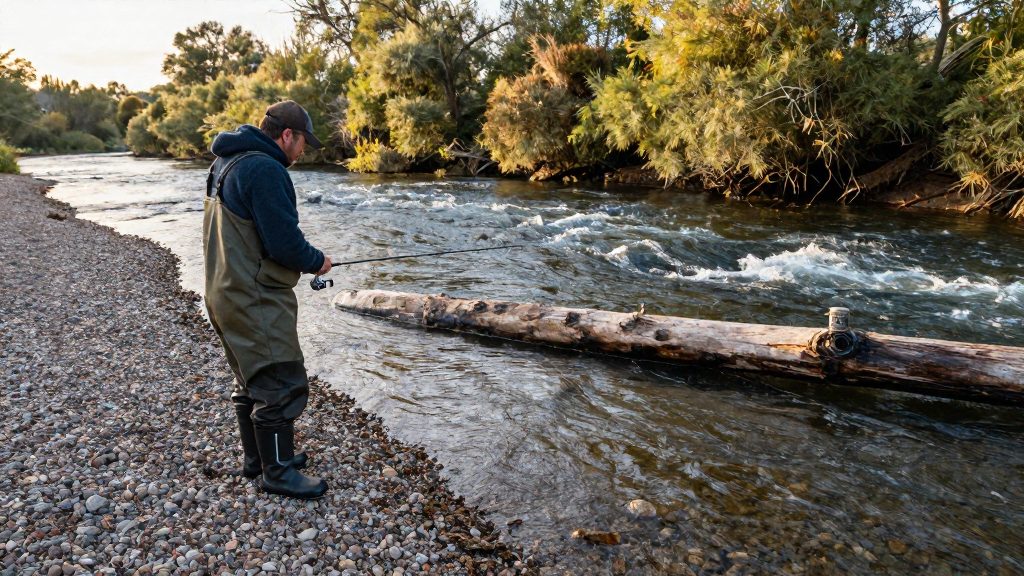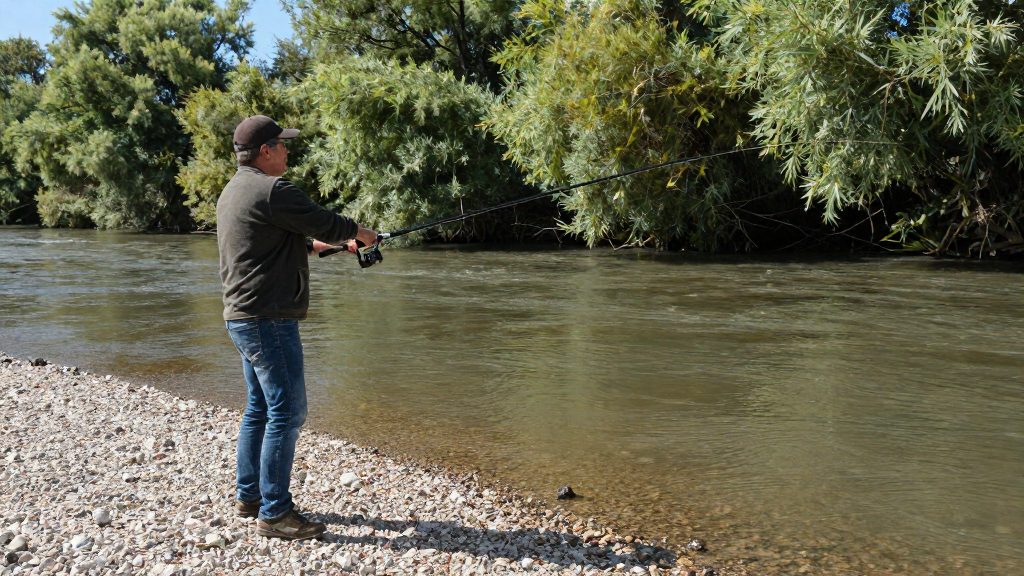
Rod length affects three things when you fish from a riverbank: how high the tip sits above the water, how much leverage you have on a hooked fish, and how well you can lift line clear of the current. Length is therefore a practical decision made before you reach the water, and it shapes how you control line and fish once you are there.
Why rod length matters when casting from a riverbank
Leverage and the rod’s effect on line lift
A longer rod acts as a longer lever. For the same hand movement, the tip travels a greater distance, which lifts more line off the surface and keeps it clear of the current. Line lying on the water drags the lure unnaturally and pulls it across the flow faster than intended, so lifting it matters on a river more than on still water.
- Tip height: a longer rod holds the tip higher, which keeps more line above the water during the retrieve.
- Leverage on the hook set: a longer rod moves the tip farther on the strike, which helps take up slack at distance, but it also gives a hooked fish more leverage against you, so strike with a smooth, controlled movement.
- Line management: a shorter rod keeps the tip lower and can be easier to control in tight spaces, but gives less line lift over moving water.
Control of fish close to the bank
Most fish are lost near the bank, not in open water, because the angle between rod and fish changes quickly as the fish comes in. Keep the rod tip up and angled toward the fish, and let the rod’s bend absorb sudden runs rather than fighting them with a rigid arm. Lowering the rod tip to the side is a useful move when a fish turns sharply near the bank.
When the fish is close enough, do not lift it out by the line. Use a landing net, and handle the fish with wet hands to protect its slime coat, following your provincial or territorial fishing regulations, including any rules on releasing fish.
Length as part of the overall setup
Rod length works alongside reel size, line diameter and lure weight.
What rod length is best for most riverbank anglers?
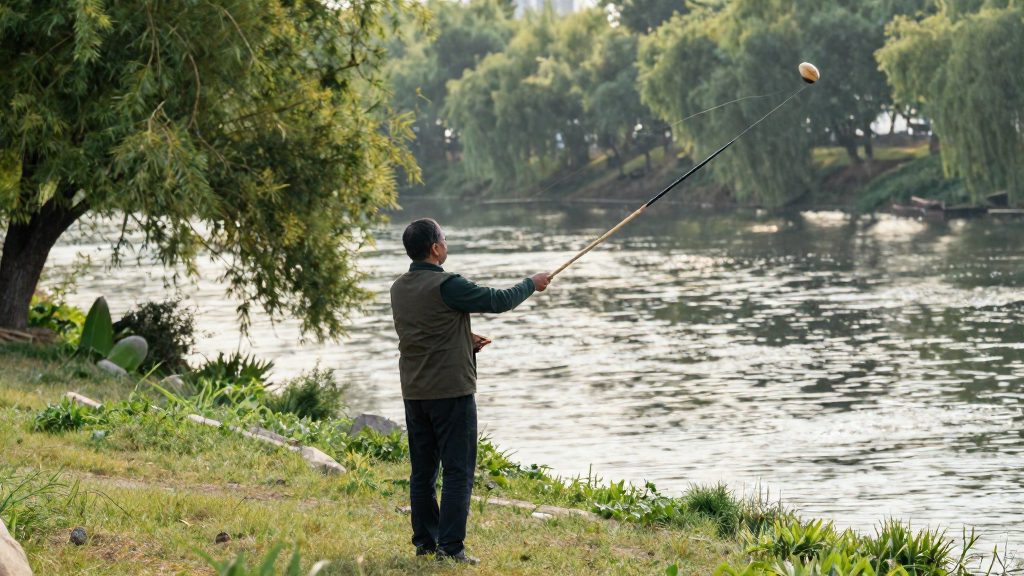
Rapala describes rods of 8 to 14 ft (243–426 cm) as suited to shore fishing from the bank or with waders. That is a general shore range, not a river-specific one. For lure fishing on a river, the species bands below (7 to 9 ft) are a closer guide, so match the length to the fish you target and the room you have behind you. Rapala describes rods in this range as suitable for shore fishing from the bank or with waders. If you want one all-round rod for general riverbank use, this bracket is the practical starting point.
Choosing a length within the 8 to 14 ft range
The rod’s length affects casting distance and how much leverage you have over the lure or bait. Shorter rods in the range give you more direct control over short, accurate casts close to you.
Before you pick a length, consider the spot:
- Check for overhead branches, reeds and bankside vegetation behind and beside you.
- Consider how much room you have for a full backswing.
- Choose the length that lets you cast cleanly from your usual position, not the longest rod you can throw.
Bank fishing with waders versus a dry bank
Waders mainly change where you can stand. Choose the rod length from the spot you are fishing and the obstacles around it. Decide on the rod length from the spot you are fishing and the obstacles around it.
A starting point for most setups
For a first riverbank rod, start from the band for the fish you target (7 to 8 ft for perch and trout, 8 to 9 ft for pike) and cast on open ground to find what feels controllable. Once you know how the rod behaves, adjust the length to the bank you fish most often. Species-specific choices go beyond this general default, so check the manufacturer’s guidance for the fish you target.
Does a longer rod really cast farther?
Generally, yes. Rapala states that longer rods generally cast farther. A longer rod moves the tip through a wider arc during the cast, which gives the lure more time to accelerate before release. The gain has a limit, though, and that limit is set by the usable length of the rod, not by the longest rod available.
Where the gain stops
Past a certain point, extra length adds little distance and makes the rod harder to control. Orvis UK, a fly-fishing manufacturer, ties rod length to water size (general guidance, not specific to Canada):
| Water type (Orvis UK, fly rods) | Suggested length |
|---|---|
| Small streams | 7’6” to 8’ |
| Medium rivers | 8’ to 9’ |
| Large rivers and open water | 9’ to 10’ |
Orvis also notes that near vegetated banks a shorter rod is easier to use for tight overhead and roll casts. When a rod is longer than you can swing within the space behind you, diminishing returns set in: the tip has less room to load, and you lose accuracy without gaining distance.
Handling weight and fatigue
Length is only one factor. A longer rod is usually heavier and puts more leverage on your wrist and forearm, so fatigue builds up over repeated casts. The effect appears late in a session, when casts become shorter and less precise. Reduce strain by:
- Holding the rod with a relaxed grip and letting the rod’s action load the cast, rather than forcing it with your arm.
- Matching the reel and line to the rod so the outfit balances in your hand.
- Taking short breaks between casting sequences.
When should you choose a shorter rod on a wooded bank?
A shorter rod earns its place when trees, branches or dense bankside vegetation limit your casting room. Longer rods cast farther, but on a wooded bank the extra length can strike overhead branches on the backcast or force a wide, exposed arc. A shorter rod keeps the tip and line inside the space you actually have, which makes the cast more predictable.
Tight overhead and sidearm casts are the main case. When branches sit above or beside your casting lane, a sidearm or lowered arc keeps the rod clear. According to Orvis UK, near vegetated banks a shorter rod suits tight overhead and roll casts, because it leaves less rod to catch on the surrounding growth.
Accuracy over distance matters more under trees. Orvis UK warns against putting distance ahead of accuracy when trees get in the way. On a wooded bank, a precise cast into a gap between branches, beside a fallen log or along an undercut usually produces more bites than a long cast that lands in the wrong lane. Shortening your rod and your cast range together gives you more control over where the lure lands.
Backcast clearance is the practical test. Before casting, look behind you and check for branches, bushes and the bank itself. If the rod tip would travel into cover, shorten the stroke, lower the arc, or switch to a shorter rod.
| Situation on a wooded bank | Priority | Rod approach |
|---|---|---|
| Branches overhead | Clear the backcast | Shorter rod, lowered arc |
| Narrow gap between trees | Precise landing | Shorter rod, shorter cast |
| Open lane behind you | Reach | Longer rod, standard cast |
Rod length by species: pike, perch and trout
Rapala suggests a rod of 8 to 9 ft (243–274 cm) for pike and other big predators, and 7 to 8 ft (213–243 cm) for perch and trout. These are lure-fishing starting bands for spinning and casting rods, not fixed sizes. They are separate from the fly-rod river bands covered in the next section. Within each band, the length you choose depends on the lures you throw and the bank you fish from. The choice is partly a trade-off between distance and handling.
| Target species | Rapala suggested length | Length in cm |
|---|---|---|
| Pike and other big predators | 8 to 9 ft | 243 to 274 cm |
| Perch | 7 to 8 ft | 213 to 243 cm |
| Trout | 7 to 8 ft | 213 to 243 cm |
Pike and other big predators
Rapala groups pike with other big predators in the 8 to 9 ft band. Because these fish are targeted with larger lures, a longer rod helps you cast farther and keep the lure working at a distance from the bank. If you mostly fish small or narrow spots, the lower end of the band (8 ft) is easier to manage, while the upper end (9 ft) gives more casting distance.
Perch and trout
For perch and trout, Rapala points to a shorter lure rod, 7 to 8 ft. A rod in this range is lighter to hold for long sessions and gives more direct control over smaller lures and presentations. If you fish both species from the same bank, one rod in the 7 to 8 ft band covers both.
Checking the length before you buy
- Compare the listed length with the length band above, not just the number on the rod’s tag. Some listings round to the nearest half foot, so convert to centimetres to check.
- Confirm the length on the manufacturer’s spec sheet or the product label, since the same model can be sold in different lengths.
Fly rods: a note for river anglers
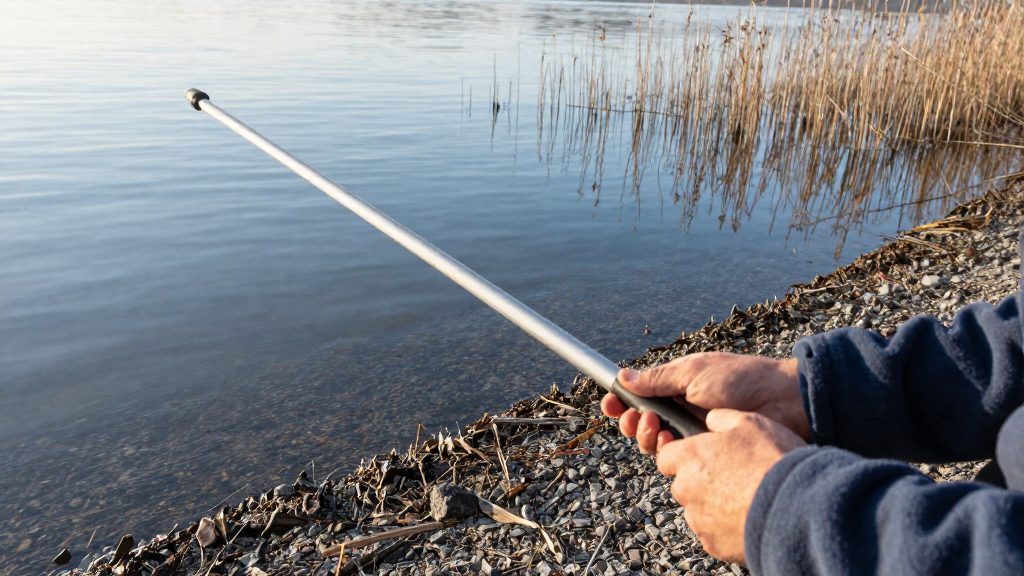
Fly rods follow a different sizing logic from the lure rods discussed above. Orvis UK gives length bands by river type for fly fishing only, and these bands are a useful starting point when you buy a fly rod length. For small streams, Orvis suggests about 7 ft 6 in to 8 ft (229 to 244 cm). For medium rivers, the suggested range is 8 to 9 ft (244 to 274 cm), and for large rivers and open water it is 9 to 10 ft (274 to 305 cm).
The small-stream band happens to overlap the 7 to 8 ft band that Rapala gives for perch and trout. The two figures come from different sources and different disciplines, so do not use one to check the other.
| River type | Orvis UK suggested length | Metric equivalent |
|---|---|---|
| Small streams | 7 ft 6 in to 8 ft | 229 to 244 cm |
| Medium rivers | 8 to 9 ft | 244 to 274 cm |
| Large rivers and open water | 9 to 10 ft | 274 to 305 cm |
The bands are not strict cut-offs. Use them to narrow your choice, then consider how you will fish the water:
- Stream width and cast distance: On a narrow stream, you rarely need to lay line far, so a rod at the short end of the small-stream band keeps the cast controllable. On a wider river, where fish may hold beyond your normal reach, move toward the upper end of the medium or large band.
- Wading or bank fishing: If you fish from a steep bank, test a rod at your local tackle shop to see how it handles your backcast space before committing.
- Line weight: Length and line weight work together. A longer rod generally needs a line weight that loads it properly, so check the line weight printed on the rod blank and match it to your line.
Because the bands overlap at their edges, a rod of 8 ft sits at the boundary between small and medium water. In that case, decide based on the stream you fish most often rather than the one you visit occasionally.
How do rod length, action and lure weight work together?
Rod length, action and the lure weight rating each control part of the cast, and they interact. A longer blank adds leverage and casting range, but it only performs well if its action and rated lure weight match the lure you are throwing.
Lure weight rating is printed on the blank, usually near the handle. It gives the lure weight range the manufacturer designed the rod to load and cast. Lures below the minimum rating will not bend the blank enough to store energy, so casts feel weak and inaccurate. Lures above the maximum can overload the blank and risk damage. Check the rating before buying lures, and keep your heaviest and lightest lures within it.
Action describes where the blank bends. At equal length, a fast-action rod bends mainly in its upper section, so it loads quickly and gives sharp, controlled casts and strong hook sets. A slower-action rod bends further down the blank. It loads more gradually, which helps with lighter lures, but gives less direct control when you need to pull a fish away from cover.
Loading the blank means bending the rod on the backcast so the lure’s weight stores energy that releases on the forward cast. To throw light lures, use a longer stroke and a smooth, steady tempo rather than a sharp snap. Let the tip load fully before you accelerate, and stop the rod at a clear angle so the lure travels in a straight line.
| Factor | Effect on casting | What to check |
|---|---|---|
| Length | More leverage and range | Shore length per species (see Rapala guidance above) |
| Lure weight rating | Sets the loadable lure weight range | Printed on the blank |
| Fast action | Sharp, controlled casts; quick hook sets | Upper-section bend when flexed |
| Slow action | Gentler loading; suits lighter lures | Bend further down the blank |
Quick checklist before you buy
Before you buy a rod, check three things: the bank type you fish, the reel and line you already own, and how the rod will travel.
Confirm the bank and its obstacles
Look at the swim in person or in recent photos before you choose a length. Note whether the bank is open, steep, or lined with bushes and tall grass, and whether branches overhang the water. These features decide how much room you have behind you for the backcast. A longer rod needs more space, so a rod that is too long for your swim will be harder to use, not easier.
Check reel and line compatibility
Match the reel to the rod’s stated reel size, and check that the line rating printed on the rod blank fits the line you plan to use. Buying a new reel or spool later? Confirm the line diameter and strength on the rod label or the manufacturer’s instructions before you commit.
Measure transport and car storage
Measure the rod in its packed length, meaning the length it takes up when carried, not its fully extended length. Compare that figure with your car’s interior length and the space behind the seats. If the manufacturer lists a packed length, use that number. If it does not, measure the assembled rod with the sections together and check the case dimensions on the packaging.
| Check | Question to answer | Where to find the answer |
|---|---|---|
| Bank | Is there room behind you for a full backcast? | Walk the swim before buying |
| Reel | Does the reel size match the rod’s stated range? | Rod and reel labels |
| Line | Is your line within the rod’s rated range? | Rod blank markings |
| Transport | Does the packed rod fit your car? | Manufacturer’s packed length and your own measurement |
Frequently asked questions
What rod length should I start with for pike from a riverbank?
Rapala suggests 8 to 9 ft (243–274 cm) for pike and other big predators. Its wider shore range of 8 to 14 ft (243–426 cm) is a general guide for fishing from the bank or with waders, not a river-specific one.
Is a shorter rod better for perch and trout?
Rapala suggests 7 to 8 ft (213–243 cm) for perch and trout, which is slightly below the start of its general shore range. If you fish for both species from the same bank, test a length near the top of the 7 to 8 ft band on open ground before you commit to it.
Does a longer rod always cast farther?
Rapala states that longer rods generally cast farther, but the gain comes with less control in tight spots. Near trees or overhanging bushes, a shorter rod is easier to use, and a longer one can limit your backcast room.