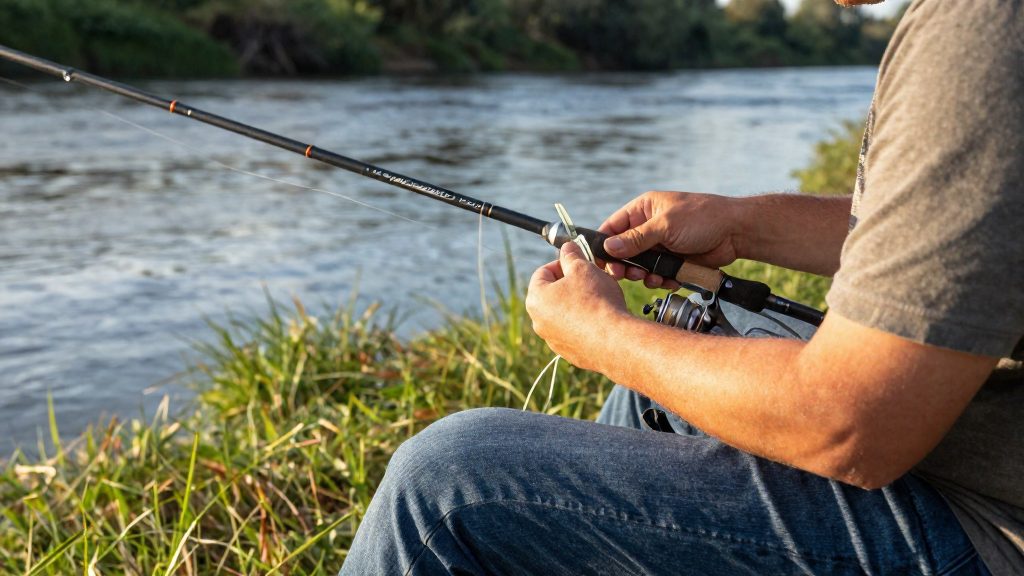
Why use a fluorocarbon leader with braid?
Braid and fluorocarbon are paired because each covers a weakness of the other. Braid has very little stretch, so movement at the lure reaches your hand quickly, which helps you feel light bites. Fluorocarbon resists abrasion better than braid and is much harder for fish to see in clear water, so it protects the section of line closest to the lure.
Why use a fluorocarbon leader with braid?
Braid: detecting light bites
Braid stretches far less than monofilament, so a fish that only taps a soft plastic or pauses a jig is transmitted to the rod almost immediately. This sensitivity is most useful in cold water, when fish often take lures gently, and when fishing deep or in heavy current, where a slack or stretchy line hides subtle takes.
Fluorocarbon: resistance to teeth, cover and rocks
Pike and zander have sharp teeth, perch have a rough, abrasive mouth, and weed, stumps, gravel and rocks all wear line during casting and retrieving. Against pike in particular, a light fluorocarbon leader can still be cut, so a wire leader is the safer choice. This is a deliberate exception to the rule of keeping the leader close to the braid’s strength. Fluorocarbon has better abrasion resistance than braid, so a leader at the lure end absorbs most of this wear. Check the leader after each snag or toothy fish, because a small nick can weaken it without any visible break.
Fluorocarbon: low visibility in clear water
Braid is a woven, light-reflecting line that is easy to spot in clear water. Fluorocarbon is less visible underwater, which matters because wary fish inspect lures closely before committing. Fluorocarbon also sinks, so the leader stays near the lure rather than rising toward the surface, which helps a lure work at the depth you intend.
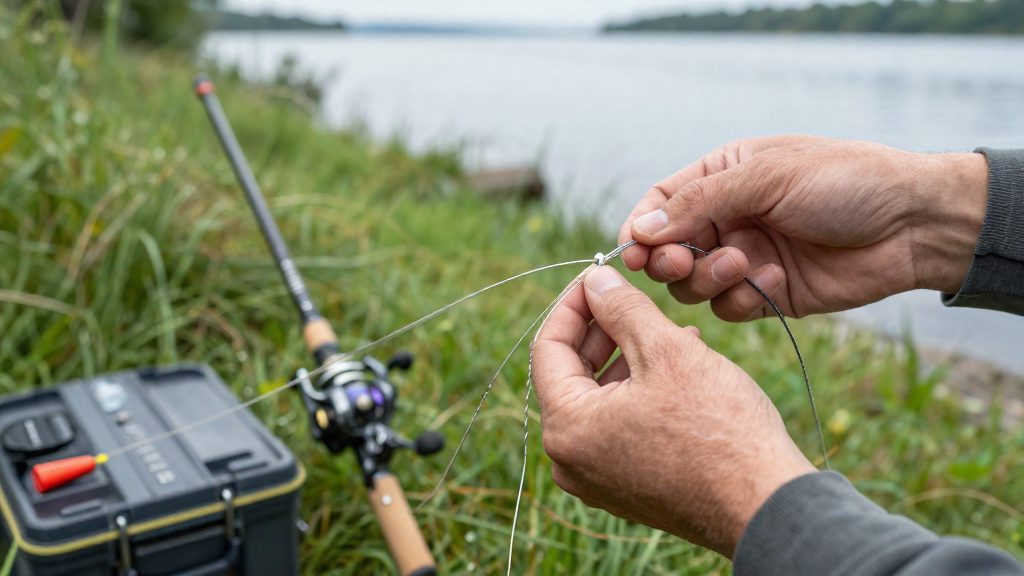
Which braid-to-leader knot should you choose?
The three knots differ in guide passage, retie speed after a snag, and skill level. Compared by how much bulk they add, the FG is the slimmest. Outdoor Life (2024) states that the FG knot is slim enough to pass through rod guides. The Alberto also goes through guides well, according to Bassmaster (2021).
Thickness matters most with the double uni. Outdoor Life (2024) advises against joining thin braid to a much thicker leader, because the braid can slip through. Whatever knot you choose, test the finished knot by pulling it through a rod guide by hand before you fish.
For retying after a snag, the double uni is quicker than the FG. Bassmaster (2021) reports that it is quicker to retie than the FG. The Alberto can also be tied quickly on the water, according to the same source. The FG takes longer to finish, so it is less practical for quick repairs on the bank.
Skill is where the FG stands apart. Bassmaster (2021) describes it as the thinnest and possibly strongest braid-to-fluorocarbon knot, but also the hardest to master. The double uni is the easier entry point, and Outdoor Life (2024) recommends it as a quick, easy option for light freshwater tackle.
In practice, a beginner fishing light lures who snags often may favour the double uni. An angler who wants the slimmest connection for casting through guides should practise the FG at home before relying on it.
How do you tie the FG knot?
The FG knot is plaited by hand. You lay the fluorocarbon leader across the braid, then work the leader in and out of the braid until the braid is wrapped around the leader. According to Outdoor Life (2026), the plaiting stage uses 20 passes.
| Stage | Action | Purpose |
|---|---|---|
| Lay | Place the leader across the tensioned braid | Sets the starting position for the plait |
| Plait | Alternate the leader under and over the braid for 20 passes | Wraps the braid around the leader |
Keeping the braid under tension
Plaiting only works when the braid stays taut. Outdoor Life (2026) gives two options: clamp the braid in your teeth, or lock the rod in a rod holder so both hands are free. Use whichever method keeps the braid from moving. With the braid fixed, your hands only need to control the leader.
Laying the leader across the braid
Before the first pass, lay the leader across the tensioned braid so the two lines meet at the point where the plait will start. Keep the leader flat and free of twists. A twisted leader makes the later passes uneven, and it is easier to correct this before wrapping begins than after.
Alternating under and over for 20 passes
Take the leader under the braid, then over it, and repeat, alternating each time, for 20 passes in total. Each pass should sit snugly against the previous one, without gaps and without bunching. Count the passes as you go, so you do not stop at 19 or continue past 20. Pull each pass evenly rather than hard on one side. Once the 20 passes are complete, the plaited section is ready for the finishing steps covered in the next part of this guide.
Finishing and trimming the FG knot
Once the braid is plaited around the leader, the knot is locked off in two stages: a single overhand knot, then a run of half hitches. According to Outdoor Life (July 2026), you tie one overhand knot with the braid tag wrapped around the leader, then make 10 to 12 half hitches, and finally trim both tags very close. The overhand knot holds the tag in place while the half hitches are added, so work it slowly and keep the tag lying flat against the leader rather than crossing over itself.
| Stage | Action | Position |
|---|---|---|
| Overhand knot | One overhand knot with the braid tag around the leader | Directly after the plaited section |
| Half hitches | 10 to 12 half hitches, each pulled snug | Stacked beyond the overhand knot |
| Trimming | Cut both tags very close | At the outer end of the knot |
To form each half hitch, pass the braid tag around the leader and through the loop you just made, then pull it firm before starting the next. Seat every hitch against the previous one so the coils stay side by side. Counting as you go helps you stay within the 10 to 12 range.
Trimming comes last. Cut the braid tag and the leader tag close to the knot with sharp clippers, and do not cut into the coils. Both tags need trimming, not just one, so the finished knot sits flat and does not catch on the guides.
Super glue is optional. Outdoor Life states that it goes only on the half hitches, never on the plaited section. If you use it, apply glue only to the half hitches, and check the glue manufacturer’s label for guidance on use with fluorocarbon and braid.
Alberto knot: a faster on-the-water option
The Alberto knot is a braid-to-fluorocarbon connection that suits anglers who need to re-rig quickly on the bank. According to Outdoor Life (2024), it works best with braid of 20 lb or more. Its main practical advantage is speed: it can be tied quickly on the water, which makes it a practical alternative to slower, more demanding connections when you are changing leaders between sessions.
Braid strength where the Alberto works best
The 20 lb threshold is the main guideline for this knot. Lighter braid is outside the range Outdoor Life describes for the Alberto, so for light lines you should consider a different knot. Check your braid’s breaking strength on the spool label before you tie.
Seating the knot
The key difference from hand-only tightening lies in how the wraps are pulled down:
- Gloves: a grip with gloves lets you pull the wraps tight without the line slipping through your fingers.
- Wrapped pliers: winding the lines around pliers gives a firmer pull than fingers can, and it helps seat the coils evenly.
- Hand tightening alone: not recommended for this knot, according to Outdoor Life (2024).
Seat the knot fully before you trim the tags. A loosely seated knot may slip under load.
Why it suits on-the-water tying
Bassmaster (2021) describes the Alberto as strong and quick to tie on the water. Once you are familiar with the wraps, it can be tied quickly on the water. That speed matters when fish are active and you need a new leader without a long pause.
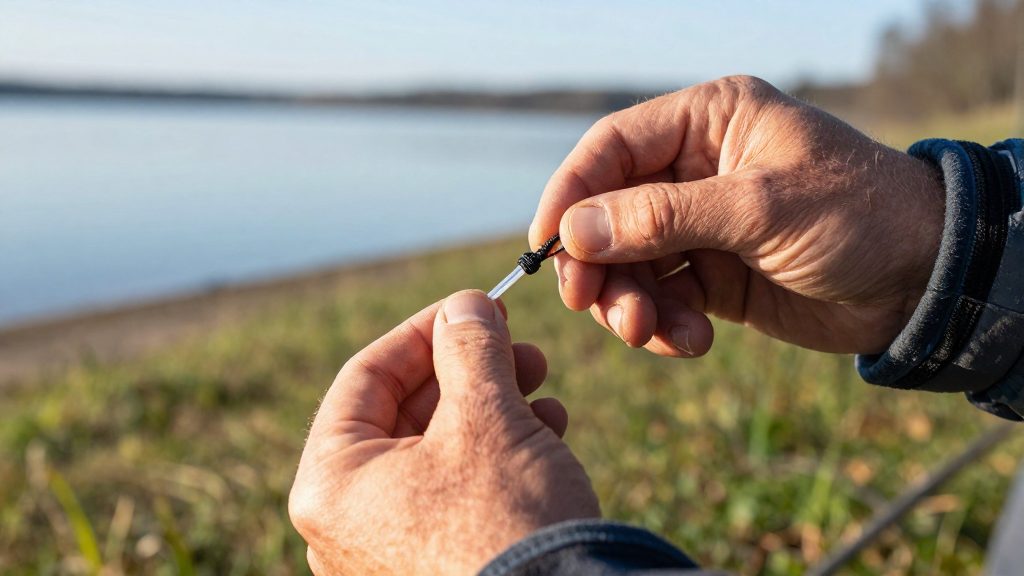
Double uni knot for light freshwater setups
The double uni is a quick, easy braid-to-leader knot for light freshwater tackle, according to Outdoor Life (2024-10-15). It suits anglers who fish small lures on light lines and want a connection that is simple to tie without much practice. Bassmaster (2021-09-21) describes it as the simpler alternative to the FG knot, and notes that the double uni uses four wraps per side.
The knot is built from four wraps on each side, with each tag wrapped around the other line:
- Overlap the braid and the leader by a short length, with the tags pointing in opposite directions.
- Wrap the leader tag around the braid and the leader’s standing line four times, then pass the tag back through the loop it formed.
- Repeat with the braid tag, wrapping it around the leader and the braid’s standing line four times in the opposite direction, and pass it back through its own loop.
Before you pull the knot tight, wet it. Outdoor Life (2024-10-15) recommends wetting the double uni before tightening, which lets the coils seat without friction-burning the line. Pull both standing lines slowly so the two loops close evenly, then trim the tags close to the knot.
Check the knot before casting by pulling the braid and leader apart steadily and gradually, without jerking. If the wraps shift or the braid moves through the coils, retie the connection rather than trusting it.
Matching leader and braid strength
The leader and braid should have close breaking strengths. If one line is much stronger than the other, the weaker line becomes the point of failure. For a 15 lb braid, Outdoor Life (2024) reports that leaders of 12, 15 or 20 lb hold well with the FG knot, so you have three workable fluorocarbon options for that braid.
Pairing 15 lb braid with a leader
Use this comparison to see how each leader option relates to the 15 lb braid. The ratio is simple arithmetic on the rated breaking strengths.
| Braid | Leader | Leader strength relative to braid |
|---|---|---|
| 15 lb | 12 lb | 0.8 × braid rating |
| 15 lb | 15 lb | 1.0 × braid rating (matched) |
| 15 lb | 20 lb | 1.33 × braid rating |
A 15 lb leader gives the closest match. The 12 lb option is slightly weaker than the braid, and the 20 lb option is stronger. Both fall within the range Outdoor Life lists as holding well, so choose based on your target fish, casting conditions and how much abrasion the leader will face.
Keeping the two lines close in strength
Matching strength helps both lines do their job. The braid provides sensitivity and cast distance, while the fluorocarbon leader resists abrasion near the lure. When the two ratings are close, a strike or a snag loads both lines in a similar way and neither is overloaded alone. Avoid jumping far above the braid rating just to feel safer, because a much heavier leader adds stiffness and can change how the lure moves.
Reading breaking strength on product labels
Compare the printed breaking strength on each spool, not the line’s diameter. Diameter varies between brands and product lines, so two spools with similar thickness can carry different ratings. Check the pound-test figure on the packaging, make sure both lines use the same unit, and confirm the figure in the manufacturer’s product information if the label is unclear.
Common mistakes and how to test your knot
Most weak braid-to-leader connections come from how the knot was tied and checked, not from the pattern itself. The two errors that appear most often are wraps laid on slack braid and knots that are never inspected after the line has been stressed. A short pull routine before each cast catches both.
Loose plaits from too little braid tension
Checking the knot after every snag or fish
A snag, a fish or a hard cast can loosen wraps or move the leader. After each of these, inspect the plait for gaps between wraps, a leader that has slid, or a tag that has come loose. If anything has shifted, retie the connection instead of casting on a doubtful knot.
Gently pulling both lines before each cast
Before each cast, pull the braid and the leader apart gently, first one line at a time and then both together. Increase the pull gradually and stop at once if the plait moves or a tag slips. Avoid sharp jerks, which can damage the braid. A knot that holds under this gentle pull passes a basic check, but it does not replace inspecting the wraps.
Frequently asked questions
Which braid-to-leader knot should a beginner learn first?
The double uni is the easiest starting point. Bassmaster (2021) reports that it is quicker to retie than the FG after a snag, and Outdoor Life (2024) describes it as a quick option for light freshwater tackle, provided you wet it before tightening.
Does the Alberto knot work with any braid and leader strength?
No. Outdoor Life (2024) recommends the Alberto with braid of 20 lb or more, and advises seating it with gloves or by wrapping the lines around pliers rather than relying on hand tightening alone. For the FG, the same source notes that 15 lb braid holds well with a 12, 15 or 20 lb leader.
Is a light fluorocarbon leader enough when pike are the target?
Not reliably. Pike teeth can cut a light fluorocarbon leader, so a wire leader is the safer choice for pike, even though it breaks the usual rule of matching the leader to the braid’s breaking strength.