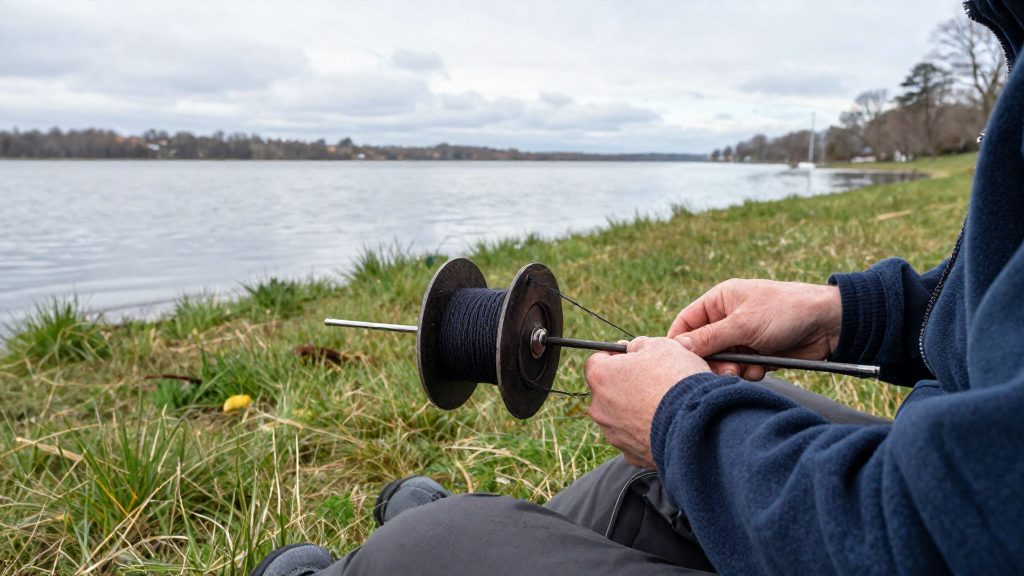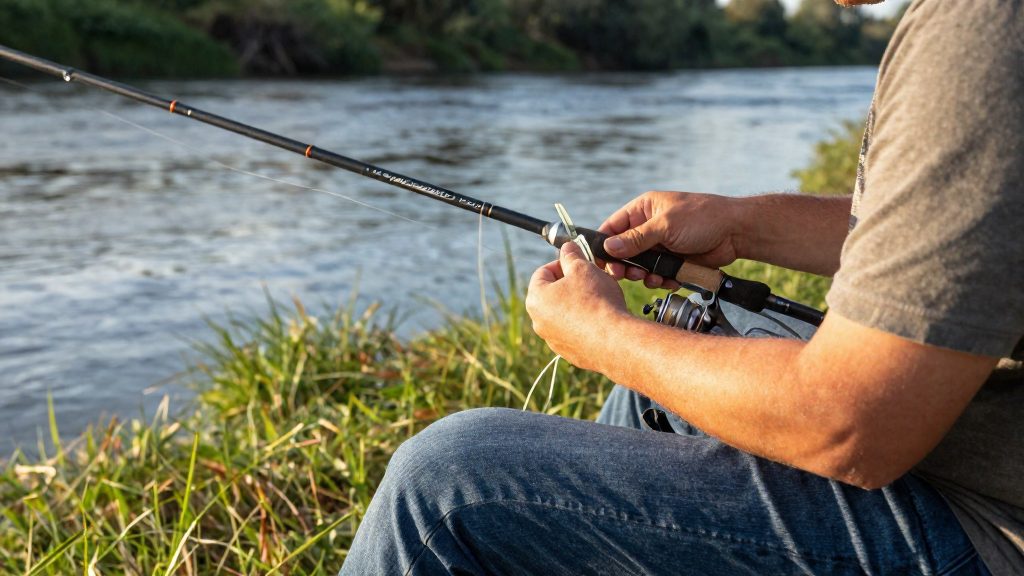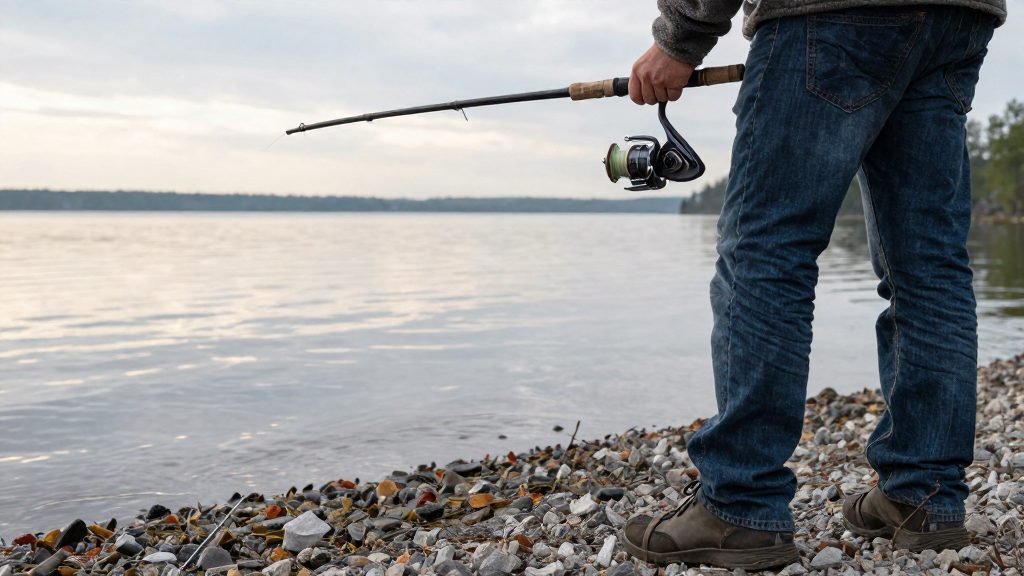
Braid and monofilament differ mainly in stretch. Braid has almost none, so movement from a bite or a strike reaches the rod almost immediately, while mono gives under load. According to FishTalk Magazine (2026), braid’s near-zero stretch gives faster hook-sets and better bite detection, whereas mono’s stretch helps keep hooks in fish with delicate mouths. Mono also has line memory, which braid does not.
Mono vs braid: what is the real difference?
| Property | Braid | Monofilament |
|---|---|---|
| Stretch | Almost none | Noticeable, lengthens under load |
| Strike transfer | Immediate, drives the hook in | Absorbed in part by the line’s give |
| Bite detection | Transmits small takes | Dampens small takes |
| Line memory | None | Present |
Stretch and hook-sets
Stretch is how far a line lengthens under tension before it passes force on to the hook. When you strike, braid moves the hook point into the fish with little delay. Sport Fishing Magazine (2025-02-21) notes that braid has no give and therefore drives the hook home better on long casts. Mono’s give cushions the strike, which is why FishTalk Magazine (2026) links it to keeping hooks in fish with delicate mouths. Choose the line based on how much force you want the hook to receive, not on how strong the line is.
Bite detection through near-zero stretch
Because braid barely stretches, small pulls from a fish reach your hand with little loss. This makes light bites, such as a perch nudging a lure, easier to feel. Mono filters some of that movement. To get the benefit of either line, keep the line tight between rod tip and lure. Any slack loop hides the take on both materials.
Line memory and coil behaviour
Mono keeps the shape it was wound into. Coils from the spool can persist in the water, and loops can tangle casts or kink near the reel. Braid has no memory and lies flatter, so it generally holds a straight path after casting. To manage mono memory, check the manufacturer’s spooling and handling instructions on the label, and avoid storing spooled line in tight coils for long periods.
Which line is better for shore casting distance?
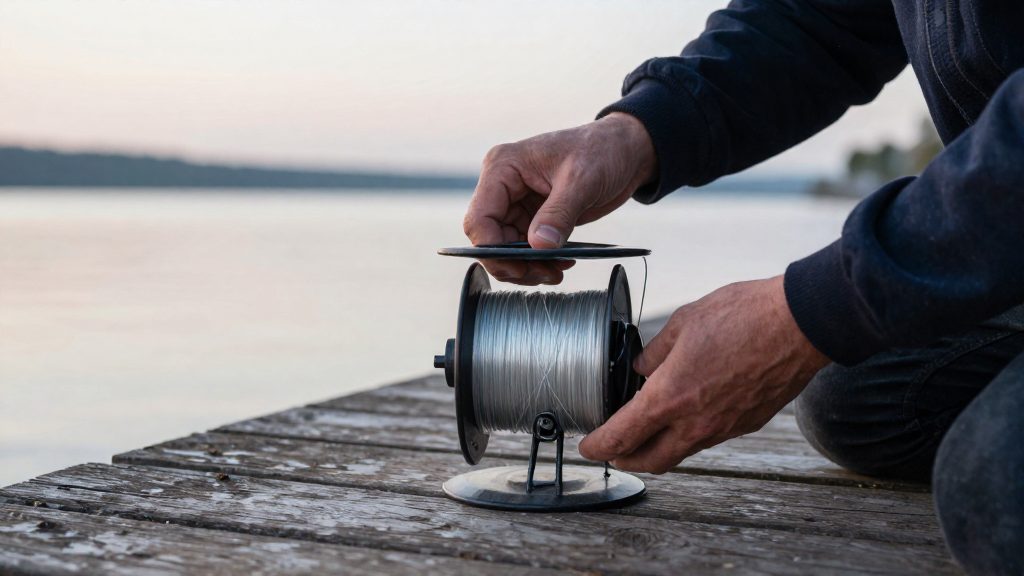
For shore casting distance, braid generally has the advantage. According to Sport Fishing Magazine (2025), braid’s thinner diameter at a given strength casts farther than mono of the same rating. The size of the gain depends on lure weight, rod and casting technique, so the difference you notice will vary from one setup to another.
Diameter at equal breaking strength
The comparison only works at diameter at equal breaking strength: lines with the same rated breaking strength, measured in pounds. Braid reaches that rating in a much thinner line than mono, and that thinness is what reduces resistance. Compare the diameter figures in each manufacturer’s chart, not the diameter of a line you remember from another brand, because the figures differ between products.
Drag and casting range
A thinner line presents less cross-section to the air during the cast and to the water during the retrieve. Less drag in the air means the lure can carry farther on the same effort. Mono’s larger diameter at the same strength creates more resistance, which shortens the cast. Braid’s advantage is therefore most noticeable with light to medium lures, where line drag makes up a bigger share of the total resistance.
Spool capacity: how much line fits
Thinner line also means spool capacity goes up: the same spool holds more length. FishTalk Magazine (2026) gives this example with a Penn Battle II 3000:
| Line | Breaking strength | Length on a Penn Battle II 3000 |
|---|---|---|
| Monofilament | 12 lb | 120 yd |
| Braid | 15 lb | 250 yd |
Even at the higher 15 lb rating (about 6.8 kg), braid gives more than twice the length of 12 lb mono on this reel: about 229 m (250 yd) against about 110 m (120 yd). Check the line capacity printed on your reel or in its specifications before buying, and fill the spool to the level the reel maker recommends.
Is braid worth the extra cost?
Braid costs roughly three times as much as mono per spool, and the gap is wider per yard. According to FishTalk Magazine (2026), a 400-yard spool of 20 lb Trilene XL mono costs about $10, while 300 yards of 20 lb Power Pro braid costs about triple that. These are US prices, so check current retail prices before buying.
Cost per yard
Dividing the spool price by its length shows what you pay for line on the reel:
| Line (20 lb) | Spool length | Approx. spool price (US) | Approx. cost per yard |
|---|---|---|---|
| Trilene XL monofilament | 400 yd | $10 | $0.025 |
| Power Pro braid | 300 yd | about $30 | about $0.10 |
Braid works out to about four times the cost per yard of mono. The premium is larger per yard than the threefold spool price gap because the braid spool is shorter. Both per-yard figures are calculated from the spool prices and lengths above.
When the premium suits shore anglers
The extra cost pays off most when the line matches the bait. If you fish mainly with worms or dough baits on a simple rig, the higher price buys little you will use.
A leader adds a second line to buy, so include it in the total cost.
A budget-led choice for occasional sessions
If you fish a few times a season, mono usually gives better value. Its lower spool price keeps the outlay small, and it handles natural baits well. Choose braid when you fish lures regularly and the added sensitivity justifies the higher price. Compare current prices and labelled yardage from your retailer before you decide.
How do abrasion and rocks affect your choice?
Abrasion resistance is another clear difference between mono and braid when a line drags over rocks, gravel or weed edges. In an abrasion test reported by FishTalk Magazine (2026), 20 lb braid kept an average of 17.4 lb of breaking strength, while 20 lb mono retained 19 lb. In this test, the braid kept less of its rated strength than the mono.
The 50 lb class shows a sharper difference. In the same test, the 50 lb braid was cut through on the fifth stroke, while the 50 lb mono held. A cut on the fifth stroke means the braid failed outright, not just weakened.
| Line (test class) | Result in FishTalk Magazine abrasion test (2026) |
|---|---|
| 20 lb braid | Average of 17.4 lb breaking strength retained |
| 20 lb mono | 19 lb retained |
| 50 lb braid | Cut through on the fifth stroke |
| 50 lb mono | Held |
The test measures remaining strength, not visible wear, so you cannot judge a line’s condition by eye alone. After a line has dragged over rocks, check it by running the last few metres through your fingers. Look for flattened, fuzzy or nicked areas, and cut back any section that feels damaged before you tie a knot. Repeated rock contact can weaken a line in ways the surface does not show, so replacing the section that touched the bottom is safer than testing the knot.
Do you need a leader with braid?
Yes, when you fish abrasive structure. FishTalk Magazine (2026) recommends a mono or fluorocarbon leader on braid for this kind of fishing. Braid stays as the main line, and the leader is the section that meets rocks, rough banks, and other hard cover. When it frays or gets nicked, you replace only the leader.
Why the knot matters more with braid
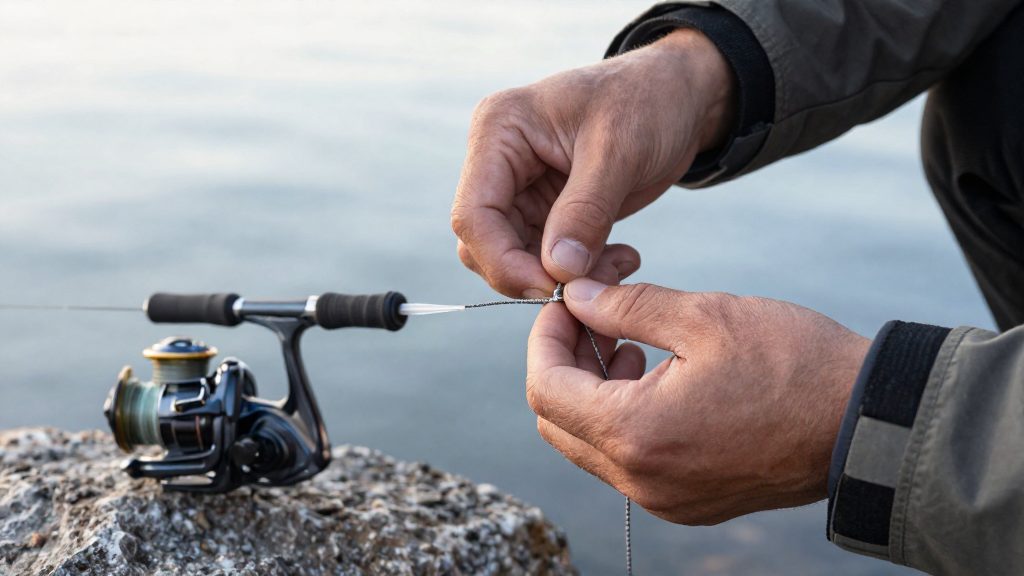
The connection between braid and leader is where braid is weakest. Sport Fishing Magazine (2025-02-21) reports that mono holds knots better than braid and that braid has a higher knot-failure rate. Trout Resource (Thomas Walsh, 2022-10-08) adds that mono knots are generally stronger and quicker to tie.
| Factor | Mono | Braid |
|---|---|---|
| Knot holding | Holds knots better | Higher knot-failure rate |
| Knot strength | Generally stronger | Needs extra wraps to stay secure |
| Tying | Generally quicker to tie | Slower to tie securely |
Testing the connection before each session
Because braid knots fail more often, check each one before you fish:
- Tie the connection, then trim the tag ends close to the knot.
- Pull both lines firmly, with gloves or the line wrapped around a rod handle or tool instead of bare fingers, because thin braid can cut skin. Look for slipping or cutting into the braid.
- Retie any knot that moves, rather than trusting it because it looked right at home.
- Check again after catching fish or after any hard snag, since friction can loosen the wraps.
Best line for lures vs natural bait
For most anglers, the choice comes down to how the bait is presented. As a rule of thumb, braid suits artificial lures and mono suits natural baits (FishTalk Magazine, 2026).
Why braid suits artificial lures
Lures are worked actively, so the angler needs to feel every contact. Spinners, crankbaits and soft plastics all produce strikes that can be subtle, especially on a slow retrieve or when a soft plastic is falling through the water. Braid transmits these touches directly to the rod tip, which helps you recognise a bite and set the hook before the fish drops the lure.
Why mono suits natural bait
Natural baits are usually fished more passively, and the fish often takes the bait slowly and holds it. This matters most when you are fishing a bait for a fish with a soft or delicate mouth.
Knot-heavy rigs and line choice
Mono is the simpler choice for rigs with many knots, because it holds them better and costs less (Sport Fishing Magazine, 2025-02-21).
Line choice for pike, perch, bass and trout
Each species puts different demands on a line. For trout, the main issue is visibility. For perch and bass, it is how the line handles cover. For pike, it is the teeth. The choice depends on which of these risks is greatest where you fish.
Trout: why clear mono is harder to see
Trout are often fished in clear, shallow water where they can see a line well. According to Trout Resource (Thomas Walsh) (2022-10-08), monofilament is naturally clear and harder to see, while braid is more visible. For that reason, the same source recommends a mono leader when braid is the main line for trout.
Perch and bass: breaking strength for cover
Perch and bass often live near stumps, weed beds, rocks and other structure, where the line rubs. Where the line will rub against stumps, weed or rocks, braid lost more strength than mono in the abrasion test above. A mono or fluorocarbon leader on braid is recommended for this kind of structure.
Pike: teeth and leader requirements
Pike have sharp teeth that can cut through light line, so the section nearest the lure needs protection. Many anglers use a wire leader for this. Wire is less likely to be cut by teeth than mono or braid, but it is more visible and stiffer, which can affect lure action. Check the manufacturer’s instructions for any leader you buy, and follow local fishing regulations on the use of wire.
Care and replacement of your line
Line ages differently depending on its material. According to FishTalk Magazine (2026), monofilament lasts about two to three seasons because ultraviolet light weakens it, while braid keeps its strength across seasons. That gap should guide when you replace a spool, and it is the first thing to check on an older reel.
Mono: UV ageing and replacement timing
Count the replacement period from the season you first spooled the line. Replace mono sooner if the line looks faded or chalky or feels stiff, and if it has been left in direct sunlight for long periods.
Braid: strength retention and wear
Its risk is physical wear. Check braid after each session where it has rubbed against rocks, weed edges or other structure. Abrasion is the main reason to retire braid early.
Storing spools away from sunlight and heat
Store spools and loaded reels out of direct sunlight. A closed tackle box, a cupboard or a shaded shed works better than a car dashboard or a sunny windowsill. Keep them away from heaters and hot vehicles as well. Before storing, rinse the reel and spool after freshwater sessions, let them dry fully, and keep the spool in its packaging or a sealed bag.