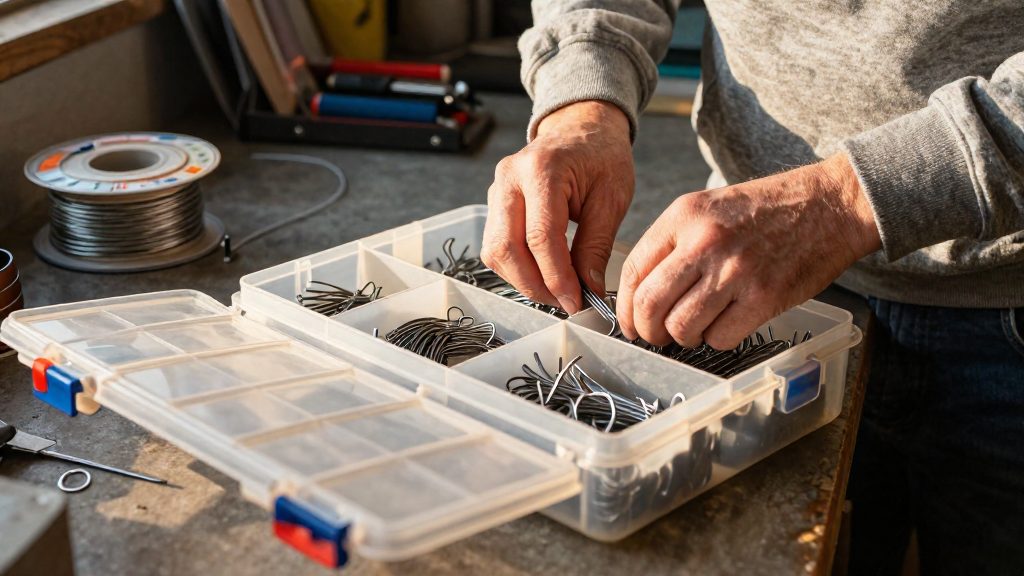
Fishing hooks rust because the iron in their steel reacts with oxygen in the presence of moisture. Water carries this reaction, so a hook that stays wet for a long time corrodes much more than one that is only briefly splashed. Rust is iron oxide, a reddish-brown layer that forms on the metal surface and can spread to nearby hooks and stain the tackle box.
Why do fishing hooks rust?
Hook steel is mostly iron. When that iron is exposed to oxygen and moisture together, it oxidises and forms the reddish-brown material everyone recognises as rust. Both ingredients are needed. The reaction depends on the metal, the oxygen and the water being present at the same time, so removing either one slows it down.
Mystery Tackle Box (2026) describes rust as forming when oxygen and moisture act on the iron in steel. Its key point for anglers is prolonged moisture. Brief time in water is less damaging than long exposure. A hook that is wet for a short session has little time for the reaction to take hold, whereas a hook left damp in a box keeps the reaction going for as long as the moisture stays.
Salt Strong (2026) tested this in a small trial. Three hooks were soaked in saltwater for 10 days:
| Hook condition | Rust result after 10 days in saltwater |
|---|---|
| Unsharpened hook (control) | Rusted least of the three |
| Sharpened hook with black Sharpie on exposed metal | Rusted less than the plain sharpened hook, more than the control |
| Plain sharpened hook | Rusted most of the three |
The test also showed that the black Sharpie wears off during use, so a marker on the metal is not a lasting barrier.
Rust does not stay on one hook. Mystery Tackle Box (2026) notes that it can spread to neighbouring hooks and stain the tackle box. Hooks that sit touching each other in a closed compartment share the same moist air and can transfer rust and rust-coloured residue from one to the next. The stain then marks the plastic of the box itself, so one corroded hook can affect the whole compartment and the hooks next to it.
Do freshwater hooks rust too?
Yes. Freshwater hooks can rust, but the main difference from saltwater is how much cleaning the trip demands. According to Mystery Tackle Box (2026), freshwater trips do not require a fresh-water rinse, whereas saltwater trips do. The corrosion risk is still present, though, and it depends on which part of the lure is exposed. Johnny Jigs (2026) names the components that matter most.
Freshwater trips versus saltwater trips
| Trip type | Fresh-water rinse required? | Source |
|---|---|---|
| Freshwater (lakes, rivers, ponds) | No | Mystery Tackle Box (2026) |
| Saltwater (coastal or marine) | Yes | Mystery Tackle Box (2026) |
A freshwater outing therefore does not add the rinsing step to your routine. Treat the hooks as the variable to watch, not the trip itself.
Plated hooks can still rust
Johnny Jigs (2026) states that plated hooks can rust even when the plating is intact. The brands it names are VMC and Gamakatsu. A plated finish reduces the problem but does not remove it, so a plated hook is not a rust-proof hook. Before each trip, look over the bend and point of every hook for orange discolouration or pitting. Set aside any hook that shows rust, then judge it using the damage guidance in the last section.
Lead jig bodies resist corrosion
Johnny Jigs (2026) reports that lead jig bodies are not very prone to corrosion. On a lure, the hook is the component that needs attention.
| Lure component | Corrosion concern | Source |
|---|---|---|
| Plated steel hooks (VMC, Gamakatsu) | Can still rust | Johnny Jigs (2026) |
| Lead jig body | Not very prone to corrosion | Johnny Jigs (2026) |
Rinse after saltwater trips and dry hooks before storing
The routine below stops rust before it starts, and it depends mainly on the type of water you fished.
Rinse after saltwater trips
Saltwater is the exposure that calls for a rinse. Mystery Tackle Box (2026) notes that freshwater fishing does not require a fresh-water rinse, whereas saltwater trips do. Rinse each hook thoroughly under fresh water, paying attention to the eye, the bend and the barb where salt tends to stay. Salt Strong (2026) advises rinsing hooks with fresh water as soon as possible, so do it at the end of the session rather than leaving gear in the bag until the next day.
Dry completely before storing
Wet metal is the main risk, so dry each hook fully before it goes back into a compartment. Johnny Jigs (2026) warns that putting damp gear away can leave saltwater in the box and rust other hooks. Lay hooks out on a towel in a dry room until no moisture remains, then pack them.
Air the tackle box after rainy-day trips
Rain adds moisture even when you did not fish saltwater. Mystery Tackle Box (2026) recommends airing tackle boxes out at home after a rainy-day trip. Open every compartment and leave the lid up until the interior is dry before closing it.
Keep salt-containing soft plastics away from hooks
Soft plastic lures can carry salt from saltwater use. Mystery Tackle Box (2026) advises keeping hooks away from salt-containing soft plastic lures, so store them in separate compartments or bags rather than mixing them with hook storage.
Quick reference
| Situation | Rinse hooks? | After-trip step |
|---|---|---|
| Freshwater session | Not required (Mystery Tackle Box, 2026) | Dry hooks if they got wet, then store |
| Saltwater session | Yes, thoroughly with fresh water (Mystery Tackle Box, 2026) | Rinse, dry completely, then store |
| Rainy-day trip | Rinse if saltwater was involved | Air the tackle box at home |
Silica gel and other moisture absorbers for your tackle box
Rust on hooks needs moisture, so one practical defence is keeping the air inside your tackle box dry. Moisture absorbers reduce the humidity trapped inside the box after a trip. Mystery Tackle Box (2026) names silica gel packets as the best method and recommends placing two or three in each tackle box.
Mystery Tackle Box (2026) also lists two cheaper alternatives:
| Absorber | Status per Mystery Tackle Box (2026) | How to use it |
|---|---|---|
| Silica gel packets | Named as the best method | Two or three per tackle box |
| Kiln-dried wooden toothpicks | Cheaper moisture absorber | Place loose in the compartments |
| Cotton swab tips | Cheaper moisture absorber | Place loose in the compartments |
Place the absorbers in the compartments that hold hooks, not only in a corner of the box, so the air around the hooks is treated. Spread them out so they do not sit against a single lure.
Before adding absorbers, air the box out at home after a rainy-day trip, so it does not close with damp air inside. Mystery Tackle Box (2026) gives this as a routine step after wet outings. Absorbers then work on the moisture that remains.
Does a Sharpie really stop hook rust?
In a single small test, a black Sharpie-marked hook rusted less than a bare sharpened hook. This is an observation and not proof that the marker protects. In a Salt Strong test (2026), three hooks were soaked in saltwater for 10 days. A sharpened hook with a black Sharpie on its exposed metal rusted less than a plain sharpened hook, but more than an unsharpened control. In this small test, the marked hook rusted less than the bare sharpened one. A single trial with one hook per condition cannot show that the marker was the cause.
How the three hooks compared
| Hook | Treatment | Rust result in the test |
|---|---|---|
| Unsharpened control | No sharpening, no marker | Least rust of the three |
| Sharpened with black Sharpie | Marker on the exposed metal | More than the control, less than the bare hook |
| Sharpened, bare | No marker | Most rust of the three |
The marker was applied to the exposed metal of the sharpened hook. The marked hook ended up between the bare hook and the control in this one test.
Why the marker loses its effect
The test also found that the marker wears off in use. Each time a hook passes through lure bodies, tackle box compartments or snags, the ink can rub away, and protection drops with it. A hook that was coloured at home may be partly bare by the end of a session.
To keep the marker useful, check the marked points after each outing and recolour any worn areas with a fresh permanent marker. Test the ink on a spare hook first to confirm it stays put on your hook metal.
How to store hooks over a Canadian winter?
Winter storage comes down to keeping hooks away from repeated cycles of cold and damp air. Your job over winter is to stop moisture from settling on the hooks and inside the box.
Store tackle boxes in a heated indoor space
Keep tackle boxes in a heated room of the house rather than an unheated garage, shed or outbuilding. A steady indoor temperature means the steel is not sitting in a cold, damp enclosure for months. Pick a shelf in a room you already heat and use daily, so you notice if the box is disturbed or the lid is left open.
Avoid moving boxes between cold and warm rooms
Moisture condenses when a cold object meets warm, humid air. Carrying a box from an unheated space into a warm room is one common way condensation forms on hooks and inside the lid. Move the box as little as possible during the season, and let it stay in one place once it is stored.
Check hooks for early rust at the start of spring
Spring is the moment to inspect what the winter did. Open each box, check the hook points and shanks, and look at the box compartments and lid for staining. Rust that has already spread to neighbouring hooks is a sign that moisture reached more than one compartment.
What if a hook is already rusty?
Rust does not always mean a hook must go in the bin, but the point and barb decide whether it stays in your box.
Judging the damage
Inspect each hook under good light and sort it into one of two groups:
| Condition | What you see | Action |
|---|---|---|
| Light surface rust | An orange film or dusty patches on the wire, eye or shank | Remove the film, then re-check the point and barb |
| Deep pitting | Small cavities or rough craters in the metal that remain after the film is gone | Replace the hook |
Replacing hooks with corroded points or barbs
The point does the work of holding a fish, so a pitted, blunted or flaking point should not be trusted. Replace the hook rather than trying to restore it. The same applies to a barb that is corroded or has eaten into the metal. Match the replacement to the size and style of the original hook.
Cleaning products
Before using any rust remover on hooks or lures, check the product label or the manufacturer’s instructions for whether it is intended for steel hooks and plated finishes. If the instructions do not cover tackle, contact the manufacturer before use.
Frequently asked questions
Does a black Sharpie stop hook rust?
In a small Salt Strong test (2026), a sharpened hook with a black Sharpie on its exposed metal rusted less than a bare sharpened hook but more than an unsharpened control. The test used one hook per condition, so it is an observation, not proof that the marker protects. The ink also wears off during use, so it is at best a temporary aid.
Do I need to rinse hooks after every trip?
Rinse hooks after saltwater trips, using fresh water as soon as possible. Mystery Tackle Box (2026) states that freshwater fishing does not require a fresh-water rinse. Whatever the water type, dry hooks completely before storing them, because damp gear can keep rust spreading.
Are plated hooks or lead jig bodies more likely to rust on a lure?
The hooks are the main concern. Johnny Jigs (2026) notes that even plated steel hooks, such as VMC and Gamakatsu, can rust. Lead jig bodies are described as “not very prone” to corrosion, so check the hook points and eyes first when a lure shows signs of rust.